

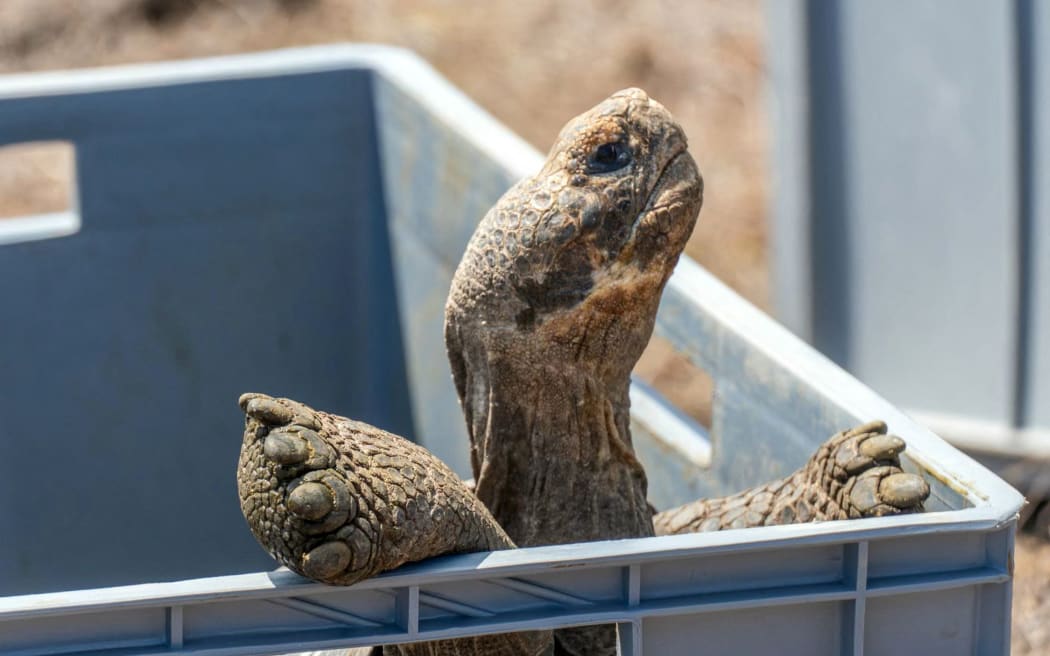
A Floreana giant tortoise before being released by park rangers on Floreana Island, in the Galapagos archipelago, Ecuador, on 20 February, 2026.
Photo: AFP PHOTO / ECUADOR’S MINISTRY OF ENVIRONMENT
More than 150 giant tortoises have been reintroduced to Floreana Island in Ecuador’s famed Galapagos archipelago where they disappeared more than a century ago, the environment ministry said Friday (local time).
Park rangers carried large crates containing the 158 tortoises on their backs, hiking 7km across volcanic terrain and hard-to-access areas before releasing them, the ministry said in a statement.
“For the first time in over a century, Floreana is once again home to giant tortoises, a species that plays a strategic role as ecosystem engineers: seed dispersers, vegetation regulators, and promoters of natural habitat regeneration,” it said.
The Galapagos Islands, a World Heritage Site, are situated some 1000km off the coast of Ecuador.
They are famous for their unique flora and fauna, and are where British scientist Charles Darwin developed his theory of evolution.
An NGO, Island Conservation, said it was the first time that giant tortoises have walked on Floreana since the native species, Chelonoidis niger niger, was driven to extinction there in the mid-1800s after the introduction of invasive mammals.

A Floreana giant tortoise after being released by park rangers on Floreana Island, in the Galapagos archipelago, Ecuador, on 20 February, 2026.
Photo: AFP PHOTO / ECUADOR’S MINISTRY OF ENVIRONMENT
There are 13 living species of Galapagos tortoises on other islands in the archipelago, according to National Geographic. They can weigh more than 250kg.
The oldest on record lived to be 175 years old.
The Ecuadoran ministry said the released tortoises come from a breeding centre of the Galapagos National Park, where a specialised program was developed using tortoises with a high genetic load of the island’s endemic species that was found on Isabela island, which lies about 180km from Floreana.
Each tortoise underwent an extensive quarantine and was microchipped for identification before their release, it said.
For a decade, researchers have been working to reintroduce 12 other endemic species to Floreana as part of a rewilding program.
Floreana, covering 173 sq km, was the first to be inhabited by humans in the entire archipelago.
– AFP