
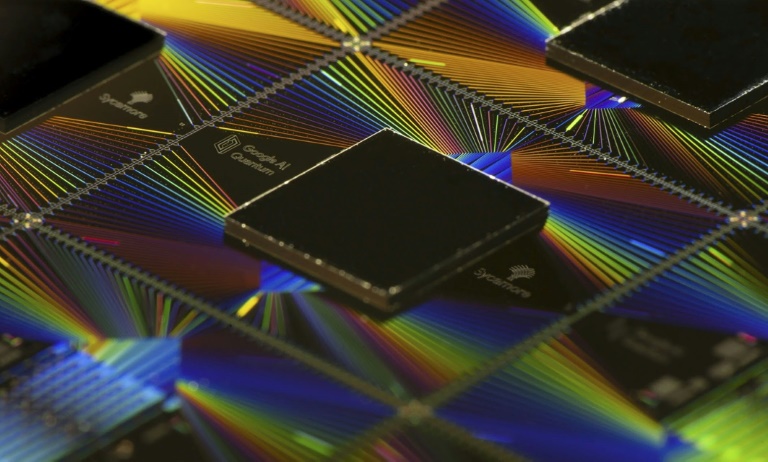
Quantum computing has been touted as a revolutionary advance that uses our growing scientific understanding of the subatomic world to create a machine with powers far beyond those of conventional computers – Copyright AFP/File LUCA SOLA
Qubits are the heart of quantum computers. They can change performance in fractions of a second. However, until now, scientists were unable to see this happening.
Researchers at the University of Copenhagen Niels Bohr Institute (NBI) have built a real-time monitoring system that tracks these rapid fluctuations about 100 times faster than previous methods. Using fast FPGA-based control hardware, they can instantly identify when a qubit shifts from “good” to “bad.” The discovery opens a new path toward stabilising and scaling future quantum processors.
Quantum technologies promise powerful new capabilities, though practical large scale quantum computers are still under development.
Qubits
Qubits are the fundamental units of quantum information. They can exist in multiple states simultaneously due to superposition. This enables them to perform complex calculations more efficiently than classical computer bits (the smallest unit of data in computing).
Qubits are developed by manipulating quantum particles such as photons, electrons, and atoms. Their ability to be entangled also enables powerful computational capabilities beyond classical systems.
Qubits are extremely sensitive. The materials used to build them often contain tiny defects that scientists still do not fully understand. These microscopic imperfections can shift position hundreds of times per second. As they move, they alter how quickly a qubit loses energy and with it valuable quantum information.
Until recently, standard testing methods took up to a minute to measure qubit performance. That was far too slow to capture these rapid fluctuations. Instead, researchers could only determine an average energy loss rate, masking the true and often unstable behaviour of the qubit.
Breakthrough
To overcome these challenges, the researchers developed a real-time adaptive measurement system that tracks changes in the qubit energy loss (relaxation) rate as they occur.
The new approach relies on a fast classical controller that updates its estimate of a qubit’s relaxation rate within milliseconds. This matches the natural speed of the fluctuations themselves, rather than lagging seconds or minutes behind as older methods did.
To achieve this, the scientists used a Field Programmable Gate Array (FPGA), a type of classical processor designed for extremely rapid operations. By running the experiment directly on the FPGA, they could quickly generate a “best guess” of how fast the qubit was losing energy using only a few measurements. This eliminated the need for slower data transfers to a conventional computer.
Programming FPGAs for such specialised tasks is challenging. However, the researchers succeeded in updating the controller’s internal Bayesian model after every single qubit measurement. That allowed the system to continually refine its understanding of the qubit’s condition in real-time.
The controller can keep pace with the qubit’s changing environment. Measurements and adjustments happen on nearly the same timescale as the fluctuations themselves, making the system roughly one hundred times faster than previously demonstrated.
The research appears in the journal Physical Review X, titled “Real-Time Adaptive Tracking of Fluctuating Relaxation Rates in Superconducting Qubits.”