
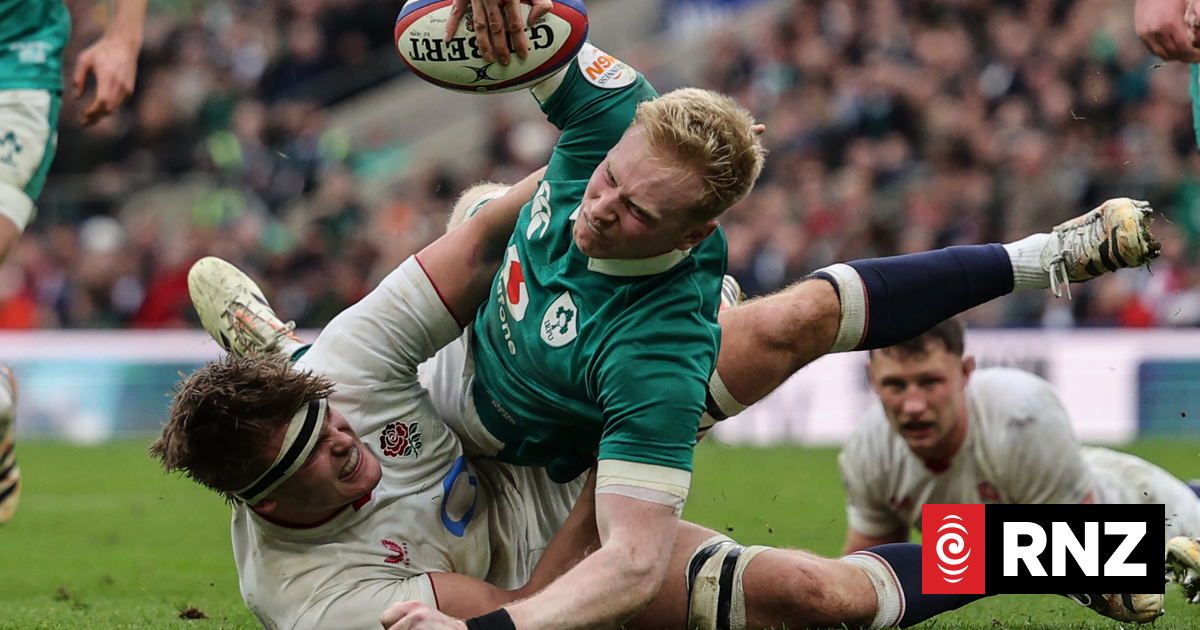
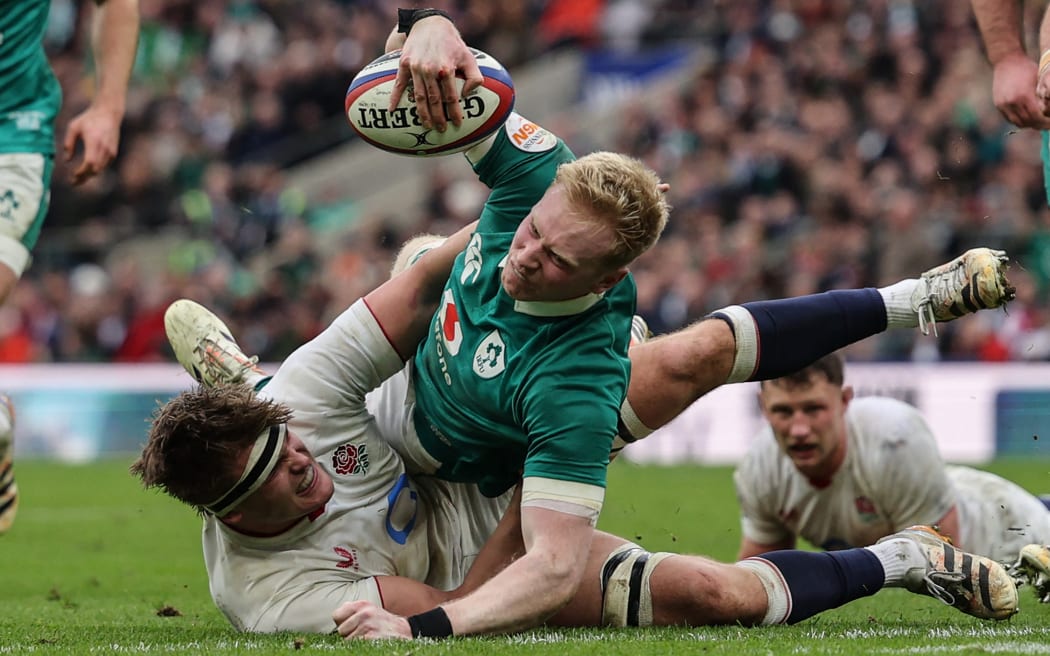
Ireland’s full-back Jamie Osborne scores a try during his team’s Six Nations win over England at Twickenham on 21 February, 2026.
Photo: AFP / ADRIAN DENNIS
England’s performance in their record 42-21 Twickenham thrashing by Ireland was a combination of technical and tactical failures but the overriding feeling was that the visitors had showed more intent in everything they did.
The day was encapsulated 10 minutes from time when, with the game safely won, Ireland centre Stuart McCloskey set off on a lung-bursting 60-metre chase of Marcus Smith, who looked certain to score.
McCloskey’s refusal to accept the seemingly lost cause got to the England replacement fullback, who clearly felt he did not have the pace to reach the line, checked, and was hauled into touch by the Ulsterman.
Ireland coach Andy Farrell punched the air in recognition of the sort of attitude he prizes above talent, and thousands of dejected England fans, already raging at what they had been enduring, began streaming out of the stadium.
A week ago, on the back of a 12-game unbeaten run, England found themselves 17-0 down to Scotland en route to a 31-20 defeat. It was even worse on Saturday (local time) as Ireland raced to a 22-0 lead after half an hour and never really looked like being caught.
As well as being comfortably Ireland’s biggest win at Twickenham it was also the third-highest points tally England have conceded at home, following the 53-10 defeat by France in 2023 and a 42-6 rout by South Africa in 2008.
England coach Steve Borthwick did not appear at his post-match press conference for well over an hour and it was hardly the way Maro Itoje wanted to mark his 100th cap.
“In the first half we turned the ball over too much, when we did get in their half we weren’t clinical,” Itoje said. “As players we have to own it. We have to take responsibility and make sure we’re better,” he said.
In Cardiff, a try five minutes from time by hooker George Turner secured Scotland a 26-23 bonus-point victory over Wales in the other six nations match this morning, which broke the hearts of the home side who extended their losing run in the Six Nations Championship to 14 games.
Wales were much improved on recent showings and led 17-5 at halftime in a positive display, but errors at key moments allowed Scotland back in.
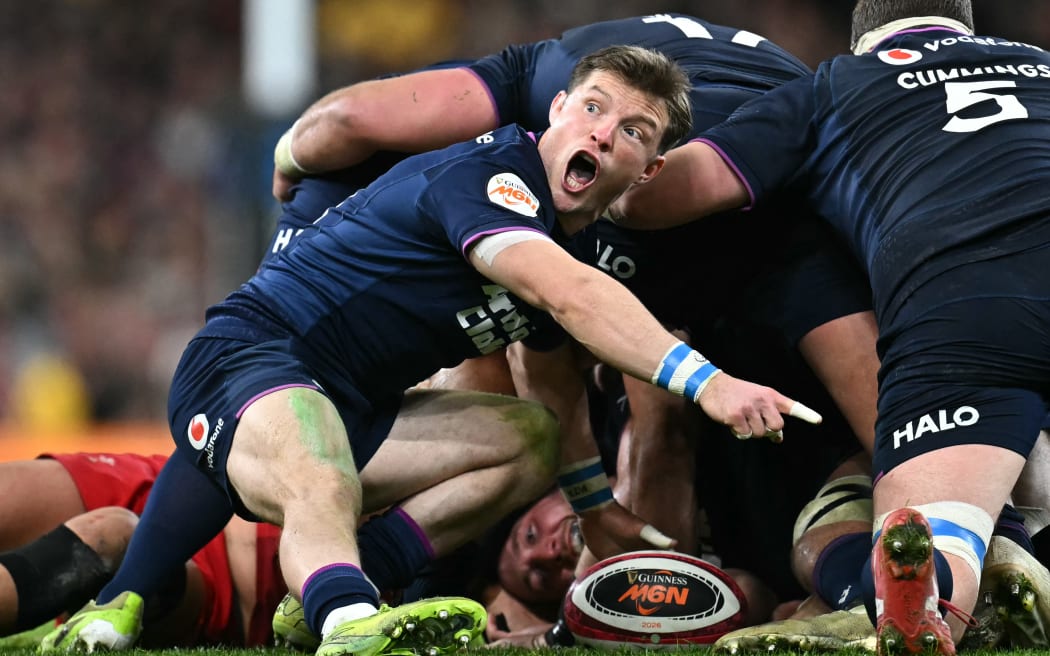
Scotland’s George Horne issues instructions during his team’s 26-23 Six Nations win against Wales in Cardiff on February 21, 2026.
Photo: AFP / PAUL ELLIS
Scotland moved to the top of the Six Nations table with 11 points from three matches, one more than France, who play Italy tomorrow.
The home side scored first-half tries through prop Rhys Carre and winger Josh Adams, but it was their improved defence that caught the eye having conceded 15 tries and 102 points in their first two games.
“It is gut-wrenching,” Wales captain Dewi Lake said. “Credit to Scotland, in their moments they were unstoppable. But the boys really fronted up and were dominant in that first half. Scotland had their moments in the second.
“We spoke a lot about staying in moments and switched on. For us it is those key moments that are going away from us at the moment.”
Scotland roared back in the second half and won thanks to tries from wings Kyle Steyn and Darcy Graham, flyhalf Finn Russell and hooker George Turner.
“We dug deep and did what we needed to do to win. Full credit to Wales, they came out with fight. We had to find a way to win ugly,” Scotland captain Sione Tuipulotu said.
“I said to the boys at halftime we would need to find a little bit in themselves to come away with the victory. Several of the boys really out their hand up.
“It was not as sharp a performance as last week, but that was down to Wales’ performance.”
– Reuters