
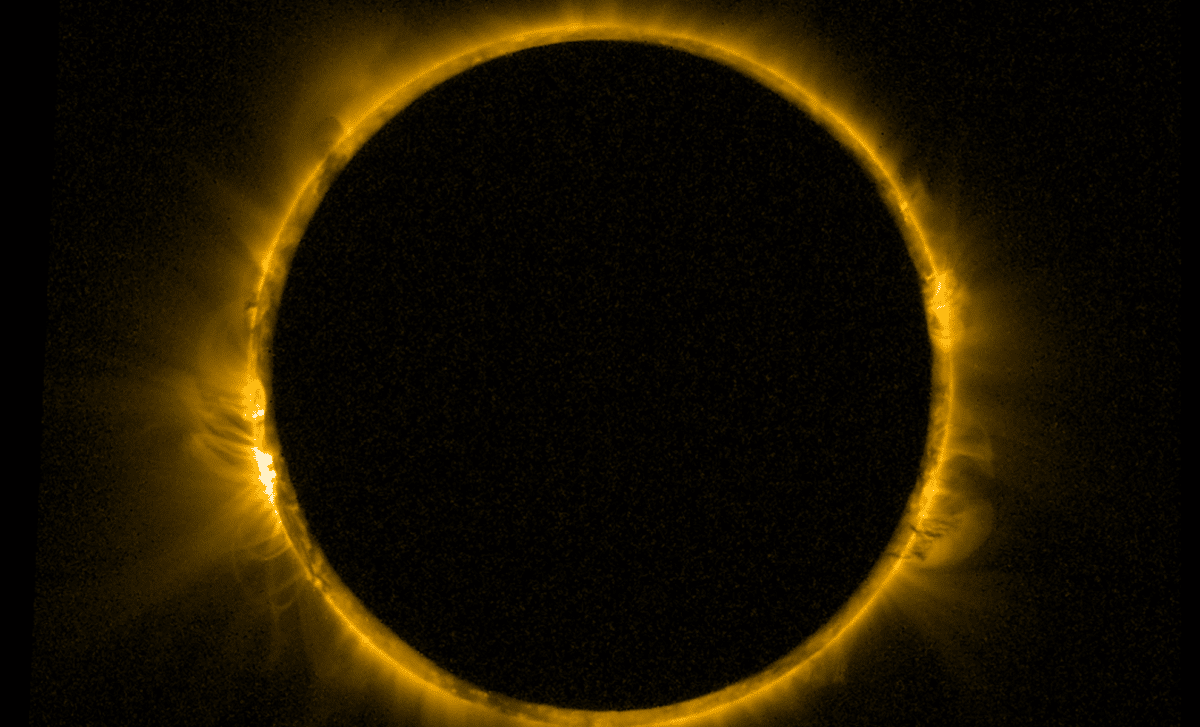
On February 17, 2026, an annular solar eclipse occurred, offering a spectacular view of the “ring of fire” in the sky. The European Space Agency (ESA) captured this rare cosmic event from space through its Proba-2 satellite, which documented the eclipse in extreme ultraviolet light. The images captured by the spacecraft have provided valuable insights into solar phenomena and showcase the technical prowess of ESA’s space missions. This article will delve deeper into the significance of this solar eclipse, the technology behind ESA’s Proba-2 satellite, and the future of solar observations from space.
What is an Annular Solar Eclipse?
An annular solar eclipse is a rare celestial event where the Moon passes directly between the Sun and Earth but appears smaller in the sky due to its position along a more distant point in its elliptical orbit. Unlike a total solar eclipse, where the Moon completely obscures the Sun, an annular eclipse results in the Sun forming a bright ring around the Moon. This unique occurrence is often referred to as the “ring of fire.” The February 2026 eclipse offered a breathtaking view of this phenomenon, particularly from space, where the event could be fully appreciated without atmospheric interference.
These eclipses occur when the Moon is far enough from Earth that its apparent size is smaller than the Sun. The result is a beautiful ring-like effect that has fascinated astronomers and skywatchers for centuries. The annular eclipse of 2026 is a reminder of the intricate dance between the Earth, Moon, and Sun, which continues to inspire awe and scientific inquiry.
ESA’s Role in Capturing the Eclipse
The European Space Agency (ESA) has played a critical role in advancing our understanding of solar phenomena, and its Proba-2 satellite’s observations during the February 2026 annular solar eclipse are a testament to this commitment. Proba-2, launched in 2009, is a small, highly versatile satellite equipped with sophisticated instruments that allow it to study solar activity and space weather in unprecedented detail. One of the key instruments on board is the SWAP (Sun Watcher using Active Pixel System) imager, which captures extreme ultraviolet light. This wavelength is essential for studying the Sun’s corona, its outermost layer, which can reveal important information about solar flares and coronal mass ejections.
The images taken by Proba-2 during the annular eclipse captured the full extent of the Sun’s corona, offering an incredible view of the solar system’s central star as seen from space. This type of observation is not possible from Earth due to the distortion caused by the Earth’s atmosphere. By flying above this distortion, Proba-2 has provided scientists with a clearer picture of solar activity, helping them better understand the Sun’s behavior and its impact on space weather.
The Scientific Importance of Solar Eclipse Observations from Space
Studying solar eclipses from space offers a wealth of scientific opportunities. While solar eclipses have been observed from Earth for centuries, having satellites positioned in space allows scientists to observe the Sun without the interference of Earth’s atmosphere. This provides a clearer and more detailed view of the Sun’s behavior, especially in wavelengths of light, such as extreme ultraviolet, which are essential for understanding solar processes.
During the February 2026 eclipse, Proba-2 captured images at a wavelength of 17.4 nanometers, a critical range for studying the Sun’s corona. These observations help scientists track solar activities such as solar flares and coronal mass ejections, both of which can have significant effects on space weather and, by extension, on Earth’s technology infrastructure. For instance, intense solar activity can disrupt satellite communications, GPS systems, and power grids on Earth. Therefore, understanding these events from space is crucial for mitigating potential impacts on modern technology.
A Glimpse of the Future: Upcoming Solar Eclipses
The annular solar eclipse of 2026 may have been rare, but it is far from the last opportunity to witness spectacular solar events. In fact, the coming years are expected to bring several more eclipses visible from different parts of the world. Notably, on August 12, 2026, a total solar eclipse will be visible from parts of Greenland, Iceland, and Spain. This total eclipse will provide a chance for observers to witness the complete obscuration of the Sun by the Moon, offering another breathtaking cosmic spectacle.
In addition, on August 2, 2027, another total solar eclipse will sweep across the southern tip of Spain, parts of northern Africa, and the Middle East. This eclipse will be particularly significant for scientists studying the Sun’s activity and its effects on Earth’s space environment. Furthermore, in 2028, an annular eclipse will once again grace the skies over South America, Portugal, and Spain, providing yet another opportunity for skywatchers to observe the “ring of fire” phenomenon.