
My great-great-grandfather collected night soil, the historical euphemism for human excrement. He came after dark on his horse-drawn cart to collect the contents of Masterton’s outhouses. Rules dictated the hours to avoid people smelling nasty odours, and manure depots were designated outside towns.
It was a vital service. Before night
soil collections started in the 1870s, open drains and backyard cesspits caused stench and disease. Collections tapered off in cities when sewerage systems were built around 1900.
Then came flushing. That’s remarkable luxury. About 60% of people on Earth still lack a home toilet that safely manages human waste. Nearly 900 million people still defecate in the open.
We flush our muck to the sewage treatment plant, never thinking of it again. But we’re about to. Wastewater, stormwater and drinking water collectively take a quarter to a third of council rates, a cost that will be separately invoiced to households under the pending “Local Water Done Well” system (the coalition’s replacement for Labour’s Three Waters legislation).
A brief explainer of what’s in the pipes: wastewater sent to treatment plants includes sewage flushed down toilets, the contents of household sinks and showers and industrial discharges. Once treated, much of this waste is flushed into waterways.
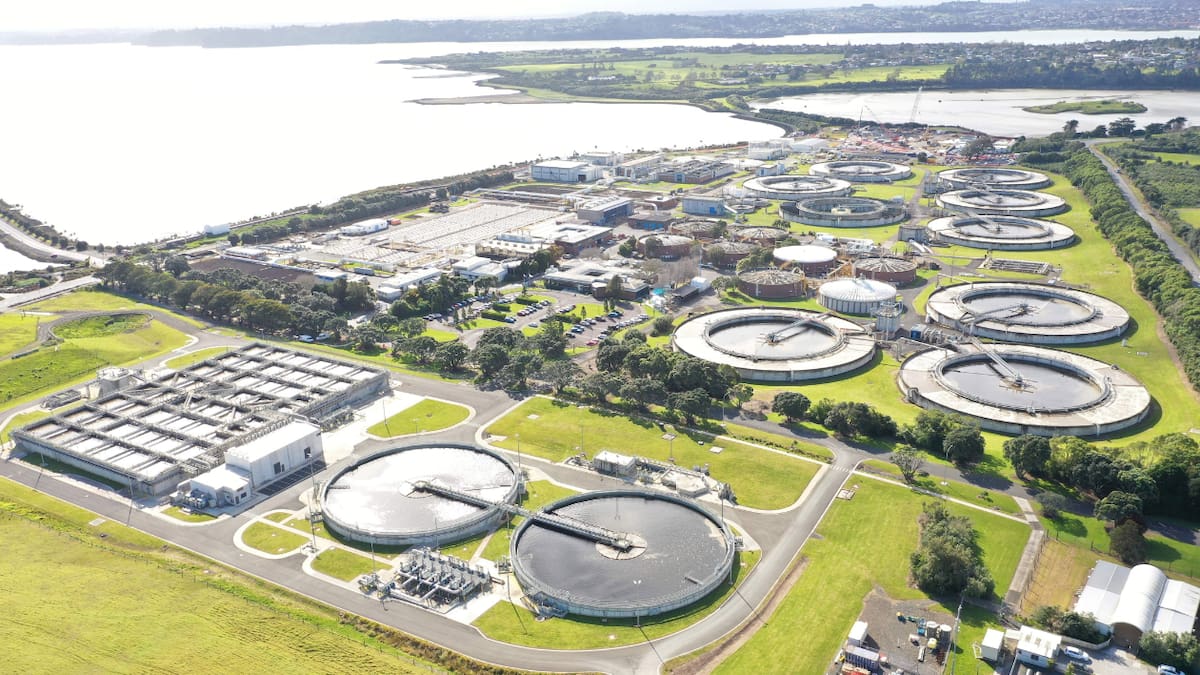
Sludge remaining after treatment expensively fills landfills. Photo / Wastewater Services Limited
The value of these out-of-sight, out-of-mind systems becomes obvious when they fail, as Wellington and Christchurch’s big stink and pollution events reveal. But maintaining and future-proofing them is expensive and rarely wins votes.
Putrid odours have plagued residents of Christchurch’s eastern suburbs since a fire destroyed part of the Bromley wastewater plant in 2021. Residents have endured headaches, nausea, dizziness and throat, nose and eye irritation. In mid-February, those suburbs had to boil drinking water due to unrelated bacterial contamination. In Wellington, untreated wastewater is being piped into the sea after a “catastrophic” failure at the Moa Pt treatment plant. In Auckland, heavy rain generally leads to “no swimming” notices due to sewage overflows into the harbours, despite billions being spent over decades separating stormwater and sewage pipes.
Hence our predicament: new and upgraded sewage treatment plants are needed and lack of treatment capacity is stopping homes being built.
The plot thickens. Sludge remaining after treatment expensively fills landfills, and it may increasingly – and controversially – turn up on land. Treated wastewater piped into freshwater rivers and the sea still contains nitrogen and phosphorus. Those are useful nutrients, but in already degraded waterways, they fuel plant growth that smothers aquatic creatures. To complicate things, we add novel filth to our filth – chemicals and heavy metals from food, household products, pharmaceuticals and industrial waste.
Lower standards
You’d think we’d be getting better at this, and cities indeed clean wastewater more thoroughly than ever. But in December, the government implemented new wastewater standards that in many cases downgrade the quality of treatment, particularly for discharge to the open ocean.
Take, for example, Tauranga’s treated wastewater. It’s discharged 950m off a surfing and swimming beach between Mt Maunganui and Papamoa. Under the new standards, 11 times more Enterococci, a faecal bacteria, will be allowed to flow out of the pipe than current discharge consent conditions allow. Suspended solids can roughly double in quantity. Nationwide, allowable nitrogen limits are set so high that plants discharging to the open ocean won’t have to remove any nitrogen.
Christchurch’s odour-prone Bromley wastewater treatment plant. Photo / Nicole Miller; Calypso Science
Eliza Cowey, a senior wastewater engineer with a global consultancy but speaking in her personal capacity, says the standards “regress open ocean discharge quality requirements to approximately what we had in Christchurch in the 1800s, with no ability to require better treatment in a consent. I have never seen anything like this globally.”
The standards will be compulsory in resource consents for public wastewater treatment plants as they are renewed – despite Local Government Minister Simon Watts saying Local Water Done Well provides “local choice on how it gets done”.
They aren’t minimum standards – cleaning wastewater more thoroughly costs more, and associated new legislation says operators must choose the most cost-effective option over the plant’s life. Places such as Tauranga could get around this because their existing equipment outperforms the standards.
“In these cases, the most cost-effective option will be to continue to run these plants as they were designed,” Sara McFall, head of systems and strategy at the Water Services Authority – Taumata Aro-wai, said in a statement.
But councillors prioritising rates control could be tempted to cut costs, reducing discharge quality.
Easing the way
Until now, there have been no national standards for sewage treatment, so getting resource consent for plants has been bespoke, slow and often expensively held up in court. After all, who wants one next door or discharging into their local waterway? A fifth of plants are operating under expired consents.
With most aspects of wastewater discharge now set in legislation, communities will be able to haggle only over plant locations and where and how much volume they discharge. The aim is to limit costs while lifting treatment levels for poorly performing plants. These tend to service smaller towns, and standards for them are slightly looser.
From left: Lutra’s David Romilly, Watercare’s Rob Tinholt, Poipoia’s Tina Porou. Photos / Supplied
Small plants are often simple shallow ponds that settle solids and oxygenate the sewage, growing microbes to digest waste. Cities generally treat sewage more thoroughly, with multiple treatment steps. They screen, settle and aerate sewage, then kill pathogens. Some pass treated water through wetlands.
There were pleas against much of what’s in the standards. They came from parties including regional councils, wastewater industry body Water New Zealand and the Parliamentary Commissioner for the Environment.
One was for no “backsliding”, with the Waikato Regional Council submitting the standards “should at least hold discharge quality at the levels of stringency they are now. If not, then water quality across the region will deteriorate and the percentage of waterways experiencing significant adverse effects will only worsen.”
David Romilly, chief engineer at water consultancy Lutra, welcomes national standards. “At least everybody’s using the same rule book and we can all have discussions about how to get the best outcome, even if these are the numbers we have to meet.” But, he says, the standards are “concerning in some instances, and the industry is certainly not pleased with where they’ve landed as a whole, especially when you look at them from an international benchmark. There’s other parts of the world that are certainly more advanced in their water regulations. In the US, there is this thing called anti-backsliding – an anti-degradation clause that prohibits you from going backwards in your water quality.”
Beyond the pipe
Treated wastewater isn’t totally clean. Almost half of our treatment plants discharge to water, and those “receiving environments” are often in poor health. About half of Waikato’s rivers are degraded by nitrogen and phosphorus. Nationwide, bacteria levels make two-thirds of river sites unswimmable.
But the new standards limit contaminants only according to a waterway’s type, such as open ocean, estuary or lake, not its health. They say consents cannot require the receiving water to be monitored and must last for 35 years, so discharge can continue even if water quality worsens.
Basing standards only on end-of-pipe quality is abnormal in developed countries, says Romilly. “In the US, where I’m from, it’s more water quality-based regulations, where you look at what you’re discharging into and assess the impacts of what the treatment plant would do to those receiving systems, and then you’re regulated on that.” Taumata Arowai commissioned technical advice that said the same.
The spread of untreated sewage off Wellington’s Lyall Bay after the failure of the Moa Pt treatment plant. Photo / Nicole Miller;Calypso Science
Some precious waterways, such as those in national parks are exempt from the standards, plus two areas covered by more recent Te Tiriti o Waitangi settlements. Lake Taupō is not. Despite some $80 million of public money being spent to reduce nitrogen entering it, it receives Tūrangi’s treated wastewater to the ongoing objections of local hapū.
There are special arrangements protecting drinking water intakes and shellfish gathering. But in general, there’s little prominence given to Māori values, which call for the highest possible treatment standards and ongoing involvement with decision-making.
The new standards also change rules for overflows, a nationwide problem in which raw sewage flows to water or land as a result of blockages or heavy rain overwhelming pipes. There are thousands each year, some caused by flushed wet wipes and “fatbergs” from fat and oil going down sinks. North of Auckland city, Warkworth’s regular sewage overflows require oyster farmers in the nearby harbour to stop harvesting for 28 days each time.
Councils currently need resource consent for overflows, but soon they won’t. For overflows, the standards primarily require better monitoring and reporting.
Tina Porou (Ngāti Porou, Ngāti Tūwharetoa), founder of resource management consultancy Poipoia, says Māori have consistently opposed sending human waste to waterways as it is culturally abhorrent – treated and especially untreated. “From a te ao Māori perspective, it’s unacceptable. We don’t want to eat our poo. I’m sure that’s a view many New Zealanders share. Just notifying people more often and being more transparent about how much poo goes into our water does not lessen the poo.”
Tauranga’s Te Maunga treatment plant pipes treated waste to 950m off a surf beach. Photo / Tauranga City Council
Porou says many Māori communities prefer treated wastewater to go through Papatūānuku [land], but shifting discharge from water to land requires pricey new infrastructure. (Just under half of wastewater discharge consents are for discharge to land.) The only window for iwi and hapū to improve things is when treatment plants come up for consent renewal, she says. “You have to wait for 35 years to get to that point, and so many of our people have been waiting. This is our chance. But now, those windows will be closed because the changes to the policy and the laws enable less engagement and lower thresholds, and that means our ability to defend those waterways is reduced.”
Porou says iwi and hapū are often the only voices speaking up during consent discussions. “In larger cities, you just flush the toilet. You don’t really think about it. But for many Māori communities, they see it going directly into the waterways where they gather kai, they see it going into areas that are important traditional sites.” Some sewage plants are built on wāhi tapu sites.
Māori also want to be involved in decision-making about biosolids’ fate. Biosolids are the processed solids that remain when wastewater is discharged, and the new standards include rules for putting them on land. Biosolids disposal costs councils about $40 million annually. A third go to landfills. Several centres near the central North Island send biosolids for vermicomposting, where they are mixed with organic waste and broken down by worms. The vermicast is sold mostly to orchardists, green infrastructure projects and councils. New Plymouth sells biosolids as fertiliser granules. Christchurch fills up holes left by the Stockton coal mine. Some, such as Nelson, spread them on forestry land.
In the country’s biggest and fastest-growing city, Māngere’s wastewater treatment plant creates 400 tonnes of solids daily that are filling an old quarry on Puketutu Island in the Manukau Harbour. By 2035, it will be full. The long-term solution will be either a new landfill or a dedicated incinerator, says Watercare’s biosolids planning manager Rob Tinholt. Landfills are hard to find acceptable sites for, and tipping fees are high. For an incinerator site, he says, “we’re looking north of Taupō and south of Kerikeri”.
Chemical contaminants
Biosolids aren’t just poo and pathogens. They also contain abundant soil-fertilising nutrients – plus residues of many drugs and medicines, personal care and cleaning chemicals, pesticides, microplastics and persistent organic pollutants such as flame retardants and PFAS, the carcinogenic “forever chemicals”. These come from households, hospitals and industry, and current treatment processes don’t remove them.
Treated wastewater piped into freshwater rivers and the sea still contains nitrogen and phosphorus. Photo / Wastewater Services Limited
But Tinholt says these contaminants are measured in Auckland’s biosolids only at parts-per-trillion (ppt) levels. “[One part] is about a sugar crystal in an Olympic-sized swimming pool.” (PFAS are found at about 4000-11,000ppt in biosolids.)
He wants more biosolids on land. “If we want good soil nutrition, how do we achieve that? The good thing about biosolids and compost is they really help with building the carbon content of soil as well. We’ve lost 50% of carbon in New Zealand’s soils. I use biosolids in my own vege garden.”
About 20% of biosolids already get put on land. What could possibly go wrong? Overseas, biosolids are widely used on food-producing land, lessening the need for synthetic fertilisers, but this has badly contaminated some agricultural land, groundwater and milk with PFAS. The patchy water testing that’s been done here shows comparatively low levels.
The new standards set upper levels for PFAS and heavy metals only, and pests and pathogens must be reduced. They are seven pages long, but other parts of the world have far more comprehensive guidelines, says David Romilly. He chairs a Water New Zealand group that published 143 pages of biosolids reuse guidelines last year drawing on international frameworks, and he thinks the standards need extra wording to make them clearer.
The new standards don’t limit or mention microplastics. But they are in biosolids, vermicompost and compost, according to a University of Canterbury study, and they can accumulate in soil.
Nobody can yet correlate microplastics numbers with effect, says Tinholt, so there’s no agreed limit. They enter agricultural soil anyway. “All these emerging contaminants, certainly PFAS and microplastics, can be present in all the agricultural chemicals, and that includes seed coatings, pesticides and fertiliser.”
A Bioforcetech pyrolysis unit supplied by Filtec. Photo / Supplied
Olga Pantos, science leader at PHF Science, the Institute for Public Health and Forensic Science, thinks we can do better. “Just because we’re exposed to it in other places doesn’t mean we shouldn’t try to stop it in places [where] we can stop it,” she says. “The plastics in seed coatings and fertilisers should be stopped. But microplastics are making it into food production land through vermicompost.”
She points out the UN Food and Agriculture Organisation concludes that even at low levels, “plastic pollution in soils is likely to change the physical, chemical and microbiological properties of the soil” and “is unlikely to be fully reversible”.
“We do need to care, and Europe is caring,” says Pantos. The European Union is requiring wastewater and sewage sludge to be monitored for microplastics and other contaminants from next year, and is spending millions to discover how the tiny plastics affect human and environmental health. The monitoring is preparation for placing limits on microplastics and other emerging contaminants.
Solid alternative
An increasingly common fix in Europe and in the US is turning biosolids into biochar, destroying most contaminants in the process, apart from heavy metals. It involves heating dried biosolids to around 600°C in an oxygen-free pyrolysis process that uses little external energy and sequesters about half the biosolids’ carbon content. It’s not happening here yet, but the Dunedin City Council has entered into a staged contract with pyrolysis plant provider Filtec.
Olga Pantos of PHF Science and Filtec’s Sam Parkin. Photos / Supplied
Dunedin currently incinerates and landfills its biosolids but says that’s becoming increasingly difficult to sustain. Filtec’s compact units firstly dry the solids using heat generated by the sludge’s microbes and the pyrolysis process. After turning them into biochar, Filtec takes it for free or even profit-shares with the council – a serious advantage for councils currently paying haulage and tip fees.
Biochar is traditionally used to improve food-growing soils, but Dunedin’s mana whenua have concerns about that, says Filtec’s new business projects manager Sam Parkin, so construction aggregate is the likely first use, and strength-test results look good. “The concrete guys got excited about using biochar to reduce the carbon footprint of their concrete. Then the question became, ‘How can we get our hands on it?’” He says higher-value uses are also possible, such as for carbon black pigment (used in rubber products and ink), which is usually made from fossil fuels.
Not everyone agrees with turning biosolids into biochar. Maria Gutierrez Gines, an environmental scientist at the University of Canterbury, sees it as a waste of resources. She agrees pyrolysis can get rid of some of the trickiest contaminants, but concurs with Tinholt that based on the scanty data available, these seem to be at low levels. Even if biochar is put on food-growing land, “you lose the nitrogen, and the phosphorus might be locked up. The carbon won’t be accessible for plants or microorganisms.”
And that is the story of sewage: trade-offs at every turn, whether it be nutrients vs contaminants or money vs water quality. In the modern world, it’s hard to have our comforts and to also affordably keep our nest clean.
Flush toilets are considered by some as one of humanity’s most unsustainable innovations. About 20% of drinking water that’s piped into households is used to flush toilets, becoming filthy with urine, faeces and other contaminants, and it’s expensively made semi-clean again before being discharged to the environment.
Another option is waterless or composting toilets. They can be buckets under toilet seats or conventional enamel thrones specially designed for the job. Unlike flushing, they require users to responsibly deal with their own waste.
One features in Whangārei’s Hundertwasser Art Centre because artist, architect and environmentalist Friedensreich Hundertwasser was a proponent of humus toilets. “He perfected it,” says his old friend, artist Thomas Lauterbach, who uses one. “There’s no problem with odour, I can assure you.”
There’s a toilet seat atop a large bucket. Users cover each deposit with soil humus, which is probably rich in decay-causing bacteria. After three months of storage, the contents have decomposed, says Lautenbach. He reuses them firstly as the toilet’s humus layers and eventually under fruit trees. The composting toilet building code requires storing compost for a year and burying it shallowly. Toilets may need building consent.
“There’s no odour” – Thomas Lauterbach and his humus toilet. Photo / Supplied
Planning where to put mature “humanure” is important, says Dylan Timney, of Waterless Composting Toilets NZ, which sells a variety of non-flushing toilets. He says aged solids are excellent soil conditioners but not suitable for edible gardens. Timney advises on products according to people’s living circumstances and property type. “Your section is your solution,” he says, and there’s no cookie-cutter answer. “We’re very stern about advising customers about what and how, and what they can do realistically.”
His toilets cost a few thousand dollars. But septic tanks aren’t cheap, either, and he says some composting toilets last a lifetime whereas septics eventually need replacing.
Poorly maintained or older septic tanks pollute water, but all discharge some contaminants even when well maintained, says Chris Ingle, of the Bay of Plenty Regional Council. They were contaminating Lake Tarawera with faecal bacteria and nitrogen, so last year, a reticulated sewage system was built to replace them.
SaveShare this article
Reminder, this is a Premium article and requires a subscription to read.
Copy LinkEmailFacebookTwitter/XLinkedInReddit
Tags:
- after
- aucklands
- avoid
- beaches
- begun
- big
- brown
- came
- cart
- christchurchs
- collect
- collected
- contents
- dark
- depots
- designated
- dictated
- euphemism
- excrement
- greatgreatgrandfather
- has
- historical
- horsedrawn
- hours
- Human
- Just
- manure
- mastertons
- nasty
- New Zealand
- News
- NewZealand
- night
- nightmare
- NZ
- odours
- our
- outhouses
- outside
- people
- rules
- smelling
- soil
- stink
- tide
- towns)
- toxic
- wastewater
- wellingtons
- were
- why