
In 2026, in its 18th Edition, the BBVA Foundation Frontiers of Knowledge Award in Information and Communication Technologies has gone to Joan Daemen and Vincent Rijmen “for the design of cryptographic technologies, and in particular AES, the algorithm that has become the international standard used in billions of connected devices globally”.
Inaugurated in 2008 by the multinational Spanish banking group, BBVA, this international award program recognizes significant contributions in the areas of scientific research and cultural creation, with Information and Communication Technologies being one of its categories.
I Programmer first encountered The Frontiers of Knowlege Award in 2017 when the focus was also cryptography, specifically the RSA algorithm. Then it went to Shafi Goldwasser, Silvio Micali, Ronald Rivest and Adi Shamir for their:
“fundamental contributions to modern cryptology, an area of a tremendous impact on our everyday life.”
This year it is the Advanced Encryption Standard, or AES, which emerged from the Rijndael algorithm devised by Joan Daemen and Vincent Rijmen, that is the breakthrough being lauded.
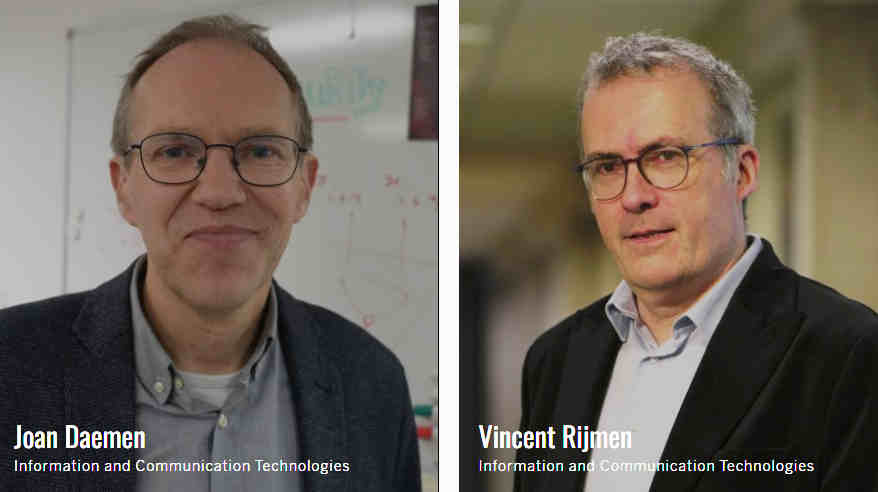
The BBVA’s Announcement outlines the Frontiers of Knowledge Committee’s reasons for this choice of laureates, recounting how in 1997, the two Belgian researchers created an algorithm they called Rijndael, a portmanteau of their names, which not long after would become the international standard used to safeguard the security and privacy of websites, laptops, mobile phones, Wi-Fi connections, bank cards, and cloud data storage, among numerous other applications. According to the committee, over the last quarter century, the cryptographic system they devised “has become an intrinsic part of everyday life”.
The announcement also outlines how the, rather unpronounceable, Rijndael algorithm was devised and went on to become the AES used as the standard today,
In the 1990s, when Daemen and Rijmen embarked on their research, the systems used to encrypt confidential information were already showing significant weaknesses. After 20 years, the DES algorithm recommended by NIST (National Institute of Standards and Technology), the body that regulates cybersecurity in the US was becoming too insecure to do its work. In response, NIST launched a competition to develop a new, faster and more secure algorithm that would become the new standard, a challenge that favored the two researchers, since their doctoral work focused precisely on the mathematical foundations of cryptography. Rijndael emerged from this work and, after years of scrutiny by the scientific community, went on to win the competition, becoming in 2001 the U.S. standard for data encryption – the Advanced Encryption Standard or AES – and four years later the international standard.
For some of the technicalities of using it, refer to Master The Pico WiFi: Random Numbers – or the version for the ESP 32, see side panel. And if you want an informal introduction see Stick Figure Guide To AES Encryption.
According to the Frontiers of Knowledge Committee:
“Thanks to this algorithm, based on profound research on the mathematical and algorithmic foundations of cryptography, our money stays in our bank accounts, our medical records remain private, and our messages only reach the people we intend.”
The Committee also highlighted Daemen and Rijmen’s:
“critical decision to leave their algorithm freely open-source, which enabled not only global standardization but also transparency in the cryptographic community – it is taught in every computer security course worldwide and can be examined for vulnerabilities.”
Given this combination of reasons, the Committee concluded that the contribution of Daemen and Rijmen:
“stands as a prime example of how fundamental theory can lead to a world-changing technology and to practical applications affecting billions of people.”
More Information
Related Articles
Frontiers Of Knowledge Award 2017
Peter Shor Gains Frontiers Of Knowledge Award
BBVA Frontiers Award Recognizes Advances In Machine Learning
Stick Figure Guide To AES Encryption
NIST Selects Lightweight Crypto For The IoT
Master The Pico WiFi: Random Numbers
What Does The NSA Think Of Cryptographers?
To be informed about new articles on I Programmer, sign up for our weekly newsletter, subscribe to the RSS feed and follow us on Facebook or Linkedin.

Comments
Make a Comment or View Existing Comments Using Disqus
or email your comment to: comments@i-programmer.info