
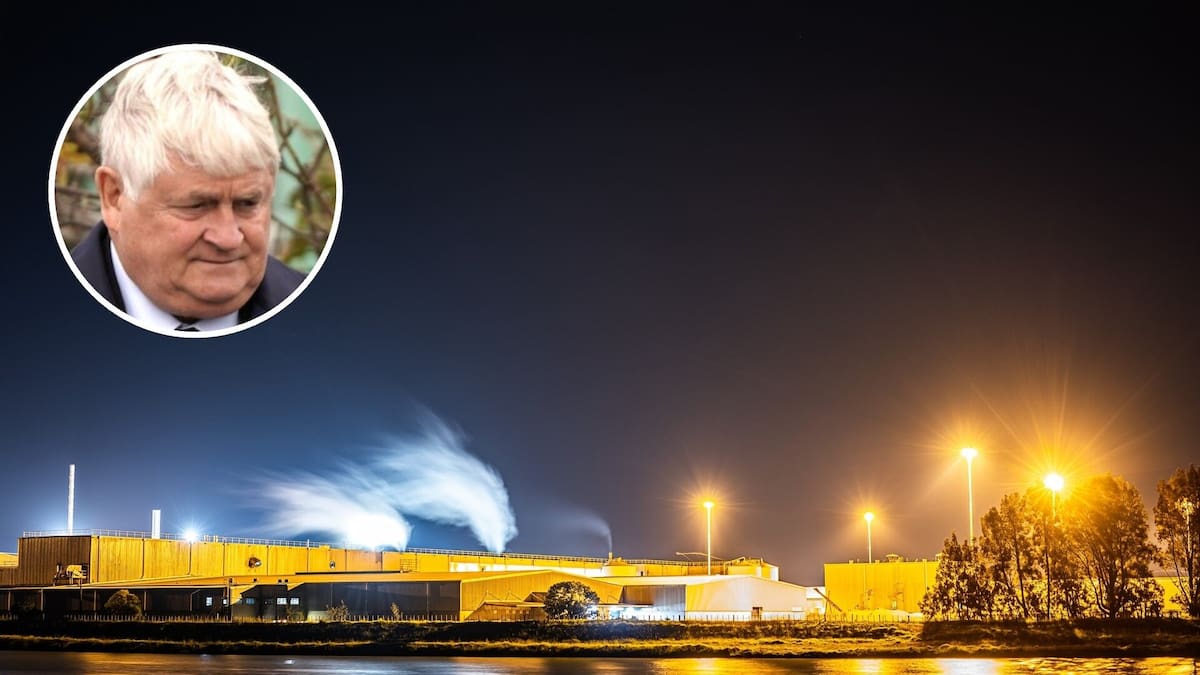
During 2024, the mill undertook a significant investment, spending $128 million upgrading equipment and technology to increase production capacity from 150,000 to 200,000 tonnes of finished goods packaging.
According to the company’s financial statements, shareholders have injected almost $90m of new equity plus more than $64.8m in loans to support the business.
Jurway’s only asset is a loan receivable of €37.19m ($73.56m), according to North Data, an online platform offering company information.
Whakatāne Mill was on the brink of closure before a consortium of investors stepped in with a lifeline in May 2021, saving around 200 jobs at the time.
The consortium was led by London-based Dermot Smurfit and Ross George, a founder of Auckland-based private equity firm Direct Capital, Sir Michael Smurfit’s Bacchantes Ltd and Swiss investor Raymond Alan Dargan, among others.
Their stakes have since been reduced with the emergence of O’Brien.
Under the 2021 deal, Power Paperboard acquired Whakatāne Mill from SIG Euro Holding GMBH for $1 in cash and a $5.96m working capital adjustment.
Net assets at the time of purchase were ascertained at $119.17m.
Irish billionaire Denis O’Brien has emerged as a majority shareholder in Whakatāne Mill. Photo / Getty Images
O’Brien is a familiar name in New Zealand business, especially in the media industry.
He had a long-running rivalry with Sir Anthony O’Reilly that centred on control of Independent News & Media, one of Ireland’s most powerful media groups and an influential shareholder in APN News & Media, the Australian‑NZ group that owned the New Zealand Herald, Newstalk ZB and other NZME assets.
When O’Reilly lost control of INM, O’Brien became the largest shareholder in that company. INM ultimately sold its APN stake in 2015.
O’Brien remains involved in several business sectors, including as the founder and long-time chairman of Digicel Group. His current wealth is estimated at US$3.1 billion ($5.21b), according to Forbes’ real-time wealth tracker.
Meanwhile, the Smurfit brothers have significant experience in the paper and packaging sector. Sir Michael expanded the family business into a multinational giant now known as Smurfit Kappa following a recent merger with Kappa Packaging.
Dermot’s path has been more of a specialist investor and operator, focusing on individual paper and pulp mills, including reviving the Cosmopolis dissolving‑pulp mill in the US.
Whakatāne Mill last year refinanced $85m of banking facilities with the BNZ and said in its annual accounts that it was forecasting an improved financial performance despite continued challenging trading conditions.
BusinessDesk reported the parent company remained reliant on its shareholders for financial support and that it noted material uncertainty following sizeable multi-year net losses amid rising energy costs.
Power Paperboard reported an operating loss of $28.6m in 2025, which was an improvement on the $38.6m loss recorded in 2024. The overall net loss last year was $27m, compared with $31.2m in 2024.
The company said in its 2025 annual report that the market remained challenging, but it had received strong support from its lender and shareholders.
“Forecasts to October 31, 2026, indicate improved performance and compliance with lending facilities,” it said.
Whakatāne Mill chief executive Ron Hooper was unavailable to be interviewed on the mill’s progress and the ownership.
Duncan Bridgeman is the managing editor of NZME Business News, overseeing the Business Herald and BusinessDesk.
Stay ahead with the latest market moves, corporate updates, and economic insights by subscribing to our Business newsletter – your essential weekly round-up of all the business news you need.