
At 14, Ngatai-Melbourne had the confidence needed for the character. She was chosen after a casting call held in schools, where she was asked to sing a song and tell a joke. What she thought was a bad audition was clearly a good one – and it opened a door.
“I’d wanted to be an actress since I was 10. I was always the loudest, never afraid to be who I was.”
After high school, the logical next step was attending Toi Whakaari: New Zealand Drama School in Wellington for three years.
Since graduating in 2020, she’s landed roles in major New Zealand films: Makareta in Cousins (2021), a teenage Whina Cooper in Whina (2022) and Rangimai in Lee Tamahori’s colonial drama The Convert (2023). She’s also had smaller parts on environmental teen drama Mystic, and Kairākau, a show about three Māori chiefs in pre-colonial Aotearoa.
Now 26, the Auckland-based actor will play Rongo in the 30th-anniversary production of the landmark play Waiora Te Ūkaipō – The Homeland, opening at the Aotearoa New Zealand Festival of the Arts next Friday and then coming to the Auckland Arts Festival in March.
Theatre legend Hone Kouka (Ngāti Porou, Ngāti Kahungunu, Ngāti Raukawa, Kai Tahu) is again directing the play he wrote three decades ago, about his whānau moving from their ancestral home, Waiora, on the East Cape to work in the South Island, seeking jobs and economic security. Can they stand together or will they drift apart?
Today, the themes of the ongoing impact of colonisation, urban drift, social dislocation and intergenerational tension are as relevant as they were in 1965 – the setting of the play – (and when it toured in 1996 and 1997.
Kouka says Waiora – the first in a trilogy – is not just a Māori story but also an immigrant story. And here’s something special: the sound designer is Kouka’s daughter, Maarire Brunning-Kouka, whose mother, the late Nancy Brunning, played Rongo in the original productions. Baby Maarire toured with them.
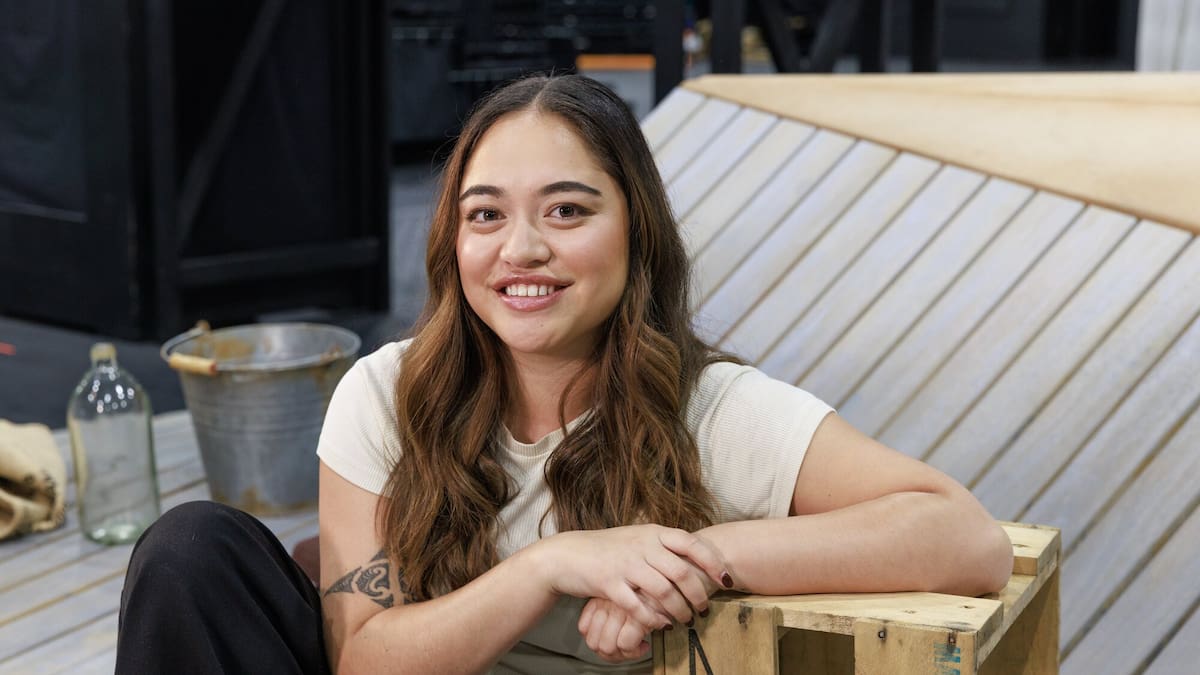
In a Wellington warehouse, the cast is rehearsing a scene where Rongo’s family prepares a beachside hāngī to celebrate her 18th birthday. She’s been standing in the ocean and is quietly shivering as her mum (Erina Daniels) wraps a towel around her.
Ngatai-Melbourne doesn’t say much, but her facial expressions and body language convey Rongo’s struggle with being separated from her tūrangawaewae. In another scene, she sings a beautiful waiata.
When Kouka messaged Ngatai-Melbourne asking her to play Rongo, she hesitated – “I consider myself a screen actress rather than a theatre actress” – but decided she was up for it. Since graduating from drama school, it’s her first stage role.
“The story is about his whānau moving from the East Cape to the South Island, so he’s intentionally brought cast and crew from those places,” she says.
That includes her. Affiliated with Ngāti Porou and Ngai Tūhoe, Ngatai-Melbourne grew up in Te Araroa, a tiny East Cape community, attending kōhanga reo and a Māori-language immersion school, with te reo as her first language.
Moving to Wellington was a shock. “My whole life, I’d been surrounded by te ao Māori,” she says. “Honestly, I didn’t know that not all Māori speak Māori. It was interesting meeting Māori from other places because they were different. Like, we weren’t all the same.” Rongo says a similar thing in Waiora.
Tioreore Ngatai-Melbourne in The Convert, Lee Tamahori’s final film before his death in 2025, with Australian actor Guy Pearce in the background.
Ngatai-Melbourne’s work is deeply rooted in her culture. “They’re true stories of what Māori have been through and are still going through,” she says.
“But there are so many more stories we can tell about Māori that the world hasn’t seen. For example, the world’s obsessed with the haka. But we’re also waiata, we’re dance, we’re humorous.”
While wanting to break down those stereotypes, she doesn’t feel a weight of responsibility to represent her culture. “I never think like that. I’m just myself and just do it. Maybe sometimes there’s pressure on my shoulders, but I know I’m good enough to be great.”
She was great in The Convert, Lee Tamahori’s final film, about a British missionary (Guy Pearce) who converts her character, Rangimai, to Christianity. “Although it’s from the Pākehā point of view, I know that would also have been the world of our ancestors, because we were converted.”
Ngatai-Melbourne wanted to do justice to the role of Rangimai, who tries to exact revenge for her husband’s death. “It was also an amazing opportunity to work with Lee Tamahori, may he rest in peace,” she says.
“It never felt like I was a new actress and he was this experienced director. I’d give suggestions because I was so confident in my Māoritanga. He’d say yes or no. Sometimes I’d push for a yes, but I was never cheeky. I respected him so much for listening to me.”
And Guy Pearce? “He really appreciated the Māori culture. He got two tāmoko [traditional Māori tattoos].”
Ngatai-Melbourne attended The Convert’s showing at the Toronto International Film Festival, receiving one of nine TIFF Rising Star Awards for 2023.
She initially didn’t know what that was, or that it was a big deal – during the festival, TIFF Rising Stars undertake professional development with international casting directors, film-makers, producers, and industry executives. In 2017, Hamnet’s Jessie Buckley was one of the actors selected.
Recently, actor Cliff Curtis asked Ngatai-Melbourne what her plan is. “I said, ‘I honestly don’t have a plan, you tell me’. He said, ‘Just keep doing what you’re doing.’ So my plan is just to go hard in everything I do. But I also want to crack something international. I know it’s close. I can feel it.”
Waiora Te Ūkaipō – The Homeland is on at the Aotearoa New Zealand Festival of the Arts in Wellington, February 27-March 1 (festival.nz) and the Auckland Arts Festival, March 6-22 (aaf.co.nz) as part of the Auckland Theatre Company’s 2026 season.