
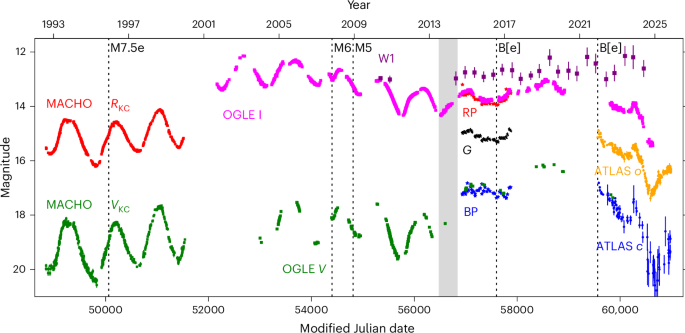
Meynet, G. & Maeder, A. Stellar evolution with rotation. X. Wolf–Rayet star populations at solar metallicity. Astron. Astrophys. 404, 975–990 (2003).
Ekström, S. et al. Grids of stellar models with rotation. I. Models from 0.8 to 120 M⊙ at solar metallicity (Z = 0.014). Astron. Astrophys. 537, A146 (2012).
Levesque, E. M. Astrophysics of Red Supergiants 2514–3433 (IOP, 2017); https://doi.org/10.1088/978-0-7503-1329-2
Van Dyk, S. D. Red supergiants as supernova progenitors. Galaxies 13, 33 (2025).
Li, W. et al. Identification of the red supergiant progenitor of supernova 2005cs: do the progenitors of type II-P supernovae have low mass? Astrophys. J. 641, 1060–1070 (2006).
Kochanek, C. S. et al. A survey about nothing: monitoring a million supergiants for failed supernovae. Astrophys. J. 684, 1336–1342 (2008).
Smartt, S. J., Eldridge, J. J., Crockett, R. M. & Maund, J. R. The death of massive stars—I. Observational constraints on the progenitors of type II-P supernovae. Mon. Not. R. Astron. Soc. 395, 1409–1437 (2009).
Smartt, S. J. Observational constraints on the progenitors of core-collapse supernovae: the case for missing high-mass stars. Publ. Astron. Soc. Aust. 32, e016 (2015).
Kochanek, C. S. On the red supergiant problem. Mon. Not. R. Astron. Soc. 493, 4945–4949 (2020).
Fang, Q., Moriya, T. J. & Maeda, K. Red supergiant problem viewed from the nebular phase spectroscopy of type II supernovae. Astrophys. J. 986, 39 (2025).
Davies, B. & Beasor, E. R. The ‘red supergiant problem’: the upper luminosity boundary of type II supernova progenitors. Mon. Not. R. Astron. Soc. 493, 468–476 (2020).
Davies, B. & Beasor, E. R. ’On the red supergiant problem’: a rebuttal, and a consensus on the upper mass cut-off for II-P progenitors. Mon. Not. R. Astron. Soc. 496, L142–L146 (2020).
Beasor, E. R., Smith, N. & Jencson, J. E. The red supergiant progenitor luminosity problem. Astrophys. J. 979, 117 (2025).
Strotjohann, N. L., Ofek, E. O. & Gal-Yam, A. A Bias-corrected luminosity function for red supergiant supernova progenitor stars. Astrophys. J. Lett. 964, L27 (2024).
Healy, S., Horiuchi, S. & Ashall, C. The red supergiant problem: as seen from the local group’s red supergiant populations. Preprint at https://arxiv.org/abs/2412.04386 (2024).
De, K. et al. The disappearance of a massive star marking the birth of a black hole in M31. Preprint at https://arxiv.org/abs/2410.14778 (2024).
de Jager, C. The yellow hypergiants. Astron. Astrophys. Rev. 8, 145–180 (1998).
Gordon, M. S. & Humphreys, R. M. Red supergiants, yellow hypergiants, and post-RSG evolution. Galaxies 7, 92 (2019).
Humphreys, R. M. & Jones, T. J. Episodic gaseous outflows and mass loss from red supergiants. Astron. J. 163, 103 (2022).
Jones, T. Red and yellow hypergiants. Galaxies 13, 43 (2025).
Humphreys, R. M. The complex upper HR diagram. Galaxies 7, 75 (2019).
Meynet, G. et al. Impact of mass-loss on the evolution and pre-supernova properties of red supergiants. Astron. Astrophys. 575, A60 (2015).
Zapartas, E. et al. The effect of mass loss in models of red supergiants in the Small Magellanic Cloud. Astron. Astrophys. 697, A167 (2025).
Smith, N. Mass loss: its effect on the evolution and fate of high-mass stars. Annu. Rev. Astron. Astrophys. 52, 487–528 (2014).
Beasor, E. R. et al. A new mass-loss rate prescription for red supergiants. Mon. Not. R. Astron. Soc. 492, 5994–6006 (2020).
Antoniadis, K. et al. Establishing a mass-loss rate relation for red supergiants in the Large Magellanic Cloud. Astron. Astrophys. 686, A88 (2024).
Decin, L., Richards, A. M. S., Marchant, P. & Sana, H. ALMA detection of CO rotational line emission in red supergiant stars of the massive young star cluster RSGC1. Determination of a new mass-loss rate prescription for red supergiants. Astron. Astrophys. 681, A17 (2024).
Antoniadis, K. et al. Investigating the metallicity dependence of the mass-loss rate relation of red supergiants. Astron. Astrophys. 702, A178 (2025).
Richards, A. M. S., Yates, J. A. & Cohen, R. J. Proper motions of water vapour masers and bipolar outflow from NML Cygni. Mon. Not. R. Astron. Soc. 282, 665–676 (1996).
Decin, L. et al. Probing the mass-loss history of AGB and red supergiant stars from CO rotational line profiles. I. Theoretical model—mass-loss history unravelled in VY CMa. Astron. Astrophys. 456, 549–563 (2006).
Singh, A. P., Richards, A. M. S., Humphreys, R. M., Decin, L. & Ziurys, L. M. ALMA reveals hidden morphologies in the molecular envelope of VY Canis Majoris. Astrophys. J. Lett. 954, L1 (2023).
Glatzel, W. & Kiriakidis, M. Stability of massive stars and the Humphreys/Davidson limit. Mon. Not. R. Astron. Soc. 263, 375 (1993).
Humphreys, R. M. & Davidson, K. Studies of luminous stars in nearby galaxies. III. Comments on the evolution of the most massive stars in the Milky Way and the Large Magellanic Cloud. Astrophys. J. 232, 409–420 (1979).
McDonald, S. L. E., Davies, B. & Beasor, E. R. Red supergiants in M31: the Humphreys–Davidson limit at high metallicity. Mon. Not. R. Astron. Soc. 510, 3132–3144 (2022).
Schootemeijer, A. et al. A constant upper luminosity limit of cool supergiant stars down to the extremely low metallicity of I Zw 18. Preprint at https://arxiv.org/abs/2510.12594 (2025).
Landri, C. & Pejcha, O. Driving asymmetric red supergiant winds with binary interactions. Mon. Not. R. Astron. Soc. 531, 3391–3405 (2024).
MacLeod, M. et al. Radial velocity and astrometric evidence for a close companion to Betelgeuse. Astrophys. J. 978, 50 (2025).
Sana, H. et al. Binary interaction dominates the evolution of massive stars. Science 337, 444 (2012).
Ivanova, N. et al. Common envelope evolution: where we stand and how we can move forward. Astron. Astrophys. Rev. 21, 59 (2013).
Westerlund, B. E., Olander, N. & Hedin, B. Supergiant and giant M type stars in the Large Magellanic Cloud. Astron. Astrophys. Suppl. 43, 267–295 (1981).
Ohnaka, K., Driebe, T., Hofmann, K. H., Weigelt, G. & Wittkowski, M. Spatially resolved dusty torus toward the red supergiant WOH G64 in the Large Magellanic Cloud. Astron. Astrophys. 484, 371–379 (2008).
Elias, J. H., Frogel, J. A. & Schwering, P. B. W. Two supergiants in the Large Magellanic Cloud with thick dust shells. Astrophys. J. 302, 675 (1986).
Levesque, E. M., Massey, P., Plez, B. & Olsen, K. A. G. The physical properties of the red supergiant WOH G64: the largest star known? Astron. J. 137, 4744–4752 (2009).
Beasor, E. R. & Smith, N. The extreme scarcity of dust-enshrouded red supergiants: consequences for producing stripped stars via winds. Astrophys. J. 933, 41 (2022).
Ohnaka, K. et al. Imaging the innermost circumstellar environment of the red supergiant WOH G64 in the Large Magellanic Cloud. Astron. Astrophys. 691, L15 (2024).
van Loon, J. T., Zijlstra, A. A., Bujarrabal, V. & Nyman, L. Å Circumstellar masers in the Magellanic Clouds. Astron. Astrophys. 368, 950–968 (2001).
Marshall, J. R. et al. Asymptotic giant branch superwind speed at low metallicity. Mon. Not. R. Astron. Soc. 355, 1348–1360 (2004).
Soszynski, I., Udalski, A., Szymanski, M. K., others, K. & Poleski, R. The Optical Gravitational Lensing Experiment. The OGLE-III Catalog of Variable Stars. IV. Long-period variables in the Large Magellanic Cloud. Acta Astron. 59, 239–253 (2009).
Boyd, D. Spectroscopic and photometric study of the Mira stars SU Camelopardalis and RY Cephei. J. Am. Assoc. Var. Star Obs. 49, 157 (2021).
Kravchenko, K. et al. Tomography of cool giant and supergiant star atmospheres. II. Signature of convection in the atmosphere of the red supergiant star μ Cep. Astron. Astrophys. 632, A28 (2019).
Solf, J. Spectral type and luminosity classification of late-type M stars from near-infrared image tube coudé spectrograms. Astron. Astrophys. Suppl. Ser. 34, 409–416 (1978).
Lamers, H. J. G. L. M., Zickgraf, F.-J., de Winter, D., Houziaux, L. & Zorec, J. An improved classification of B[e]-type stars. Astron. Astrophys. 340, 117–128 (1998).
Kraus, M. A census of B[e] supergiants. Galaxies 7, 83 (2019).
Rayner, J. T., Cushing, M. C. & Vacca, W. D. The Infrared Telescope Facility (IRTF) spectral library: cool stars. Astrophys. J. Suppl. Ser. 185, 289–432 (2009).
Allen, D. A. A catalogue of symbiotic stars. Publ. Astron. Soc. Aust. 5, 369–421 (1984).
Mikołajewska, J. Symbiotic stars: continually embarrassing binaries. Baltic Astron. 16, 1–9 (2007).
Cowley, A. P. The VV Cephei stars. Publ. Astron. Soc. Pac. 81, 297 (1969).
Wright, K. O. The system of VV Cephei derived from an analysis of the Hα line. J. R. Astron. Soc. Can. 71, 152 (1977).
Liimets, T. et al. New insights into the outflows from R Aquarii. Astron. Astrophys. 612, A118 (2018).
Soker, N. Close stellar binary systems by grazing envelope evolution. Astrophys. J. 800, 114 (2015).
Dori, N., Bear, E. & Soker, N. Wobbling jets in common envelope evolution. Astrophys. J. 954, 143 (2023).
Beristain, G., Edwards, S. & Kwan, J. Helium emission from classical T Tauri stars: dual origin in magnetospheric infall and hot wind. Astrophys. J. 551, 1037–1064 (2001).
Massey, P., Levesque, E. M., Olsen, K. A. G., Plez, B. & Skiff, B. A. HV 11423: the coolest supergiant in the SMC. Astrophys. J. 660, 301–310 (2007).
Munoz-Sanchez, G. et al. Episodic mass loss in the very luminous red supergiant [W60] B90 in the Large Magellanic Cloud. Astron. Astrophys. 690, A99 (2024).
Dessart, L. & Jacobson-Galan, W. V. A modeling perspective on the diversity of red-supergiant stars exploding within circumstellar material. Preprint at https://arxiv.org/abs/2510.17676 (2025).
Levesque, E. M., Massey, P., Olsen, K. A. G. & Plez, B. Late-type red supergiants: too cool for the Magellanic Clouds? Astrophys. J. 667, 202–212 (2007).
Paczyński, B. & Sienkiewicz, R. Evolution of close binaries VIII. Mass exchange on the dynamical time scale. Acta Astron. 22, 73–91 (1972).
Ercolino, A., Jin, H., Langer, N. & Dessart, L. Interacting supernovae from wide massive binary systems. Astron. Astrophys. 685, A58 (2024).
Clayton, M., Podsiadlowski, P., Ivanova, N. & Justham, S. Episodic mass ejections from common-envelope objects. Mon. Not. R. Astron. Soc. 470, 1788–1808 (2017).
Nandez, J. L. A., Ivanova, N. & Lombardi, J. C. J. Recombination energy in double white dwarf formation. Mon. Not. R. Astron. Soc. 450, L39–L43 (2015).
Valsan, V., Borges, S. V., Prust, L. & Chang, P. Envelope ejection and the transition to homologous expansion in common-envelope events. Mon. Not. R. Astron. Soc. 526, 5365–5373 (2023).
Hubble, E. & Sandage, A. The brightest variable stars in extragalactic nebulae. I. M31 and M33. Astrophys. J. 118, 353 (1953).
Koumpia, E. et al. Optical and near-infrared observations of the Fried Egg Nebula. Multiple shell ejections on a 100 yr timescale from a massive yellow hypergiant. Astron. Astrophys. 635, A183 (2020).
van Genderen, A. M. et al. Investigation of the pulsations, outbursts, and evolution of the yellow hypergiants: ρ Cas, HR 8752, and HR 5171A, with notes on HD 179821. Astron. Astrophys. 694, A136 (2025).
Humphreys, R. M., Jones, T. J. & Gehrz, R. D. The enigmatic object variable A in M33. Astron. J. 94, 315 (1987).
Humphreys, R. M. et al. M33’s variable A: a hypergiant star more than 35 years in eruption. Astron. J. 131, 2105–2113 (2006).
Smith, N. et al. MagAO-X images of the inner core of VY Canis Majoris: a disk and a companion. In American Astronomical Society Meeting Abstracts Vol. 245, 163.13 (American Astronomical Society, 2025).
De Beck, E., Andrews, H., Quintana-Lacaci, G. & Vlemmings, W. H. T. The circumstellar environment around the extreme Galactic red supergiant NML Cygni: dense, dusty, and asymmetric. Astron. Astrophys. 698, A179 (2025).
Marchant, P. & Bodensteiner, J. The evolution of massive binary stars. Annu. Rev. Astron. Astrophys. 62, 21–61 (2024).
van Loon, J. T. & Ohnaka, K. A phoenix rises from the ashes: WOH G64 is still a red supergiant, for now. Preprint at https://arxiv.org/abs/2601.02057 (2026).
Davies, B., Plez, B. & Petrault, M. Explosion imminent: the appearance of red supergiants at the point of core-collapse. Mon. Not. R. Astron. Soc. 517, 1483–1490 (2022).
Sengupta, S., Sujit, D. & Sarangi, A. Dance to demise—how massive stars may form dense circumstellar shells before explosion. Astrophys. J. 996, 18 (2025).
Bronner, V. A., Laplace, E., Schneider, F. R. N. & Podsiadlowski, P. Explosions of pulsating red supergiants: a natural pathway for the diversity of type II-P/L supernovae. Astron. Astrophys. 703, A61 (2025).
Laplace, E., Bronner, V. A., Schneider, F. R. N. & Podsiadlowski, P. Pulsations change the structures of massive stars before they explode: interpreting the nearby supernova SN 2023ixf. Preprint at https://arxiv.org/abs/2508.11088 (2025).
Ercolino, A. et al. The demographics of core-collapse supernovae I. The role of binary evolution and CSM interaction. Preprint at https://arxiv.org/abs/2510.04872 (2025).
Van Dyk, S. D. et al. The progenitor of supernova 1993J revisited. Publ. Astron. Soc. Pac. 114, 1322–1332 (2002).
Folatelli, G. et al. The progenitor of the type IIb SN 2008ax revisited. Astrophys. J. 811, 147 (2015).
O’Connor, E. & Ott, C. D. Black hole formation in failing core-collapse supernovae. Astrophys. J. 730, 70 (2011).
Wright, E. L. et al. The Wide-field Infrared Survey Explorer (WISE): mission description and initial on-orbit performance. Astron. J. 140, 1868–1881 (2010).
Cutri, R. M. et al. AllWISE data release (Cutri+ 2013). VizieR Online Data Catalog II/328 https://ui.adsabs.harvard.edu/abs/2014yCat.2328….0C (2021).
Tonry, J. L. et al. ATLAS: a high-cadence all-sky survey system. Publ. Astron. Soc. Pac. 130, 064505 (2018).
Gaia Collaboration et al. The Gaia mission. Astron. Astrophys. 595, A1 (2016).
Gaia Collaboration et al. Gaia Data Release 3. Summary of the content and survey properties. Astron. Astrophys. 674, A1 (2023).
Alcock, C. et al. The MACHO Project Large Magellanic Cloud microlensing results from the first two years and the nature of the Galactic dark halo. Astrophys. J. 486, 697–726 (1997).
Mainzer, A. et al. Preliminary results from NEOWISE: an enhancement to the Wide-field Infrared Survey Explorer for Solar System science. Astrophys. J. 731, 53 (2011).
Udalski, A., Kubiak, M. & Szymanski, M. Optical Gravitational Lensing Experiment. OGLE-2—the second phase of the OGLE project. Acta Astron. 47, 319–344 (1997).
Udalski, A. et al. The Optical Gravitational Lensing Experiment. OGLE-III photometric maps of the Large Magellanic Cloud. Acta Astron. 58, 89–102 (2008).
Udalski, A., Szymański, M. K. & Szymański, G. OGLE-IV: fourth phase of the Optical Gravitational Lensing Experiment. Acta Astron. 65, 1–38 (2015).
Heinze, A. N. et al. A first catalog of variable stars measured by the Asteroid Terrestrial-impact Last Alert System (ATLAS). Astron. J. 156, 241 (2018).
Shingles, L. et al. Release of the ATLAS Forced Photometry server for public use. Transient Name Server AstroNote 7, 1–7 (2021).
Alcock, C. et al. Calibration of the MACHO Photometry Database. Publ. Astron. Soc. Pac. 111, 1539–1558 (1999).
Marshall, J. L. et al. The MagE spectrograph. Proc. SPIE 7014, 701454 (2008).
Kelson, D. D., Illingworth, G. D., van Dokkum, P. G. & Franx, M. The evolution of early-type galaxies in distant clusters. II. Internal kinematics of 55 galaxies in the z=0.33 cluster CL 1358+62. Astrophys. J. 531, 159–183 (2000).
Kelson, D. D. Optimal techniques in two-dimensional spectroscopy: background subtraction for the 21st century. Publ. Astron. Soc. Pac. 115, 688–699 (2003).
Dekker, H., D’Odorico, S., Kaufer, A., Delabre, B. & Kotzlowski, H. Iye, M. & Moorwood, A. F. Design, construction, and performance of UVES, the echelle spectrograph for the UT2 Kueyen Telescope at the ESO Paranal Observatory. Proc. SPIE 4008, 534–545 (2000).
Vernet, J. et al. X-shooter, the new wide band intermediate resolution spectrograph at the ESO Very Large Telescope. Astron. Astrophys. 536, A105 (2011).
Ballester, P. et al. The UVES data reduction pipeline. The Messenger 101, 31–36 (2000).
Modigliani, A. et al. Silva, D. R., Peck, A. B. & Soifer, B. T. Observatory operations: 912 strategies, processes, and systems III. Proc. SPIE 7737, 773728 (2010).
Smette, A. et al. Molecfit: a general tool for telluric absorption correction. I. Method and application to ESO instruments. Astron. Astrophys. 576, A77 (2015).
Houck, J. R. et al. Mather, J. C. (ed.) The infrared spectrograph on the Spitzer Space Telescope Proc. SPIE 5487, 62–76 (2004).
Calzoletti, L. et al. REMIR: the REM infrared camera to follow up the early phases of GRBs afterglows. Nuovo Cimento C 28, 759 (2005).
Gustafsson, B. et al. A grid of MARCS model atmospheres for late-type stars. I. Methods and general properties. Astron. Astrophys. 486, 951–970 (2008).
van Loon, J. T., Cioni, M. R. L., Zijlstra, A. A. & Loup, C. An empirical formula for the mass-loss rates of dust-enshrouded red supergiants and oxygen-rich asymptotic giant branch stars. Astron. Astrophys. 438, 273–289 (2005).
Jian, M., Matsunaga, N., Jiang, B., Yuan, H. & Zhang, R. Exploring Be phenomena in OBA stars: A mid-infrared search. Astron. Astrophys. 682, A59 (2024).
Tabernero, H. M., Dorda, R., Negueruela, I. & González-Fernández, C. An LTE effective temperature scale for red supergiants in the Magellanic clouds. Mon. Not. R. Astron. Soc. 476, 3106–3123 (2018).
Humphreys, R. M., Weis, K., Davidson, K., Bomans, D. J. & Burggraf, B. Luminous and variable stars in M31 and M33. II. Luminous blue variables, candidate LBVs, Fe II emission line stars, and other supergiants. Astrophys. J. 790, 48 (2014).
Bergemann, M., Kudritzki, R.-P., Gazak, Z., Davies, B. & Plez, B. Red supergiant stars as cosmic abundance probes. III. NLTE effects in J-band magnesium lines. Astrophys. J. 804, 113 (2015).
Accetta, K. et al. The Seventeenth Data Release of the Sloan Digital Sky Surveys: complete release of MaNGA, MaStar, and APOGEE-2 data. Astrophys. J. Suppl. Ser. 259, 35 (2022).
de Wit, S. et al. Properties of luminous red supergiant stars in the Magellanic Clouds. Astron. Astrophys. 669, A86 (2023).
Patrick, L. R. et al. Red supergiant stars in binary systems. I. Identification and characterization in the small magellanic cloud from the UVIT ultraviolet imaging survey. Mon. Not. R. Astron. Soc. 513, 5847–5860 (2022).
Neugent, K. F., Massey, P., Skiff, B. & Meynet, G. Yellow and red supergiants in the Large Magellanic Cloud. Astrophys. J. 749, 177 (2012).
Mathewson, D. S. & Clarke, J. N. Supernova remnants in the Large Magellanic Cloud. Astrophys. J. 180, 725–738 (1973).
van Loon, J. T., Hekkert, P. T. L., Bujarrabal, V., Zijlstra, A. A. & Nyman, L.-A. Discovery of H2O maser emission from the red supergiant IRAS04553−6825 in the Large Magellanic Cloud. Astron. Astrophys. 337, 141–144 (1998).
Kravchenko, K. et al. Atmosphere of Betelgeuse before and during the Great Dimming event revealed by tomography. Astron. Astrophys. 650, L17 (2021).
Kourniotis, M., Kraus, M., Maryeva, O., Borges Fernandes, M. & Maravelias, G. Revisiting the evolved hypergiants in the Magellanic Clouds. Mon. Not. R. Astron. Soc. 511, 4360–4376 (2022).
Humphreys, R. M., Jones, T. J. & Martin, J. C. Yellow supergiants and post-red supergiant evolution in the Large Magellanic Cloud. Astron. J. 166, 50 (2023).
Lobel, A. et al. High-resolution spectroscopy of the yellow hypergiant ρ Cassiopeiae from 1993 through the outburst of 2000–2001. Astrophys. J. 583, 923–954 (2003).
van Genderen, A. M. et al. Pulsations, eruptions, and evolution of four yellow hypergiants. Astron. Astrophys. 631, A48 (2019).
Nieuwenhuijzen, H. et al. The hypergiant HR 8752 evolving through the yellow evolutionary void. Astron. Astrophys. 546, A105 (2012).
Oudmaijer, R. D., Groenewegen, M. A. T., Matthews, H. E., Blommaert, J. A. D. L. & Sahu, K. C. The spectral energy distribution and mass-loss history of IRC+10420. Mon. Not. R. Astron. Soc. 280, 1062–1070 (1996).
Nieuwenhuijzen, H. & de Jager, C. Checking the yellow evolutionary void. Three evolutionary critical hypergiants: HD 33579, HR 8752 & IRC +10420. Astron. Astrophys. 353, 163–176 (2000).
Dotter, A. MESA Isochrones and Stellar Tracks (MIST) 0: Methods for the construction of stellar isochrones. Astrophys. J. Suppl. Ser. 222, 8 (2016).
Choi, J. et al. Mesa Isochrones and Stellar Tracks (MIST). I. Solar-scaled models. Astrophys. J. 823, 102 (2016).
Munoz-Sanchez, G. et al. The dramatic transition of the extreme red supergiant WOH G64 to a yellow hypergiant. figshare https://doi.org/10.6084/m9.figshare.30738671 (2025).