
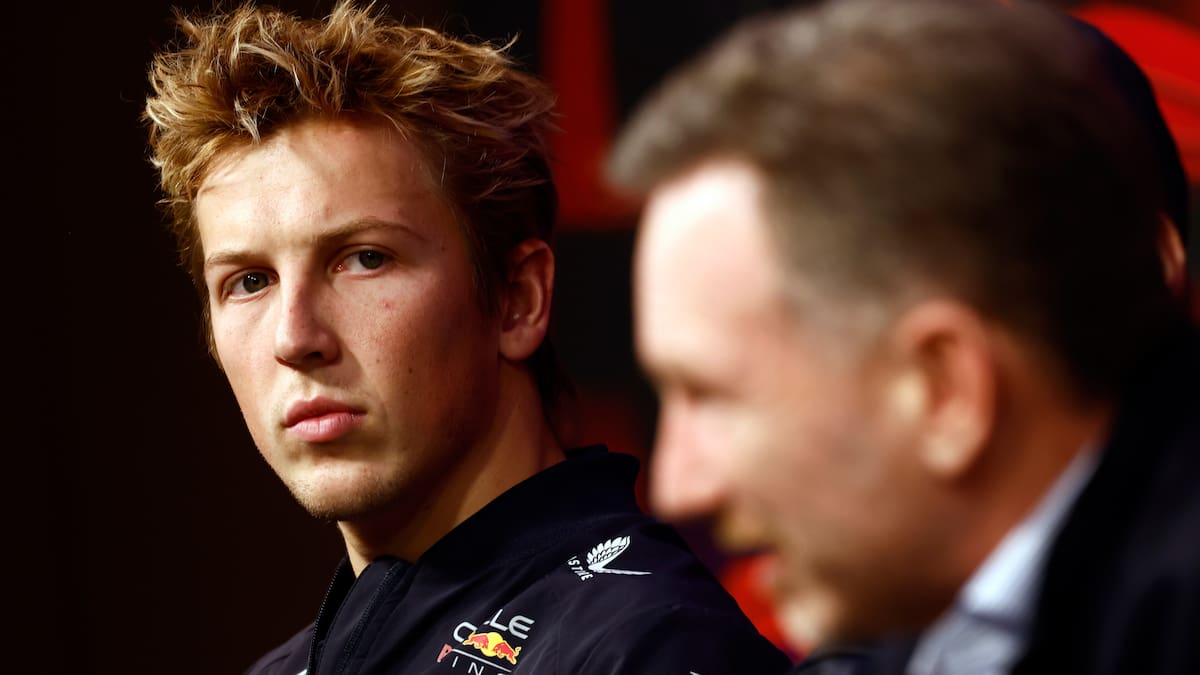
“I think ultimately things changed within the business, within the group. The founder died, and after Dietrich [Mateschitz]’s death, I was probably deemed to have maybe too much control.”
Jos Verstappen (left) and Christian Horner together in vaguely happier times. Photo / Red Bull
Horner also claims it “wasn’t his choice” to swap Liam Lawson for Yuki Tsunoda after two races last season, a decision with which Verstappen disagreed. “I was always pushed to take drivers from the [Red Bull] young driver programme,” he says. “Helmut was a big driver in it.”
In the same interview, Horner reads out a text message from Mercedes team principal Toto Wolff, his long-time rival, reminiscing on their battles. It read: “I didn’t know what to say, because on one side you’ve been a real a*** hole. But on the other hand, the sport will miss one of its main protagonists. Who should I fight? And ‘love to hate’, as you always said? Wolff and Horner have a combined 14 of the last 15 world championships. Not a bad points statistic.”
Horner replied: “I’ve loved locking horns with you all these years. So thank you for the rivalry, the competition and the needle. No one else even came close, as the statistics point out. I wish you all the best for the future. ps You need a haircut.”
There is a moment in the latest series of Drive to Survive that feels like the fly-on-the-wall sports doc equivalent of breaking the fourth wall. F1TV presenter Laura Winter is in the Abu Dhabi pit lane, previewing the impending season finale – where Lando Norris must fend off Max Verstappen and his own McLaren teammate Oscar Piastri to secure his maiden world title – when she remarks: “It’s perfectly poised isn’t it? It’s as though the racing gods have written the script for us.”
“It’s either the racing gods or Netflix, but someone has scripted it,” former IndyCar driver James Hinchcliffe replies.
As if there are not already enough Formula One fans who feel that Netflix is the tail wagging the dog – conjuring plot twists, controlling the narrative – now the series-makers are openly mocking them.
Mind you, since those people are unlikely to watch DTS in the first place, maybe it doesn’t matter. We’re up to season eight now, for those keeping count, and this remains very much a series for the sport’s “newer” fans.
To be honest, it feels almost like painting by numbers at this point. Drivers in private jets, drivers playing padel, drivers on yachts during their summer breaks, drivers with their girlfriends, staged interviews between drivers/team principals and people from their inner circle, all interspersed with in-race footage and talking heads explaining to viewers what is going on as if they are talking to a 3-year-old.
It is tricky to add much new into the mix. When there is a big news story, DTS sometimes goes light on it. Last year, the biggest stories were Horner’s sacking mid-season, and the accusations McLaren favoured Norris over Piastri, which became such a big talking point it was raised in the Australian Parliament. It doesn’t feel as if the treatment of either issue quite hits the mark.
Episode four, A Bull With No Horns, deals with the walls closing in on Horner as on-track results and off-track politics conspire to see him ousted after 20 years. But it does not come close to capturing the poison or rancour that actually surrounded those events.
We get a bit of Wolff flirting with Max Verstappen mid-season, ramping up the pressure on his old adversary. We get some shots of Mintzlaff and Marko looking glum. We have Horner looking physically sick and exclaiming “Oh, for f***’s sake” after Verstappen is taken out by Kimi Antonelli in Austria. We get the Dies Irae from the Mozart requiem. But there must be so much content on the cutting room floor. The tension between Horner and Jos Verstappen, which erupted at Silverstone a couple of days before Horner got the bullet. The bad blood with Marko etc.
The trouble here may be the right of veto that teams and drivers get, and it is one of the major problems with DTS in general. The series is so hand in glove with Formula One now – so in simpatico – it can end up feeling a bit sterile. So instead of the poison, you get a staged conversation between Horner and his wife Geri, discussing the “s*** sandwich” he has just been served, followed by a sit-down with Horner in his stables at home. Actually, there is some nice content here, including Horner reading out a generous text message he received from Wolff in the aftermath.
Lando Norris (left), Oscar Piastri and Max Verstappen took out the top three places in the 2025 drivers’ championship. Photo / Red Bull
Less clear is why DTS ducks the conspiracy theories at McLaren. Even if they were fanciful, they became a major talking point last year, particularly after the team orders row at Monza, where Piastri was ordered to give way to Norris. Bizarrely, that incident does not even warrant a mention.
Episode three, The Number 1 Problem, deals with McLaren’s decision to have two No 1 drivers despite the tensions that can cause. Nico Rosberg is a useful talking head here, referring back to his tussles with Lewis Hamilton in 2016. We do get the crash in Montreal, where Norris went into the back of Piastri. And Piastri’s 10-second penalty at Silverstone after which he asks the team to swap back positions and is denied (Zak Brown explaining: “We can’t play God”.) But there is no interrogation of the charges of favouritism in Monza, or in Qatar, where McLaren botched the pit-stop strategy, costing Piastri a possible win as they tried to be even-handed.
Where DTS thrives is when its cameras capture genuinely unguarded moments that then make it past the censors. The booing of Horner at the season launch at the O2 Arena in episode one, New Kids on the Block. Drivers looking genuinely embarrassed backstage. Hamilton saying: “S***”. Liam Lawson asking: “Wait, how? In London?” Verstappen saying: “I don’t give a f***.”
It can be insightful too. Episode six, The Duel, is brilliant on Antonelli, one of last year’s rookies, showing him in a genuinely sympathetic light. Under immense pressure after a poor run in mid-season, the teenager’s humility, his vulnerability and the relationship with his family, are all well handled. You cannot help but be delighted when he finishes second in Brazil.
There are some amusing moments. George Russell is involved in a few of them. In one episode, he discloses he and his partner, Carmen, are beginning to design their own skincare products, but laments the first batch “smelt like semen”. Later, there is a bizarre conversation in Las Vegas where Russell discusses finding a “pleasure kit” in his hotel room. “Obviously, I know what pleasures a woman… but when there’s a pleasure kit for a man…” he says, his voice trailing off. “Did you open it?” he is asked. “Of course I opened it!” Wisely, DTS ends that segment there.
All in all, season eight is much the same as previous seasons. Those who like the format will love it. Those who don’t will hate it, or ignore it, or pretend to ignore it while actually binge-watching it. Either way, it remains a stonking success for Netflix, generating an estimated US$290 million ($490m) in value since 2020. And even more so for Formula One, helping to add billions of dollars to teams’ values.
While viewing figures have decreased slightly year-on-year, it remains by far the most successful offering in the genre. More than 10 million people viewed season seven in the first couple of months after its release 12 months ago (Full Swing, Netflix’s behind-the-scenes golf offering, generated 4.1 million by comparison). Like it or not, it feels as if there is plenty of fuel left in the tank. Or should that be power left in the battery?
– Telegraph