
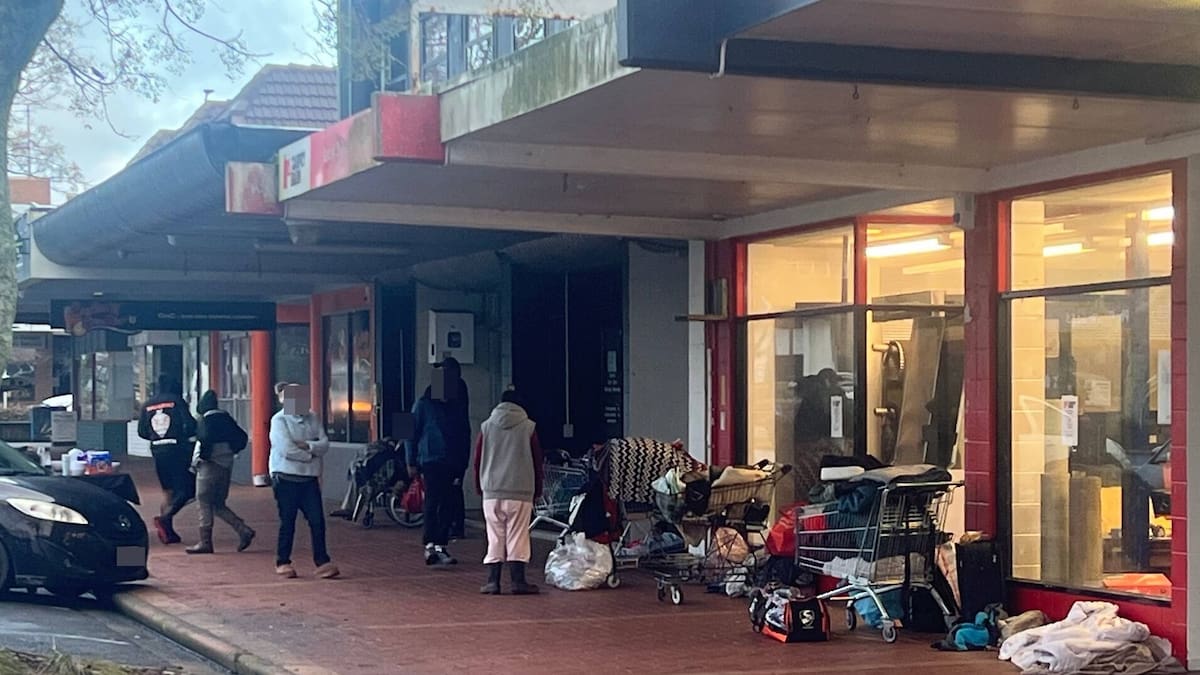
“Oh my God, amazing. Finally,” the landlord, who spoke on the condition she was not named, told the Rotorua Daily Post.
She claimed homeless people had smashed windows, urinated and defecated in doorways, openly used and dealt drugs, and tried to “scab” cigarettes and money from passers-by.
“The number of complaints we get from customers … ”
She said at least two trolley-loads of belongings were dumped at the back of the buildings daily.
She said she regularly called the Rotorua Lakes Council to remove rubbish and contacted police up to three times a week to break up disorder incidents.
The problem had become so bad, she feared losing her tenants.
Suitcases of belongings stacked up outside Pukuatua St businesses.
She said Rotorua already had a lot of support for homeless people available, including from agencies that brought food to them outside her building.
She said she believed most of the core 20 or so people seen regularly appearing to sleep rough in the CBD chose to live that way.
“They don’t go away. If you feed seagulls, they are not going to leave.”
Political views
Waititi said the Government had stripped Māori health providers such as Whānau Ora of funding, and left the wrong people in charge of finding solutions.
“How can you trespass someone and arrest someone out of poverty? They are desperate, they are poor and homeless, and now they are making it a crime.
”It’s one of the most disgusting pieces of legislation that the Government has put out.”
Waiariki MP Rawiri Waititi. Photo / Mark Papalii / RNZ
He said there was nowhere for the homeless to go and most of them had drug, alcohol and mental health issues and were not ready for homes.
“Move them into a nice, safe space and think about the next space. It is a step-by-step process.”
Waititi said the legislation reeked of the Government looking for votes to improve its popularity ahead of the election.
Rotorua MP Todd McClay said the legislation was important for Rotorua and Waititi was out of touch.
“Rawiri is wrong and he says every piece of legislation is the most disgusting, so he needs to find a few more adjectives.”
McClay said this was another tool to help the police take action where there were grey areas around enforcement.
Rotorua MP Todd McClay. Photo / Mark Mitchell
“Ultimately, every citizen has the right to feel safe.”
Rotorua Mayor Tania Tapsell said Rotorua knew firsthand that disorder, begging and threatening behaviour impacted local workers, and had been difficult to manage with limited powers and consequences.
“To fix this locally our council and local police have worked proactively to ensure our inner city is a safe and welcoming place for both locals and visitors and these efforts have made noticeable positive change already.”
She said she wanted to see support for solutions to prevent these issues happening in the first place.
The council was working on a homelessness strategy.
Community views
Salvation Army community ministries manager Darnielle Hoods said the number of people sleeping rough outside the organisation’s doors on the corner of Pukuatua and Amohia Sts had significantly reduced.
“However, that might have to do with the trespass notices that were given last year.
“I support safe communities. I also support the dignity of every person in them, including those sleeping rough.”
Salvation Army community ministries manager Darnielle Hoods. Photo / Andrew Warner
She said what might look like disruptive behaviour was often a mental health crisis, trauma or someone on a housing waitlist that stretches for months due to no houses being available.
“A 24-hour move-on order will not resolve any of that.”
She asked what the cost of the enforcement action would be when frontline services were already stretched to breaking point.
“If you’re going to move people on, can we not be moving them toward something?”
According to the most recent Ministry of Social Development housing register, more than 600 people in Rotorua are waiting to move into social housing.
Restore Rotorua chairman Trevor Newbrook welcomed the move-on legislation, saying it was a move to make towns and cities safer and less intimidating.
“When politicians talk about ‘some of the most vulnerable people’, we are all being made vulnerable by the actions of a few. Everyone should feel safe to walk the streets of our town without being harassed or intimidated.”
How ‘move-on orders’ will work
The Government has agreed to amend the Summary Offences Act to provide police with the power to issue move-on orders to people who are:
Displaying disorderly, disruptive, threatening or intimidating behaviourObstructing or impeding someone entering a businessBreaching the peaceBegging, in all formsRough sleepingDisplaying behaviour indicating an intent to inhabit a public place.
A police officer issuing a move-on order must warn the person that it is an offence to breach the order without a reasonable excuse for being there.
The new orders will require a person to leave a specified area for a specified amount of time, up to 24 hours.
They must move a reasonable distance from the area, as specified by the police officer. If the bad behaviour continues at another location, they can be moved on again.
It will apply to all people aged 14 or older and be issued in writing “as is operationally appropriate”.
These rules will come into effect following a law change, likely before the November election.
Kelly Makiha is a senior journalist who has reported for the Rotorua Daily Post for more than 25 years, covering mainly police, court, human interest and social issues.