
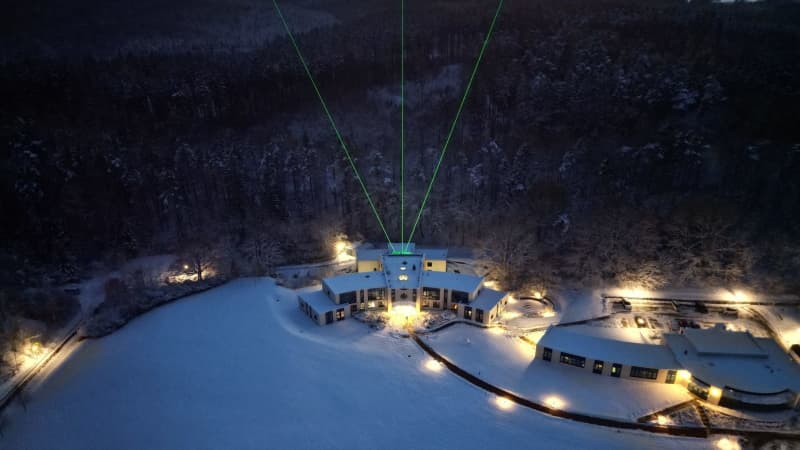
Researchers have detected measurable traces left in the upper atmosphere when a rocket stage burns up, finding about ten times more lithium atoms than normal at around 96 kilometres, roughly 20 hours after re-entry, an international team led by the Leibniz Institute for Atmospheric Physics in Germany reports.
The study by a team led by Robin Wing, published in the journal Communications Earth & Environment in February, warns that the effects of increasing spaceflight activity on the upper atmosphere are poorly understood. The researchers ruled out a natural cause.
“Despite the important role Earth’s upper atmosphere plays in shielding terrestrial life, the consequences of increasing pollution from re-entering space debris on radiative transfer, ozone chemistry and aerosol microphysics remain largely unknown,” the authors wrote.
Scientists are keen to investigate the impact of the rapid rise in satellites and rockets being launched into orbit. They said they aimed to show that intensified spaceflight has consequences for the upper atmosphere, which shields Earth from dangerous cosmic radiation.
For SpaceX’s Starlink satellite internet project alone, nearly 10,000 satellites are currently in space, with more than 40,000 planned in the long term.
The measurement was made using a laser-based lidar method, a type of laser scanning that can map particles in the atmosphere in three dimensions. The lithium cloud was discovered more or less by chance during routine measurements.
The team observed lithium at an altitude between 94.5 and 96.8 kilometres for 27 minutes. They then used various measurement and modelling approaches to check whether the lithium could have come from natural sources.
Instead of a natural cause, all indications point to a Falcon 9 rocket stage from SpaceX that re-entered the atmosphere on February 19, 2025.
“The event garnered international attention when debris fragments, including a fuel tank, were recovered near the Polish city of Poznań,” the authors wrote. The measured lithium came mainly from lithium-ion batteries and lithium-aluminium alloys used in fuselage panels.
So far, discussion has centred chiefly on the risks to people and infrastructure from falling debris, the authors noted.
“The Falcon 9 case study on 19 February 2025 is both a harbinger of the expected increase in the number of satellite and rocket re-entry events over the coming decade and an excellent test of our ability to monitor and detect the pollution which results from the re-entry of artificial satellites.”
The researchers sent their article and underlying data to SpaceX and gave the company a chance to correct them, but received no response.
Previous investigations into the effects of burning rocket and satellite parts have focused mainly on aluminium, because it is used in large quantities in such objects.
According to a 2023 study in the scientific journal PNAS, about 10% of sulphuric acid particles in the stratosphere already contain aluminium and other metals from incinerated satellites and rocket stages. When aluminium reacts with oxygen it forms aluminium oxide, which has long been known to accelerate ozone depletion.
Many processes involved when rockets and satellites burn up have not yet been adequately researched, however.

Part of the Falcon 9 rocket enters the atmosphere on 19 February 2025. The rocket body has already broken into several pieces. Gerd Baumgarten/Nature/dpa