
The fact futures contracts for the period after the new liquefied natural gas (LNG) terminal opens have fallen is being used by the Government to indicate the market is responding in the way officials intended.
Last week, the Government announced it would impose a levy on power companies to fund the construction of an LNG import facility. It provided an indicative estimate of the levy as between about $2-$4/MWh.
Chris Hipkins delivered his State of the Nation speech at Auckland’s Wynyard Quarter on Monday. Photo / NZME
It estimated the presence of the terminal would reduce the dry-year risk that is currently incorporated into the price of electricity by at least $10/MWh. The cost of the levy minus the cost of the savings was meant to result in a net saving, reducing household energy bills overall.
However, not everyone is convinced, with Labour attacking the plan as a “gas tax” that will add the cost of a levy to energy bills without resulting in a saving. Labour leader Chris Hipkins said he would stop the terminal from being built if a contract was not signed by the time a future Labour-led Government took office.
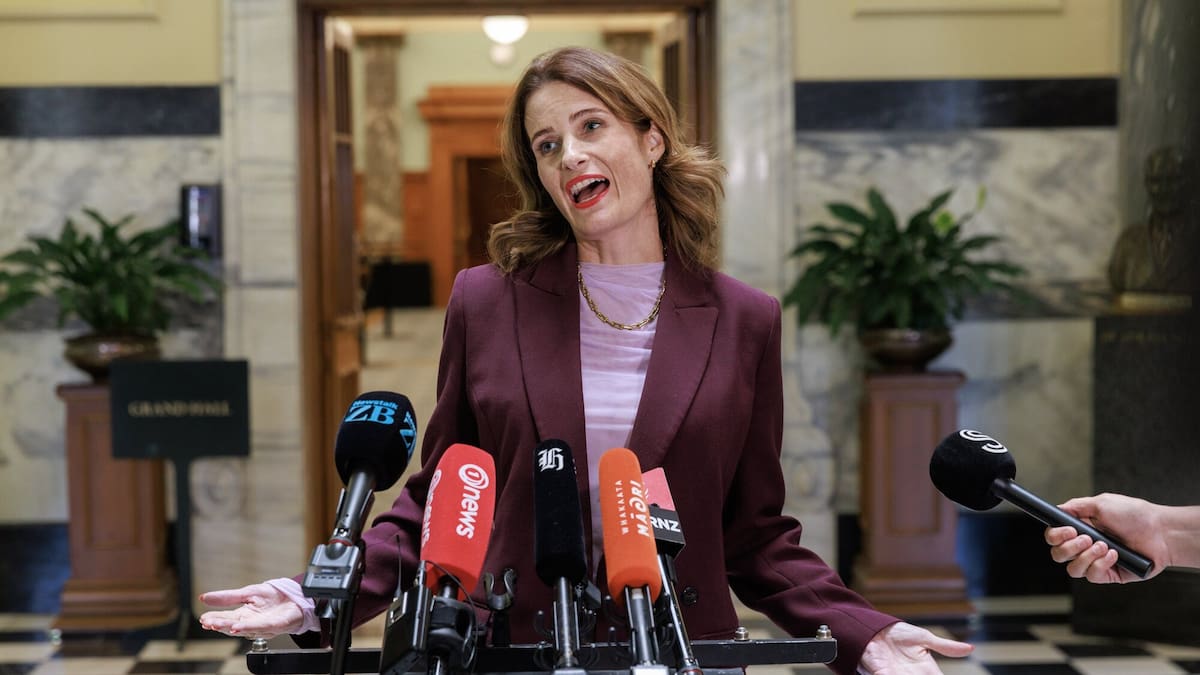
Finance Minister Nicola Willis was positive on Monday.
“Already we have seen that in response to the Government’s announcement about an LNG proposal to provide that reliable fuel supply, we’ve seen the future pricing come down and that reflects risk being removed from the equation,” she said.
Willis said it would “take some time over the coming months” to sign a deal to build the terminal.
Genesis chief executive Malcolm Johns told Newstalk ZB’s Heather du Plessis-Allan Drive that the fall in futures prices was significant “in the context of where we’ve been”.
He was less certain on whether the change was down to the LNG terminal directly, which Genesis has in the past said should only be considered as a last resort.
“I can’t relate it [the drop in prices] to any deal. There’s a lot of generation that’s being built at the moment but the more fuel resilience you have, the more certainty there is in being able to generate electricity in the future,” Johns said.
“I don’t think there’s a single lever or a single silver bullet,” he said.
Infometrics economist Gareth Kiernan said the terminal was likely to be having an effect on prices, but the influence may be overblown.
“Wholesale spot electricity prices have been very low over the last 2-3 months, even allowing for the usual lower demand levels over summer, but I noted when looking at the 2027 futures prices recently that they were still on a par with where they were in mid-late 2024 – implying that the market still expected supply constraints to be an issue over the medium term,” he said in an email.
“So given that wholesale prices have eased to their lowest levels in about 16 months over the last fortnight, it seems likely that the Government’s LNG announcement is having some effect on the market.
“However, I’d note that the effect on 2027 prices might be a bit overblown, given that the Government themselves has said that the LNG facility ‘could be operational as soon as 2027 or early 2028’, which hardly fills me with confidence that it will be up and running by winter next year.”