
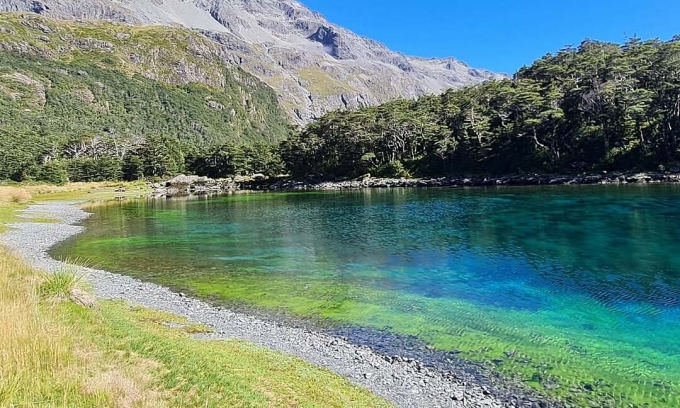
Lake Rotomairewhenua, also known as Blue Lake, sits about 1,200 meters above sea level in Nelson Lakes National Park, New Zealand, and is considered sacred by the local Maori community for its vivid blue color.
A 2011 study by New Zealand’s National Institute of Water and Atmospheric Research (NIWA) found underwater visibility in the lake can reach up to 80 meters, approaching the theoretical limit of pure water. According to IFL Science, this clarity makes it the clearest known freshwater body and even clearer than most marine waters.
“There may well be other systems somewhere in the world that are comparable but there’s not very much wriggle room between the clarity of Blue Lake and pure water,” Dr Rob Davies-Colley, principal scientist at NIWA, told the Nelson Mail. “If there’s anything else in the world clearer, it could only be very slightly clearer.”
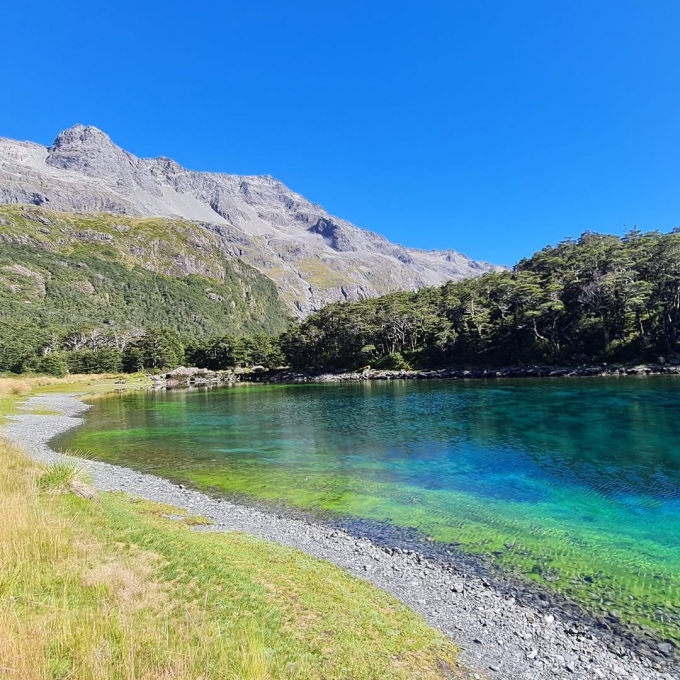
Lake Rotomairewhenua, also known as Blue Lake, in New Zealand. Photo from Instagram
The title of “clearest lake in the world” and widely shared landscape photos have turned the site into a popular tourist destination. Conservationists and local communities now fear the increased popularity could threaten the lake’s purity.
Their biggest concern is the spread of lindavia, a microscopic alga colloquially known as “lake snow” or “lake snot” for the slime it creates just below the water’s surface. The alga is already present in nearby lakes downstream of Rotomairewhenua and could be carried along hiking trails on boots or in water bottles, according to CNN.
For saltwater, identifying a single clearest location is more complex. According to IFL Science, several candidates have been proposed, including the Weddell Sea in the Southern Ocean around Antarctica, where underwater visibility reached 79 meters in a 1986 experiment.
Satellite observations provide another perspective. In 2017, NASA analysis of satellite imagery indicated that a region in the South Pacific contains the most expansive and intensely blue waters on the planet.
The area lies at the center of the South Pacific Gyre, a vast system of swirling currents that suppress biological growth by pushing nutrients such as nitrogen and phosphorus into deeper layers where photosynthesis cannot occur. With little life present, the water appears a pure, deep blue.