
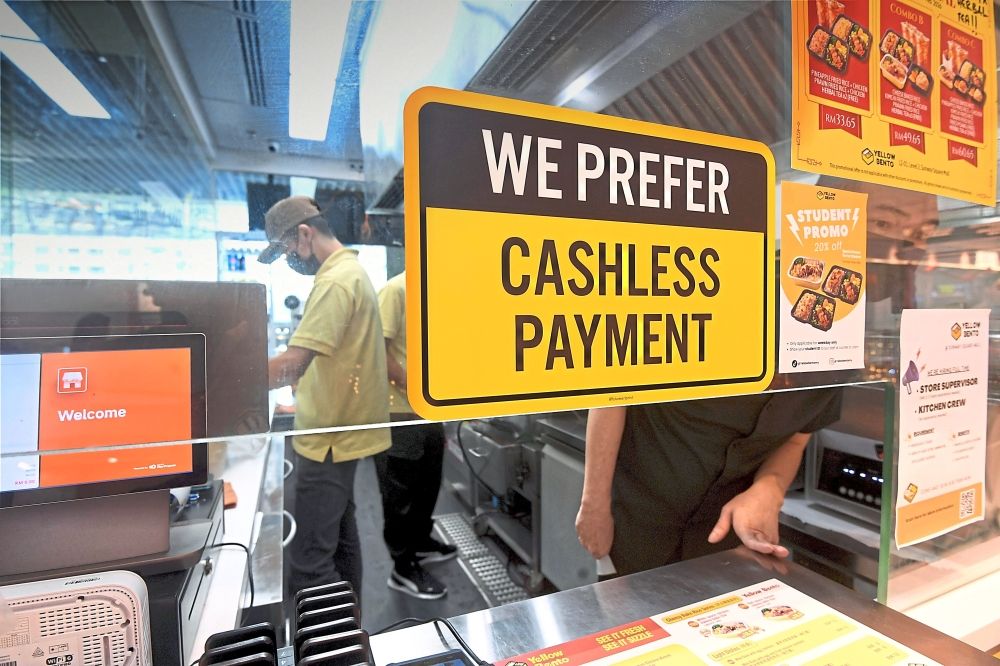
PETALING JAYA: As more Malaysians opt for e-wallets over physical cash for their daily needs, the Association of Banks in Malaysia (ABM) is anticipating a further surge this year in the adoption of cashless payments.
Citing data from the Bank Negara Malaysia Annual Report 2024, ABM said e-payment transactions increased by 28% to 14.7 billion transactions compared to 11.5 billion transactions in 2023.
“We anticipate further growth in 2026,” ABM told The Star yesterday.
According to ABM, e-wallets have become the primary mode of payment for a wide range of daily activities, including food and beverage purchases, retail transactions, online shopping, tolls, parking, and bill payments.
While younger adults remain the most active users due to their comfort with technology, ABM said adoption among older age groups is steadily rising.
ALSO READ : Consumer habits shifted after Covid-19 pandemic
“With simpler interfaces, stronger security features, and greater familiarity with digital services, more senior citizens are expected to adopt cashless payments over time,” it said.
To stay safe, ABM advised consumers to enable multi-factor authentication and biometric verification, and to avoid conducting financial transactions over unsecured public WiFi.
“Download apps only from official app stores, regularly update operating software on devices and applications, and monitor transaction alerts to report suspicious activity immediately,” it added.
Wise product manager Yee Won Nyon said Malaysia is the company’s fastest-growing market in the Asia-Pacific region.
“The momentum is driven by a combination of factors: a young, digitally-native population, strong smartphone penetration, and a regulatory environment that has been genuinely progressive in encouraging fintech innovation,” Yee told The Star.
However, Yee said one of the major hurdles in e-wallet adoption is the inclusion of hidden charges, which tends to frustrate most Malaysian users.
ALSO READ : No online fraud risks! Cash still king for older generation
“Wise’s own research found that Malaysians lose between RM200 and RM350 per overseas trip to exchange rate markups they never see, even after spending days hunting for the best travel deals,” he said.
Yee also said access remains a challenge in cashless adoption in rural areas, and though adoption of cashless services is growing in remote places.
“The fundamentals like smartphone access, reliable connectivity and financial literacy are improving, but unevenly.
“What gives us optimism is that the use cases most relevant to rural Malaysians, particularly remittance and cross-border transfers for families with members working abroad, are one of the strongest drivers of digital financial adoption,” he added.
Centre for Market Education chief executive officer Carmelo Ferlito said physical money must remain fully acceptable for transactions, as refusing cash altogether raises institutional and legal questions.
“From a broader economic perspective, a healthy monetary system should allow the plurality of payment methods.
“Some individuals value privacy. Others prefer budgeting discipline through physical cash. Some may distrust digital systems or face technological barriers.”
Malaysian Association of Money Services Business president Datuk Seri Jajakhan Kader Gani said that despite the growing use of e-wallets, demand for physical cash is still strong.
Jajakhan said money changers have the necessary mechanisms to protect themselves from unscrupulous individuals who would attempt to exchange counterfeit notes.
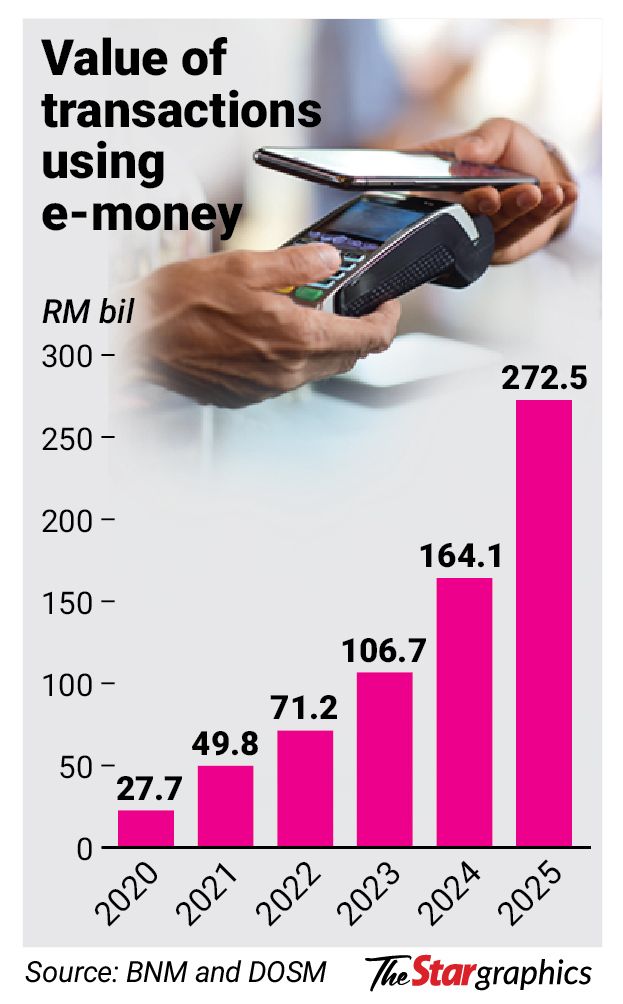
Between 2022 and 2025, the amount of e-money transacted had almost quadrupled in value from RM71.1bil to RM272.5bil.