
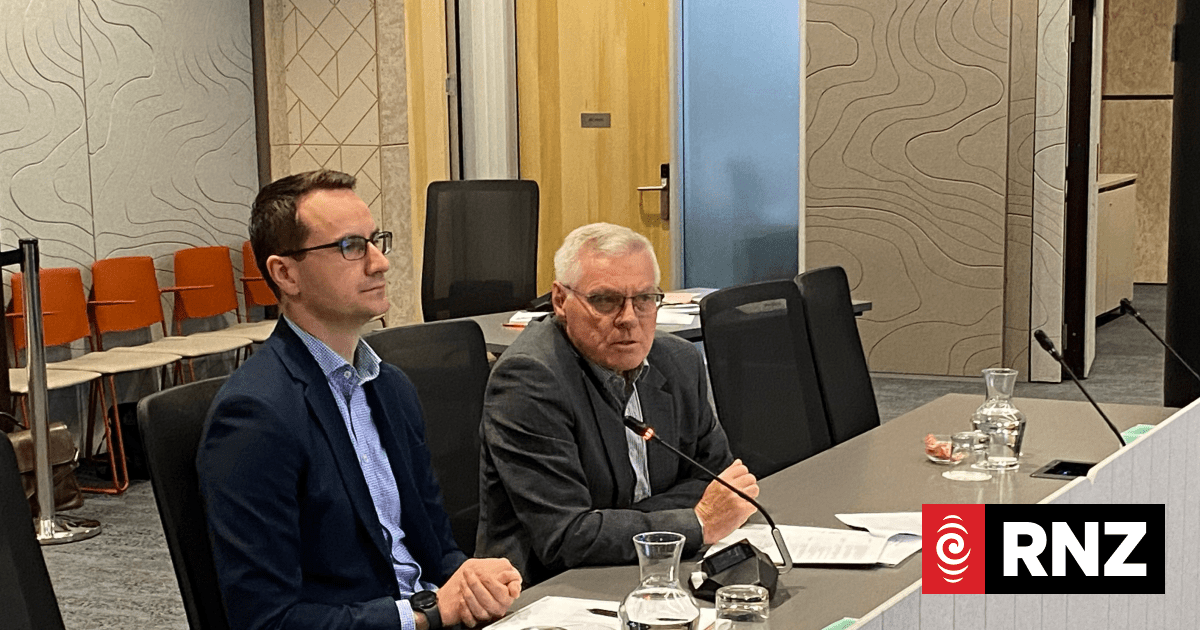
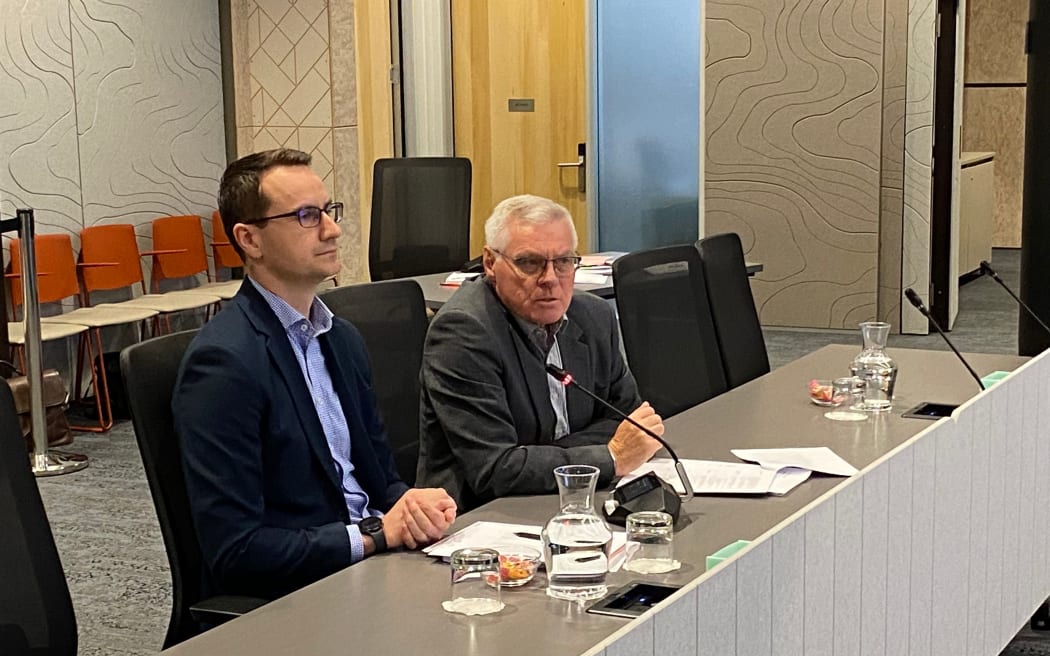
Electoral Officer Dale Ofsoske (right) addresses Whangārei District Council’s meeting this week supported by fellow electoral office Ben Roser (left).
Photo: LDR / Susan Botting
A top elections specialist says a government inquiry must get to the bottom of major electoral roll anomalies during the 2025 local election.
Chief electoral officer Dale Ofsoske said roll anomalies had resulted in electors – most of whom were Māori – missing out on getting their voting packs.
Ofsoske made the comments at a Whangārei District Council (WDC) meeting on Tuesday, ahead of the Friday deadline for submissions to Parliament’s Justice Committee as part of the inquiry.

Ofsoske criticised the Electoral Commission, which maintains the rolls, in the wake of the issues.
However, the head of the Electoral Commission has rejected the criticism and said there were no anomalies or unusual patterns with people’s enrolments.
The Justice Committee’s inquiry into the 2025 local elections will look at the voting processes.
This includes reports of people being removed from rolls or switched between them, and the number of disallowed special votes.
Ofsoske said the Electoral Commission must answer the “burning question” as to why there had been roll anomalies which saw many people left out of voting.
“We were very surprised and a little upset actually,” Ofsoske said.
“Right across the country we had instances of electors who were on the preliminary (electoral) roll and they had their letter sent out by the Electoral Commission and all of a sudden, they were removed from the final roll by the Electoral Commission.
“And because they were removed from the final roll, they did not receive their voting packs in the post.
“We had a number of those.”
Ofsoske has been working in the sector for 30 years, providing election services to around half of councils including Northland’s four – Whangārei, Far North and Kaipara district councils and Northland Regional Council.
His business was among those impacted by electoral roll anomalies, he said.
Ofsoske said he had seen the Electoral Commission regarding the matter but had not received answers.
He said the select committee inquiry meant the commission would have to explain, before Parliament, why a number of electors – most of whom were Māori – were on the preliminary roll but were removed and put on the dormant roll – “or worse even put on to the general roll”.
Electoral Commission chief executive Karl Le Quesne rejected Ofsoske’s criticism.
“We did not see anomalies or unusual patterns with people’s enrolments in the 2025 local elections,” Le Quesne said.
Le Quesne said there were more than 710,000 enrolment updates processed for last year’s elections.
“Preliminary rolls were supplied to councils and election providers on June 24, the final rolls on August 1 and (updated) supplementary rolls on October 10 and 14.
“There were always roll differences between preliminary and final rolls. This was mostly because people had changed address,” he said.
The commission sought to contact all electors whose initially distributed voting correspondence was returned, he said.
Those who could not be reached were put onto the dormant roll, until electors updated their address.
Le Quesne said the commission had worked with Ofsoske “for a very long time” and both had a good relationship.
The commission got in touch with Ofsoske after being approached by Local Democracy Reporting Northland for comment.
Le Quesne said the commission had given an explanation of its processes to electoral service providers before the local elections, and assurances these were followed.
Whangārei District Council Māori Ward councillor Deb Harding said she wanted answers after the 2025 local election issues.
“We did have a lot of members, residents not satisfied about the roll situation where they were on one (electoral) roll and went to go and check, and they were on another (electoral) roll,” Harding said.
Le Quesne said a new rule brought in at the 2025 elections may have caused issues.
He said Māori electors got to choose whether they were on the Māori or general electoral roll.
The commission did not put Māori electors onto a specific electoral roll by default, nor did it change which roll Māori electors were on without their permission.
Māori electors were able to change rolls at any time – except in the last three months before local elections.
Le Quesne said the commission processed electoral roll change applications received during this window after the 2025 local elections.
This new rule “may have caused some confusion”, Le Quesne said.
Voting on the future of Māori electoral areas was a major focus for many councils at the elections.
There were widespread efforts to get Māori and other electors onto the electoral roll so they could vote in council referendums on Māori wards.
Around 40 percent of Northland’s population identifies as Māori.
Far North District Council voters chose to keep their Ngā Tai o Tokerau Māori ward at the 2028 local election.
Northland Regional Council voters by a very slim majority voted to get rid of their Te Raki Māori Constituency.
Whangārei District Council voters too chose to get rid of their Whangārei Māori Ward.
LDR is local body journalism co-funded by RNZ and NZ On Air.