
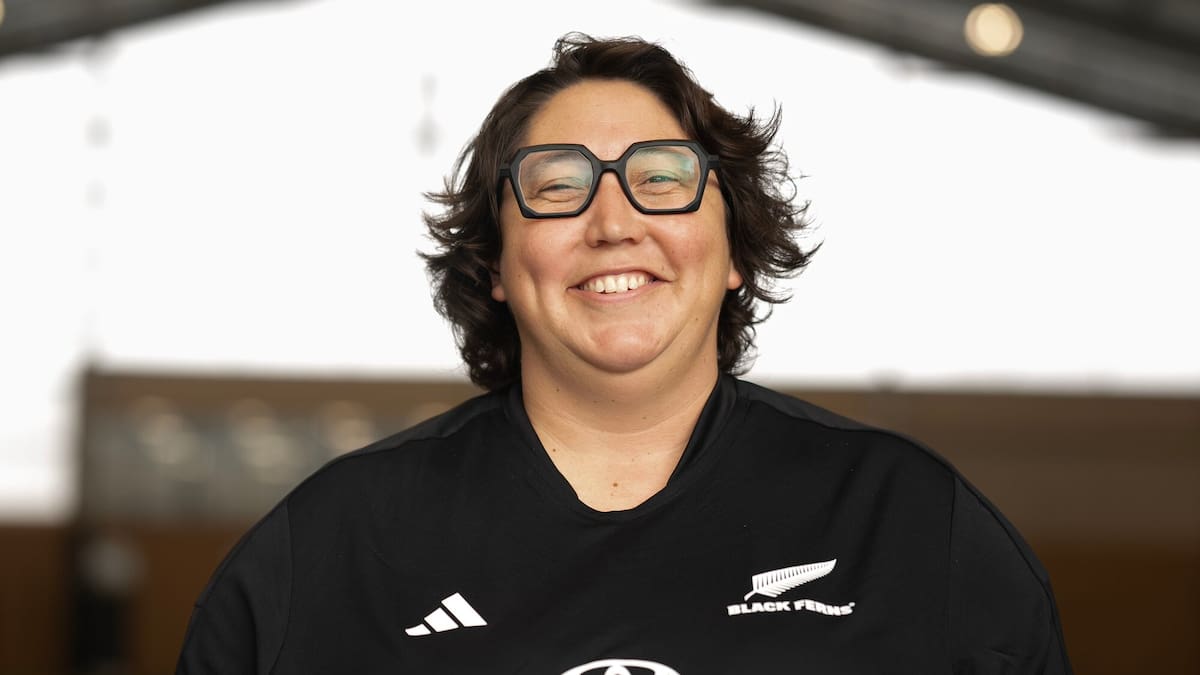
“The coach would probably tell you, centre back and I’d say midfield; every now and again, striker. But that was in an era where they sort of didn’t move too much at the end, right?” Hansen quips, her delivery dry as the Canterbury Plains.
Her story is a familiar one to many women in rugby: growing up in another code before being convinced by a mate to come to a rugby training in her early 20s. Hansen ended up playing 100 games for the Canterbury University side and a handful of seasons for the Canterbury FPC team.
“I was very much a player coach at the end of it, but at the beginning I was just a player-learner.” says Hansen.
Whitney Hansen: “We have a real opportunity to be courageous and look at some young talent.” Photo / Photosport
Luckily her club was full of legends. Black Ferns flanker Olivia Coady and lock Kim Smith were among those who took the No 8 under their wing. When she eventually hung up her boots in 2018, it was another Black Fern that gave Hansen a proper push into coaching.
“We had some amazing coach educators around at the time: Jimmy Sinclair and Blaire Baxter. They’d come out and see me do some coaching, and I knew that they had my back to support around all the things that I didn’t have. But to be honest, the biggest influence on that was Kenj.”
The endorsement of the Black Ferns stalwart, Kenj – aka Kendra Cocksedge – was the vote of confidence that Hansen needed. She took on the Canterbury under 18-girls team in 2018 and a year later was already knocking on the door of high performance when she joined the Black Ferns development team.
“When we went over to that Oceania tournament, we had a Black Ferns assistant with us. So it was kind of like a co-coaching mentality,” explains Hansen. “It was a safe space to grow, but then also a space to be able to go ‘you can do this’, which was hugely powerful on my journey.”
This is the part where Hansen’s story diverts from what has been the traditional experience of women in coaching. The 32-year gap between women leading the Black Ferns highlights the opportunity chasm that has existed for many other ambitious coaches. Bridging this has taken targeted intervention, programmes like New Zealand Rugby’s Ako Wāhine, Sport New Zealand’s Te Hāpaitanga and World Rugby’s Internship programme, which was tied to the target of 40% women coaches at Rugby World Cup 2025.
All of these programmes Hansen went through but unfortunately Ako Wāhine has since been repurposed to target level-1 coaches and New Zealand Rugby opted out of the internship scheme at the past World Cup.
At the same time though, new rungs have been added to the high-performance ladder putting new opportunities within reach. The U18 New Zealand camps led to a North v South match last year, the Black Ferns XV side is now firmly established and there are rumours of an emerging under-20s scene.
As the ground continues to shift, Hansen knows she has a role to play in developing the next wave of coaches.
Whitney Hansen coaching as part of the Kia Manawanui programme. Photo / Photosport
“First and foremost, my role is to make sure that this team and our people go well, right?” says Hansen, “But something that I’m exceptionally passionate about is sending the elevator back down.”
Hansen is just getting started but the clock is already ticking. Her contract is up at the end of 2027, half-time in this World Cup cycle. At that point, NZR will make the call on reappointment, but first up she’s already facing a big challenge: preparing the Black Ferns for the Pacific Four Series (PAC4) with the majority of the team having not played since last year’s World Cup.
“There’s a piece here around the structure of the calendar changing but it’s also the athlete that’s in front of us that’s changing,” says Hansen.
“In this first six months and in this journey into PAC4, we have a real opportunity to be courageous and look at some young talent. It’s not going to be hard and fast, ‘that’s who we take to 2029′, but I think we will have a really clear picture going into 2027 that we would have tried some things.”
For Hansen though, it’s not about starting from scratch as she believes that some of the rugby played at the last World Cup was “actually pretty epic”. Her difference in opinion is perhaps most clearly defined in the role that DNA plays in the team. It was a term we heard a lot during last year’s campaign and it’s a word that Hansen is wary of.
Whitney Hansen in her playing days taking on Bay of Plenty’s Tamia Dinsdale. Photo / Photosport
“What I will say about DNA is it’s a funny word that we use sometimes. Great when you talk about standards, habits and things that we want to keep the same.” explains Hansen, “DNA is also a dangerous word, because fundamentally, DNA doesn’t change.”
It’s clear Hansen wants to bring change to the Black Ferns. She’s at her most animated as she talks about her plans for the rugby itself.
“I’ll give you the high level and then you can wait to PAC4 for the rest,” she laughs.
Hansen is ready to hit the ground running with a four-point plan for her Black Ferns team. The first is a reflection of where the game has grown internationally combined with what we do best.
“We want to be unpredictable. We’ve got to have different systems that we use because the international women’s games evolved. So we can’t have one type of way of playing.”
Along with the results of last year, this was the corner England painted themselves into in 2022. Hansen wants to learn from these examples. To be able to change the game plan, we need to build on the type of rugby players we proudly grow here in Aotearoa.
“There’s a piece here around being physically dominant. We have a type of athlete in New Zealand that the rest of the world doesn’t produce. So we lean on that.”
Young players take part in the Kia Manawanui Coaching Programme. Photo / Photosport
That’s all well and good, but to keep pace with rivals in England and Canada, Hansen needs us to level up from here by making full use of the professionalism Black Ferns XVs players now enjoy and replicating the grit the Sevens sisters are known for.
“Being relentless is something that probably every team chases, but is going to be massive for us. It’s the ability to go for a repeat effort. If we’re great, can we be great again?”
That’s the piece that was missing from last year’s World Cup. Too often brilliance was followed by a brain fart, which is why the next point is obvious.
“And last, we want to be clinical.” Still a primary school teacher by trade, Hansen is quick to elaborate. “If we unpack that word, because it gets chucked around a lot, what it’s going to mean for us is when it counts and when we’re under pressure, 90% of the time we execute what we’re trying to do.”
All of this will be music to Black Ferns fans ears. The trouble for Hansen is the role of an international women’s rugby coach currently extends far beyond the team. The feeders to international sides are still in flux as they continue to develop. So, a close eye on this evolving landscape is vital.
As Dombroski noted though, this is Hansen’s advantage. She’s walked the path to the top job through every part of the game. She’s clear on what the system needs and more specifically, what it needs from her.
“Those systems are in their infancy. So it’s supporting those to become really robust. We need people-proof systems in there, rather than [relying] on amazing people doing a good job of it.” says Hansen. “From my perspective, how do I influence that role? Making sure they are clear on what it is we’re looking for.”
Hansen knows what a Black Fern in her team needs to be. This is tied to what she believes this team could be. It’s here that Hansen articulates the vision that captures the type of ambition that may get our team back on top.
“The Black Ferns are more than a team. It’s beyond a brand. It’s a way of being and it’s something to aspire to.” says Hansen, climbing onto her soapbox. “When we talk about what that looks like and where we want to go, it’s world-leading and it’s something that stands alone.
“The standalone piece is really important to me and I know it’s something I’ve got real support from NZR around. This team has a unique whakapapa and legacy. It has amazing stories to tell and we have some amazing people that tell them. So let’s own the narrative. Let’s tell that story. Let’s not just be another team in black – we’re the Black Ferns.”
Hansen’s not just talking rugby now, she’s talking about the wider sporting world and our place in it.
“Everyone out there, not just New Zealand, but the world that looks at and goes women’s sport, look at that team, how cool is that?”
Alice Soper is a sports columnist for the Herald on Sunday. A former provincial rugby player and current club coach, she has a particular interest in telling stories of the emerging world of women’s sports.