
As more than 100 million people watched the Super Bowl, the battle for the future of artificial intelligence spilled out into a massive public arena.
In a series of viral commercials, AI upstart Anthropic broadcast to football fans that they should avoid AI with ads. The commercial was obviously targeting OpenAI, which plans to add ads to ChatGPT. Anthropic’s bot, Claude, will never have ads, it says.
In one of the Super Bowl slots, a short man asks a representation of an AI assistant how to get six-pack abs. The super supportive AI trainer says he has a workout plan for the man before abruptly pivoting to a pitch for height-increasing insoles.
Sam Altman, co-founder and chief executive of OpenAI, fired back on social media, calling the ads “clearly dishonest.”
The public spat between the dueling San Francisco companies showcased an intense rivalry between OpenAI and Anthropic as they go head-to-head in a battle that could shape the technology’s future. While both companies are still very young, their grappling could emerge as the next big clash between brands like IBM vs. Apple, Coke vs. Pepsi or McDonald’s vs. Burger King.
While there are other AI behemoths — including Google, Meta, Microsoft, Amazon and others — OpenAI’s tension with Anthropic is telling because it stems from their shared origins and different philosophies.
OpenAI has historically favored quick, free, public releases of its latest AI models, such as ChatGPT. It believes that feedback from many users helps improve its models and make them safer.
Anthropic, co-founded by Dario Amodei, who left OpenAI in part because of its direction, says it is taking a more cautious approach. It says it is focusing on how to build AI products slowly and safely. It tries to control who gets the latest tech before unleashing it on the masses.
That difference in stances — OpenAI’s need for speed versus Anthropic’s stress on safety — has helped trigger the tension. Experts say OpenAI seems more likely to push boundaries with broad public access, while Anthropic initially prefers incremental steps through partnerships. Each wants to steer the conversation on what responsible AI will mean.
Of course, it is also a fight for market share in a fast-growing, multibillion-dollar industry. The two companies are competing for corporate and retail customers. They both want to be thought leaders and revenue leaders in AI.
“AI is the most consequential technology that we have ever experienced in the history of humanity,” said Tim Law, research director for AI & automation at IDC, a global market intelligence firm. “They are competing at so many different layers.”
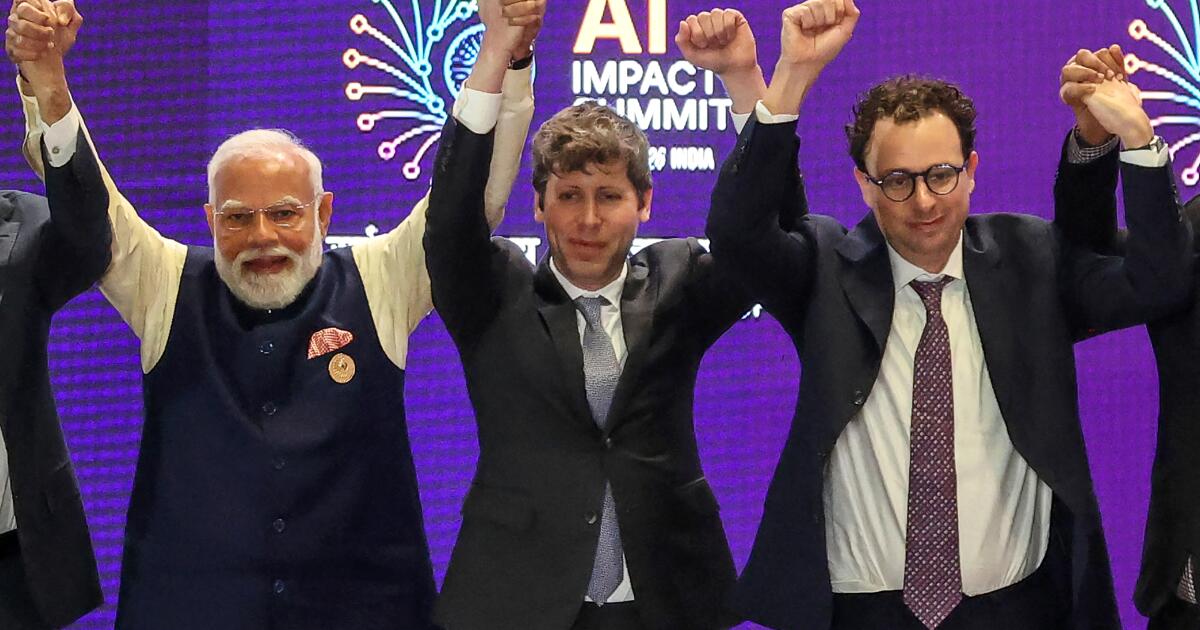
The tension between Altman and Amodei seemed to surface last week, when they were the only ones who didn’t clasp hands onstage during a group pose at an AI event in India.
Amodei and Altman also have different takes on AI’s potential to displace workers. Amodei said in 2025 that AI could wipe out half of all entry-level white-collar jobs. Altman has acknowledged technology’s role in disrupting jobs but says it can also create new, more fulfilling roles.
Amodei previously worked at OpenAI as its vice president of research. He and other OpenAI employees, including his sister Daniela, left the company to create Anthropic in 2021 because of disagreements over OpenAI’s direction.
In a 2024 interview, Amodei said he had a different vision for how AI safety should be handled, and “it’s incredibly unproductive to try and argue with someone else’s vision,” so he left.
Anthropic and OpenAI both offer chatbots to consumers. Anthropic, though, has pledged that Claude will remain ad-free while OpenAI is currently testing ads in ChatGPT.
Valued at roughly $380 billion, Anthropic is legally required to balance profit-making with advancing the company’s public benefit of “responsible development and maintenance of advanced AI for the long-term benefit of humanity.”
It makes money from enterprise contracts with businesses, government agencies, and other organizations, as well as from paid subscriptions. Its chatbot, Claude, has fewer users than ChatGPT, but developers and businesses, including Amazon, Microsoft, and other companies, often prefer Anthropic’s tools. Claude can generate code, translate languages, write and perform other tasks, but the chatbot can’t produce images.
It says it has revenue equivalent to about $14 billion a year. PitchBook estimates it has around 2,000 employees.
Anthropic is pushing for AI safety through political donations. This month, the company said it’s contributing $20 million to a group called Public First Action to “support public education about AI, promote safeguards, and ensure America leads the AI race.” The organization is advocating for greater regulation of AI’s high risks, such as its potential use in biological weapons and cyberattacks.
Anthropic faces pressure to scale back its safeguards. The Pentagon reportedly threatened to end its $200-million contract with Anthropic if the company doesn’t loosen restrictions on its AI model so it can be used for more military purposes.
The company this week dropped a vow not to release AI models if Anthropic can’t guarantee it could properly mitigate risks amid more competition. It’s unclear if the change is related to the Pentagon contract.
OpenAI’s valuation exceeds $800 billion. It has roughly 4,000 employees, according to PitchBook. The company’s chatbot can also code, write, and generate images. More than 800 million people use ChatGPT weekly for writing, brainstorming, coding and other tasks.
Initially founded as a nonprofit in 2015, the company restructured to raise more capital. While it’s testing ads in ChatGPT, OpenAI also makes money in other ways, including fees and subscription plans.
While the companies overlap in customers, OpenAI has a much broader user base that also uses ChatGPT for free, making advertising an attractive revenue source.
“The reality is that advertising is the core business model of the internet as a whole,” said Andy Wu, an associate professor at Harvard Business School. “Given the consumer focus of OpenAI, I would take the view that it’s inevitable that OpenAI has to do advertising.”
OpenAI began testing ads in ChatGPT and says conversations will remain private from advertisers.
OpenAI’s Altman said Anthropic’s Super Bowl ads illustrate how it is elitist.
“Anthropic serves an expensive product to rich people,” Altman posted on X. “We are glad they do that, and we are doing that too, but we also feel strongly that we need to bring AI to billions of people who can’t pay for subscriptions.”
Despite the jabs thrown by the two companies, industry insiders say it is healthy that these debates are spilling out into the public, though it may add to the confusion about the powerful technology and the top companies behind it.
“This is going to have significant consequences for society,” IDC’s Law said. “It could be a very disruptive period for enterprises as well as consumers as well as governments.”