
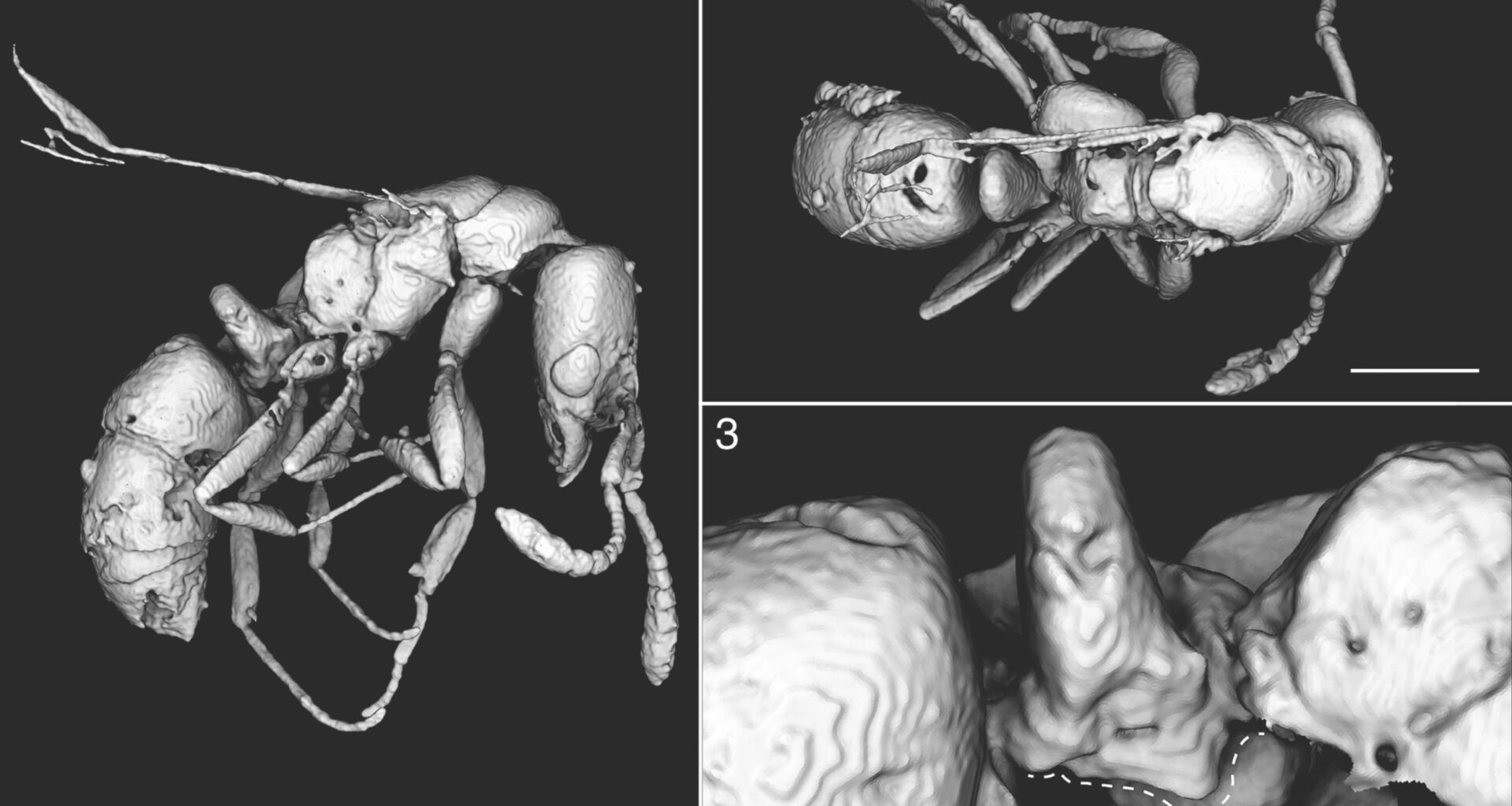
A 16-million-year-old ant queen trapped in amber has revealed the first fossil trace of her kind in the Western Hemisphere.
The discovery shows that these small ground-living ants were already part of Caribbean forests millions of years ago, widening the known history of a group that still thrives on tropical forest floors today.
Queen preserved in amber

Encased in a clear piece of Dominican amber, the winged queen preserves the same compact body shape seen in her living relatives today.
Studying the specimen, Dr. Gianpiero Fiorentino at the New Jersey Institute of Technology (NJIT) documented the defining traits that place it within that globally distributed genus.
Features of the head, mandibles, and body closely match living Caribbean species, showing that this lineage already resembled its present-day relatives 16 million years ago.
Because fossil representatives of Hypoponera are almost unknown, that resemblance raises deeper questions about how such a widespread group left so little trace in the amber record.
Clues from winged ants
Winged queens carry traits that worker ants never show, so fossil queens can confuse even experienced ant identifiers.
Unlike workers, a queen must fly and start a colony, so her body grows larger eyes and sturdier wing muscles.
Fiorentino noted that scientists study workers far more often, which makes matching a fossil queen to living species harder.
Without fossils of workers from the same group, the queen alone cannot settle every branch on the family tree.
Taxonomy by elimination
Sorting this ant group into species depends on taxonomy, the science of naming and grouping organisms.
In the new fossil, Fiorentino faced a genus that often lacks obvious markers, so experts identify it by elimination.
On one University of Utah key, the group’s plain look even earned a famous joke.
“If Ponerinae is a Mr. Potato Head game, Hypoponera is the potato,” said Dr. John Longino, an entomologist at the University of Utah.
Amber’s built-in bias
Resin oozes down trunks and branches, so amber captures many tree-dwelling insects and misses much of the forest floor.
By comparing modern resins with amber fossils, researchers measured taphonomic bias, meaning the record overrepresents some habitats.
For ants, that bias tilts toward species that patrol bark and branches, while soil hunters spend their time below.
Finding a ground-hunting Hypoponera queen in amber suggests many soil and leaf-litter ants stayed invisible in past collections.
Caribbean time capsule
Dominican amber formed when tree resin hardened, then slowly changed into stone-like material as it sat under sediments.
Warm coastal forests once covered Hispaniola, the island shared by Haiti and the Dominican Republic, and resin dripped there for ages.
Within that amber, insects froze at the moment of entrapment, sometimes keeping hairs, wings, and even microbes on their bodies.
For the Miocene, an epoch spanning 23 to 5 million years ago, Dominican amber ranks among the richest insect fossil archives.
Gaps in ant evolution
Until this queen came to light, only one fossil from this ant group had ever been formally named, and it was discovered in Baltic amber in northern Europe.
Describers first labeled that specimen in 1868, then later scientists moved it into Hypoponera as Hypoponera atavia in 2002.
Across today’s tropics, living Hypoponera includes more than 150 species, yet fossils remain rare enough to count on one hand.
That gap leaves long stretches of ant history blank, especially for small species that spend most of their lives underground.
Clues in body parts
Close inspection showed a queen that looked surprisingly familiar, with body proportions much like modern Caribbean Hypoponera.
Her mandibles, the hard jaws ants use for gripping, carried seven or eight large teeth in the fossil.
Instead of odd, ancient shapes, the head and body resembled living species already documented on Caribbean islands.
Similarity hints that some ant lineages can hold steady for millions of years, even as islands and climates change.
Digital fossil archive
At NJIT, the team used X-rays to build a three-dimensional view of the queen’s shape without cutting amber.
The NJIT scans acted like medical computed tomography, X-ray slices stacked into three-dimensional images, but tuned for a speck-sized fossil.
Digital files from the scans now sit in an open repository, letting other scientists check measurements without handling amber.
Sharing that kind of data can speed future comparisons, especially when another rare queen appears in a private collection.
Correcting the record
Modern surveys find Hypoponera in soil and leaf litter, the loose layer of dead leaves on ground, across many forests.
In one global set of 110 samples, researchers found these ants in 75% of leaf-litter collections from five continents.
Such everyday abundance makes their near absence in amber stand out, reinforcing how a single fossil can correct a skewed record.
Still, one queen cannot reveal whether ancient Caribbean Hypoponera lived on one island or spread widely.
Implications for ant evolution
A rare amber queen now anchors Hypoponera in the Miocene Caribbean and highlights what the fossil record tends to miss.
Future finds and better maps of living species will decide whether this queen marks long-term stability or a vanished branch.
The study is published in the Journal of Paleontology.
—–
Like what you read? Subscribe to our newsletter for engaging articles, exclusive content, and the latest updates.
Check us out on EarthSnap, a free app brought to you by Eric Ralls and Earth.com.
—–