
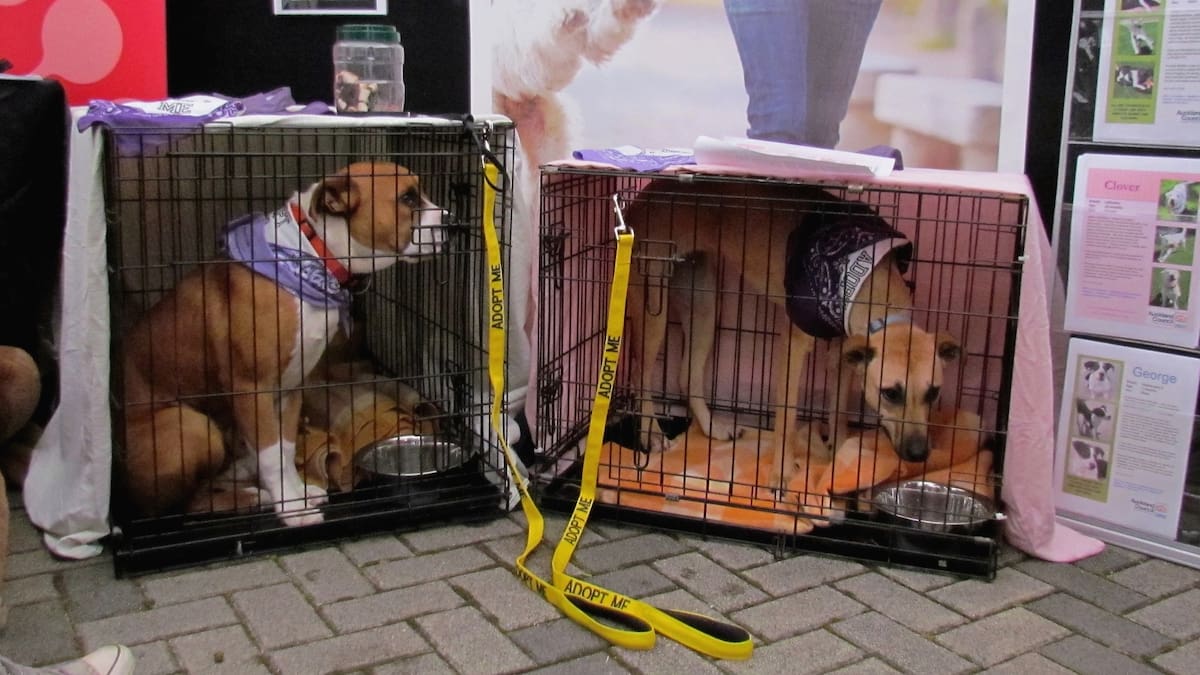
Tessa and Mia waiting for forever homes at an Auckland Council animal shelter.
Robert Irvine, Auckland Council’s general manager of licencing and compliance, said even if it takes years to get a court outcome “the dog is held in the shelter the whole time”.
Korowai, the young American bulldog cross, had been delivered to the Silverdale shelter by police after biting and seriously lacerating the face of a toddler who had climbed on him in 2020.
The Dog Control Act 1996 states that every dog whose owner is awaiting prosecution must be kept in custody and given proper care and exercise until the prosecution is determined.
In 2020 an American bulldog cross named Korowai attacked a 2-year-old. Korowai was held for three years in Auckland Animal Shelter before being put down.
As such, Korowai had to be accommodated while his owners waited more than three years for their day in court.
Shelter staff bonded with him over those years, providing training, care and enrichment every day.
“It doesn’t take long for staff to gain trust,” Cripps told the Herald. She said that Korowai “being there for so long and from such a young age” meant he became used to his routine and was happy to see the staff members who handled him over the course of the three years.
At first, Korowai’s owners loudly vocalised their intention to have him returned to them.
But as the legal process dragged on, their communication with the shelter eventually lapsed and suddenly, Korowai had become a long-term part of daily life for staff.
All 250 kennels in Auckland animal shelters are currently occupied – and 25% of those places are taken by dogs who are going through the prosecution process.
The majority of dogs going through a prosecution end up with an order for destruction.
“If there weren’t so many dogs being held in shelters at once, it would free up space for more dogs who are suitable for adoption,” Cripps told the Herald.
Last year, 10,000 dogs were brought in, and 6000 had to be euthanised.
At times, dogs for adoption have been euthanised because of the squeeze on kennel space.
Despite the best efforts of staff, “the animal shelter is not an ideal environment for dogs long-term”, according to Cripps, who said constant barking, unfamiliar smells and the overall stress of the environment can cause anxiety in dogs.
On August 16, 2024, a decision was finally reached in court: It was ordered that Korowai be destroyed.
“Obviously, staff were very upset about that decision, is the only way I can say it,” Cripps told the Herald. “The staff do understand the reason why, it just doesn’t make it any easier for them.”
A number of longer-term staff who had formed bonds with Korowai requested that they not have to be present at work on the day he was put down.
A rise in dog attacks across the country has shone a light on the inadequacy of the Dog Control Act, with councils and animal experts calling for change to the 30-year-old law.
“The law did what it needed to do in this case,” Cripps told the Herald. “It took the dog that did the attack off the streets and into our care.”
But the law still needs updating, Cripps said: “The law needs to look at how long we look after these dogs for, for the wellbeing for the dog and also for the wellbeing of staff.”
Sign up to The Daily H, a free newsletter curated by our editors and delivered straight to your inbox every weekday.