
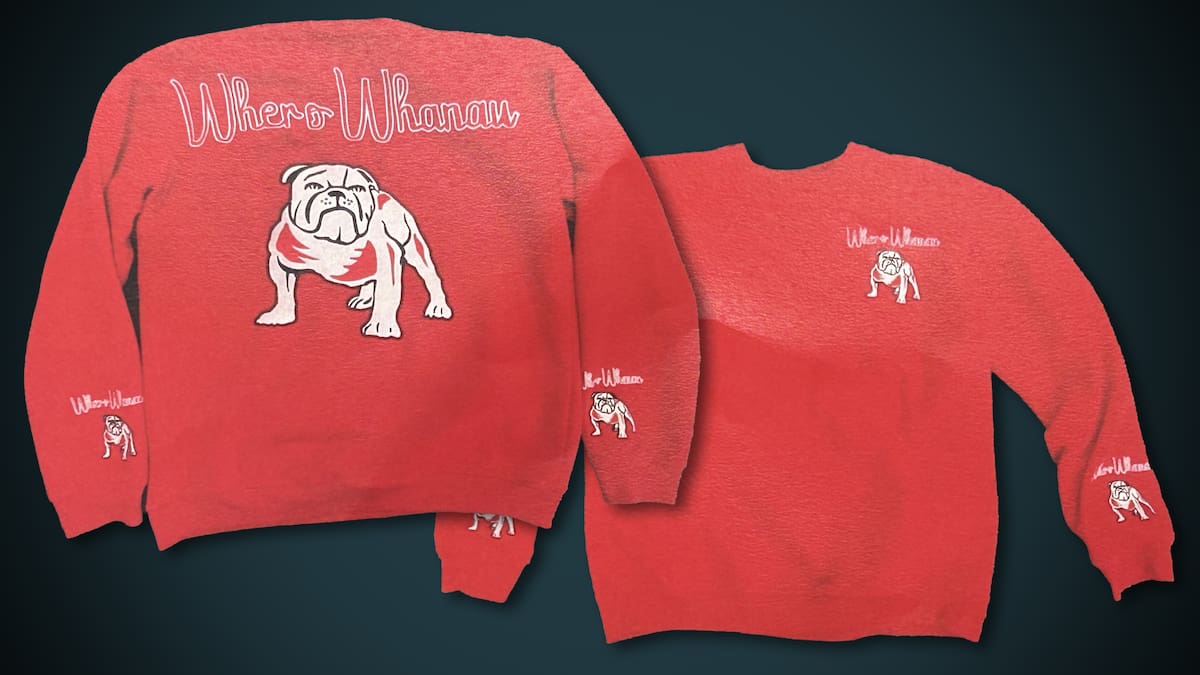
‘I don’t want to upset her’
According to the summary of facts, Kahui was caught wearing the sweatshirt in the Wellington suburb of Taitā in January as he made his way home from community work.
When arrested for wearing the sweatshirt, it was seized, despite Kahui telling police it wasn’t his.
Kahui was summoned to appear in court the following week and took the bus to Lower Hutt to do so.
But following his appearance, during which he was convicted and discharged for the sweatshirt offending, he was arrested again for wearing gang insignia in a public place.
According to a summary of facts, as Kahui got off the bus and walked towards the court, he claimed to have got hot, and, forgetting that he was wearing “an old tatty black Mongrel Mob T-shirt” underneath, the longtime gang member removed his top layer.
Barry Kahui appeared in the Hutt Valley District Court in Lower Hutt for sentencing. Photo / Melissa Nightingale
He was apparently seen on the city’s CCTV cameras in the T-shirt.
Kahui’s lawyer, Chris Nicholls, has claimed police waited until he and Kahui left court several hours later to arrest Kahui as they walked back to Nicholls’ office.
The T-shirt was also confiscated and Kahui was summoned to appear in the Hutt Valley District Court again.
That appearance, for sentencing on the T-shirt charge, was today.
During the hearing, Nicholls also advanced an application under the Gangs Act to have the earlier confiscated garment – the sweatshirt – returned to Kahui’s wife.
In an affidavit, Kahui explained why he believed it should be given back.
“I didn’t think I was breaking the law, as it was not a patch and the dog pictured wasn’t the usual image of a bulldog for Mongrel Mob, however, after taking legal advice, I accept now that it is gang insignia and that is why I pleaded guilty.”
He explained the sweatshirt held sentimental value for his wife, “and I don’t want to upset her”.
It was a theme Nicholls expanded on.
“Happy wife, happy life, it’s rather outdated now, but in my experience it’s true, Your Honour,” Nicholls told Judge Bruce Davidson.
While Judge Davidson didn’t challenge that argument, he was more troubled by Nicholls’ other submissions.
“A cold day in January?” the judge asked.
“A Wellington summer,” Nicholls responded.
He also questioned why Kahui’s wife, as the sweatshirt’s owner, hadn’t sworn an affidavit.
Nicholls explained that she expected her husband to sort the matter out, without having to get involved.
But it was the rules around community probation that concerned the judge the most, clarifying with probation staff in court that different gangs attended on separate days, and those who attended weren’t allowed to wear gang colours.
‘Deliberately provocative’
Having heard from community probation, Judge Davidson declined the application for the return of the sweatshirt, saying it was clear Kahui intended to wear it to community work.
“That was deliberately provocative, even if he did not think of it, or consider it, that way,” the judge said.
“This is far more than an innocent occasion, rather it was an occasion where he intended to wear it to a centre which assembles people on community-based sentences.
“Looked at in this way, this was more than just a display of gang insignia in public.”
Judge Bruce Davidson declined to return to sweatshirt. Photo / File
Judge Davidson declined to return the sweatshirt.
“Sadly, he will have to answer to his wife when he gets home,” the judge said.
On the recent charge of wearing gang insignia, relating to the T-shirt, Kahui was again convicted and discharged.
A potential appeal
In a statement to NZME, Nicholls said his client was disappointed by the decision and intended to appeal.
Nicholls says there was no evidence that Kahui wearing the sweatshirt was a deliberately provocative act on his part.
He claimed his client simply wore it because he had no clean jerseys, he was cold, and he didn’t think he was breaking the law.
“At the Lower Hutt Community Work Centre, there is no ban on wearing red clothing. No one going to community work that day would have been intimidated by Mr Kahui’s sweatshirt.”
Nicholls said Kahui planned to try to make up for the loss of the sweatshirt to his wife by getting her some chocolates.
Catherine Hutton is an Open Justice reporter, based in Wellington. She has worked as a journalist at the Waikato Times and RNZ. Most recently she was working as a media adviser at the Ministry of Justice.