
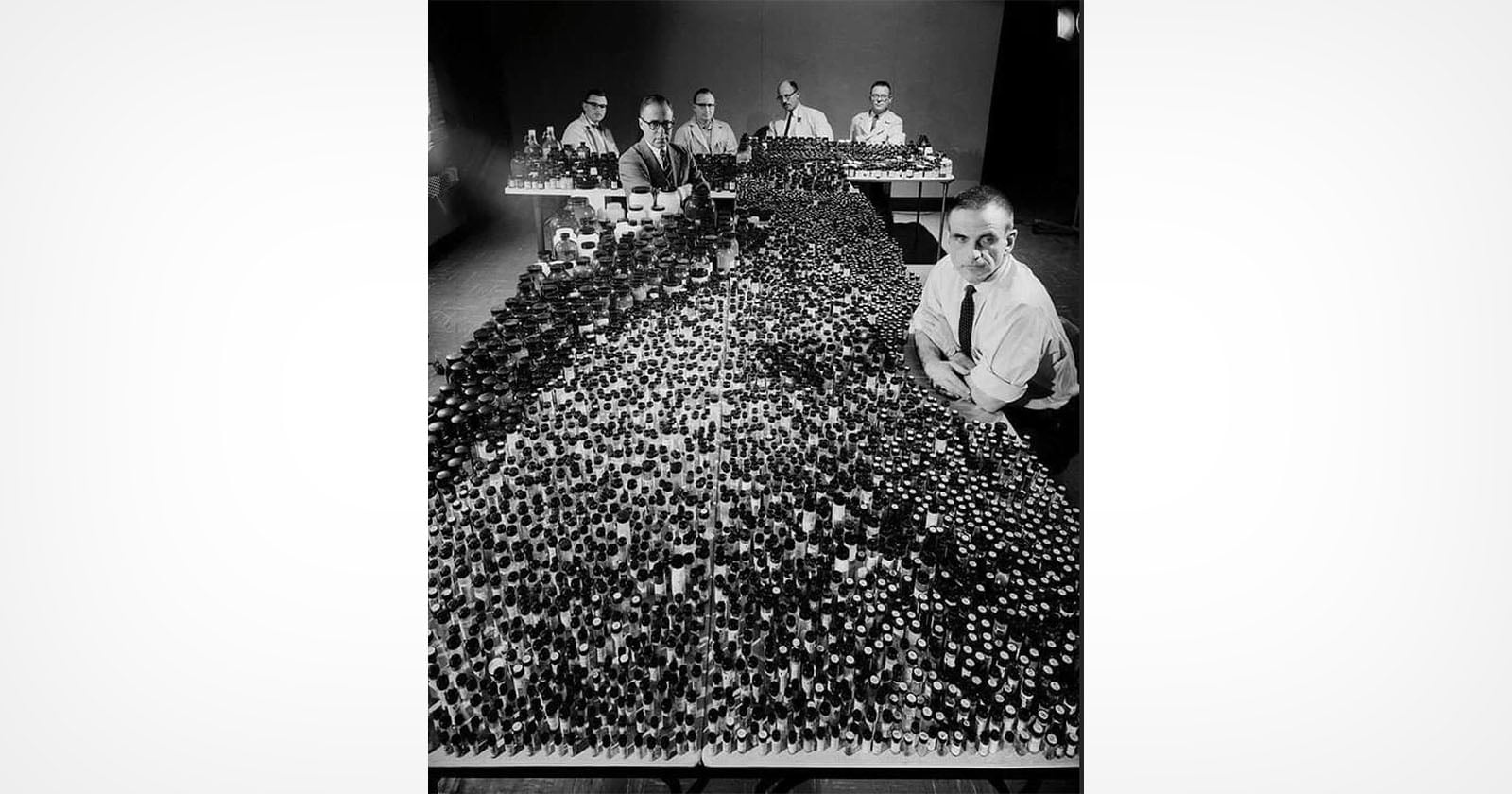
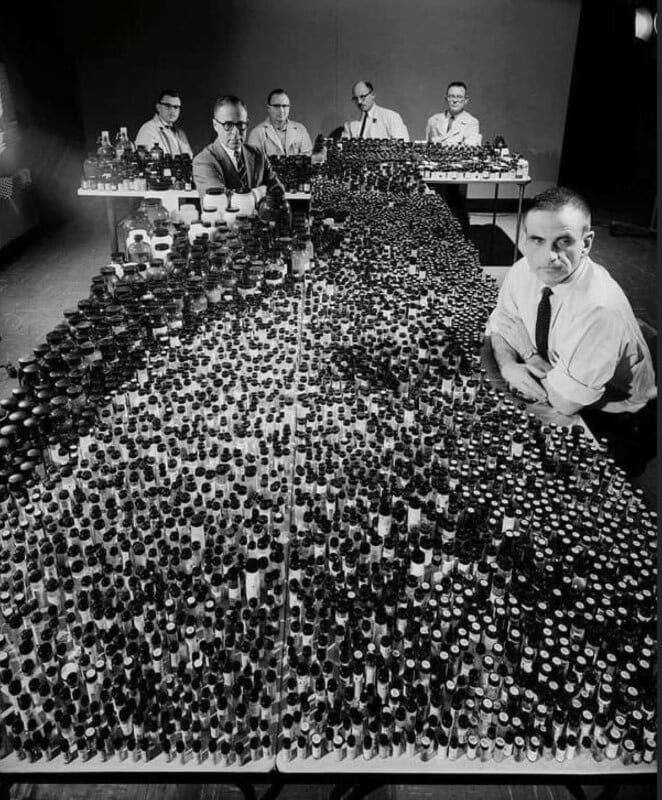
 Chemist Howard G. Rogers posing with his Polaroid colleagues and the 5,000 bottles of chemical compounds they tested to make instant color photography.
It’s a remarkable photo that frequently goes viral online: Polaroid engineer Howard G. Rogers and his team of engineers standing proudly beside an astonishing amount of chemical bottles that had been used in their attempt to crack an instant photography enigma: how to create an instant color photograph.
The photo, believed to be taken by Fritz Goro for the benefit of Life magazine in 1963, shows Rogers with the 5,000 bottles of chemical compounds that had been used while inventing the Polaroid color film process.
A Brief History
Edwin Land is the famous inventor who co-founded the Polaroid Corporation after his three-year-old daughter Jennifer asked him why she couldn’t see the photo he’d just taken of her straight away.
“Within an hour, the camera, the film, and the physical chemistry became so clear,” he later recalled of the lightbulb moment that took place while on vacation in 1943.
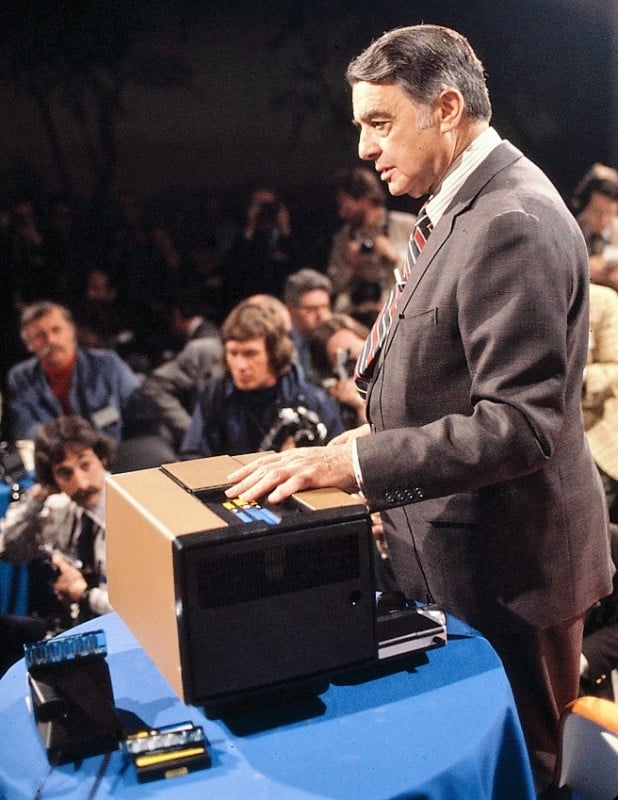 Edwin H. Land. Image by Gotfryd, Bernard, photographer, via Wikimedia Commons
Less than five years later, Land was ready to show his revolutionary Polaroid camera to the world. The Polaroid Corporation grew rapidly shortly afterward.
Bringing Color to Polaroids
As color photography became readily available via traditional photography, there was pressure for Polaroid to evolve from sepia prints to color. But as the American Chemical Society (ACS) explains, color was far more complicated than black and white.
This is where Polaroid’s Director of Research, Rogers, comes in. Via his thousands of bottles, he discovered a new chemical compound.
“Instead of using separate dye and developer molecules for each of the three colors used in film, Rogers proposed, and then led the creation of, new compounds called dye developers in which both components were tethered together,” notes the ACS.
But that process involved Rogers and his team testing thousands of new molecules and chemical reactions inside film units.
“Each color followed a separate path of development from its negative layer to the positive photographic print,” explains the ACS. “Timing of these molecular movements was crucial for proper color formation.”
After the team had solved the problem, the last hurdle was image permanence: the alkaline developer molecules, necessary for the process, transferred with the dyes to the positive layer and would immediately begin to destroy the final image.
“Finally, the team solved the problem by inserting acid molecules within a layer of polymer in the positive sheet where they would react with the alkaline developer molecules the moment after they completed the process of developing the image,” writes the ACS.
“When this happened, the acid and base combined, forming water in the film and fixing the dyes in place.”
Polaroid unveiled its color film to the world in 1963; it was a huge success.
This article is part of PetaPixel’s semi-regular feature, Historical Fridays.