
Bishop was clearly too integral to these projects to be dismissed, and so he stayed, earning gongs from the press usually reserved to a victorious prime minister (an honour which, thus far, has eluded him).
But Bishop’s 2026 has begun with double helpings of humble pie.
February saw an embarrassing backdown on Auckland’s plan change 120, which allowed intensification of the city.
The backdown is all the more humiliating for the fact Bishop was clearly forced into it by the rest of his Cabinet and caucus.
For those following along at home, that U-turned plan built on another U-turn on another Auckland intensification plan, the MDRS (don’t ask), which itself followed on from the NPS-UD (don’t ask), on which National also performed a semi-U-turned, only this time in the opposite direction – the party opposed the plan before Bishop twisted caucus’ arm into supporting it. Got that?
Bishop’s next big challenge – the Government isn’t calling it a “U-turn” – is what to do about the Government’s Roads of National Significance (RoNS) programme.
The 17 roads, promised on the 2023 campaign, were estimated by National to cost just $17.3 billion and begin construction this decade.
They’re now forecast to cost $44 to $54 billion. Something must be done.
Housing Minister Chris Bishop orchestrated a U-turn on intensification plans. Cartoon / Daron Parton
The Infrastructure Commission’s scathing report on New Zealand’s infrastructure predicament, published earlier this month, not-so-subtly urged this Government to pull back on expensive mega projects like these.
The Government quietly agrees.
Delivering the RoNS in full over the next 20 years would cost $56 billion.
Funding this entirely from petrol tax would require a one-off 70% increase, equivalent to a 49c a litre increase in petrol tax – and that would only cover the building of the roads, not anything else like maintaining the rest of the network.
The government is preparing a backpedal and signalling it very loudly – in fact, those costings and fuel tax estimate came from Bishop himself in a speech delivered to the roading industry last year, in which he promised “hard choices”.
“Not everyone is going to get what they want, exactly when they want it. Some roads won’t be starting for many years.
This is not going to be easy. But it will be worth it,” he said.
The backdown (although the Government will deny it’s a backdown and focus on the “phasing”) will come before the Budget, a fact hinted at by Treasury Secretary Iain Rennie when he appeared before the Finance and Expenditure Select Committee this year.
The Government will reveal its detailed Major Transport Projects Pipeline, or MTPP, which in Bishop’s words will be a “credible, long-term pipeline of transport projects with a variety of funding options and in a logical sequence”.
“It includes the RoNS but also major public transport projects we need to advance as well,” he said last year.
The pipeline will be ordered based on how soon projects can be started, their value, measured by the benefit-cost ratio, and corrected to ensure a fair spread of projects throughout the country.
The Government hopes the pipeline will provide certainty over who gets what and when, but it will also help justify the government’s choices to the public.
But the most politically salient fact of the MTTP will be that it will show some roads are dropped so far down the pipeline they’re effectively cancelled.
Transmission Gully a Road of National Significance. Photo / Mark Mitchell
The challenge for the Government is that what it will present will clearly be very, very different to what it promised on the campaign, which is that these roads could be started within the decade.
Worse still, the cost overruns and delays were predicted by Labour and the Greens who, on the campaign, said the costings were “breathlessly misleading” and that National was “literally billions of dollars short”. A rare example of the word literally being used properly, as it turned out.
Both parties will have a glorious “I told you so” moment prior to the Budget. The politics are complex.
These roads are popular. Even if National’s forced into a blushing backdown over their cost and timing, it’s still the only major party to promise it’ll actually deliver most of them (a promise that still stands … if the Government manages to survive a few decades).
But the projects could also show National is no better at managing cost overruns than Labour, which had terrible trouble managing blowouts the last time it was in government.
It’ll be a big set-piece for Bishop, who must also be wondering what will come of the Transport portfolio in Luxon’s forthcoming reshuffle.
Everyone thinks he’ll lose something (he’s even said it publicly), but what? Transport, a popular portfolio in National, or perhaps Housing, to signal a change in approach after Bishop’s controversial approach to reducing prices?
Labour has its own costly headache. The release this week of the report from the People’s Select Committee on Pay Equity once again shed light on the unfairness of low pay rates in vital, woman-dominated professions; it showed the cruelty of the coalition in concocting its reversal in secret, then springing it upon an unsuspecting Parliament and passing it under urgency.
The report also shone light on how Labour which has pledged to restore the old regime, hasn’t any plan to pay for it.
Protestors marching for pay equity along. Photo / Evie Thorne.
Most of Labour’s MPs know restoring the old regime will be expensive, very few have an idea of how expensive it would be.
For some perspective, at $12.8b over four years, or about $3.2b a year, reinstating the policy as it was would cost 50% more than the total operating allowance (to be spent on cost pressures across all government spending) of the Key-English Government’s largest Budget.
It’s even larger than Grant Robertson’s first operating allowance.
It would be one of the largest single operating promises made during an election by one of the two major parties, behind only Labour and National’s joint multi-year cost pressure funding for the health system in 2023.
It would cost four-and-a-half times money more than Labour’s promised capital gains tax (CGT) would raise (a moot point, as CGT money has already been allocated).
In fact, at about 0.7% of GDP, restoring the old regime would require almost the same share of national income as the Budget of Nasa at the height of the Apollo lunar programme in 1966 (about 0.79% falling to 0.5% by the end of the decade).
The challenge, in other words, isn’t just that Labour, or indeed anyone, hasn’t any plan to pay for this – it’s that few, if any, MPs have twigged to just how insurmountable a fiscal obstacle the policy is.
The “how will they pay for it?” question is therefore the wrong one.
It’s not that you can’t afford to reinstate the old regime — you can, it’s just that the trade-offs in tax rises and spending cuts are so immense, and have so little political upside, it’s very difficult to see the current “small target” Labour Party making them.
Even if Labour had the chops to raise taxes and cut spending to the extent it could reinstate the old regime, it would still have to find yet more money to promise anything else in areas like health and education.
The real question is what will Labour do to make pay equity more affordable, and do its MPs have the political and economic fluency to justify the changes.
There are some changes Labour can make. The party’s clearly laying the groundwork for scrapping or curtailing the $6.6b Investment Boost tax credit.
That gets you halfway there, but it still leaves you two CGTs away from the sum required.
There are some tax hikes Labour is looking at. Hipkins has heavily hinted at bringing back a digital services tax on tech companies worth $479m at last count, and this week on Ryan Bridge TODAY, he hinted at some specifics regarding a rumoured plan to bring back the ban on interest deductions for residential landlords.
Hipkins said after “feedback from landlords” that “removing 100% of interest deductibility was … something that we’re unlikely to do in that same way again”.
His remarks suggested restoring a 50% ban, a level favoured by the architect of the original ban, David Parker.
In an interview with the Herald on his retirement from Parliament, Parker, the architect of the interest deduction ban, reckoned the original 100% ban went “a bit far”, and said he preferred something more modest, like 50%.
While you can’t sniff at the revenue from the policy,it’s nowhere close to what Labour needs. Tweaks to the regime still need to be made, perhaps reducing the threshold at which sectors can apply to continue to exclude more male-heavy sectors like secondary teachers, or perhaps dialling back the underwrite of the funded sector claims.
Any big changes will hurt the party’s relationship with its base, but restoring the old regime as it was doesn’t seem politically possible. Even if Labour proposed a combination of big tax hikes and spending cuts to pay for the scheme, it would need even more tax hikes and spending for its health and education promises.
They’ll have some cover. Labour seems to be saving big fiscal decisions until after the Budget in order to blame the coalition for destroying the fiscals to the extent that Labour is forced to increase taxes.
It’s a clever tactic. National used a similar tactic to wriggle out of its expensive pledge to cut the top tax bracket, but it’s an obvious one, and could unravel if the Budget shows some improvement in the fiscals, as it may.
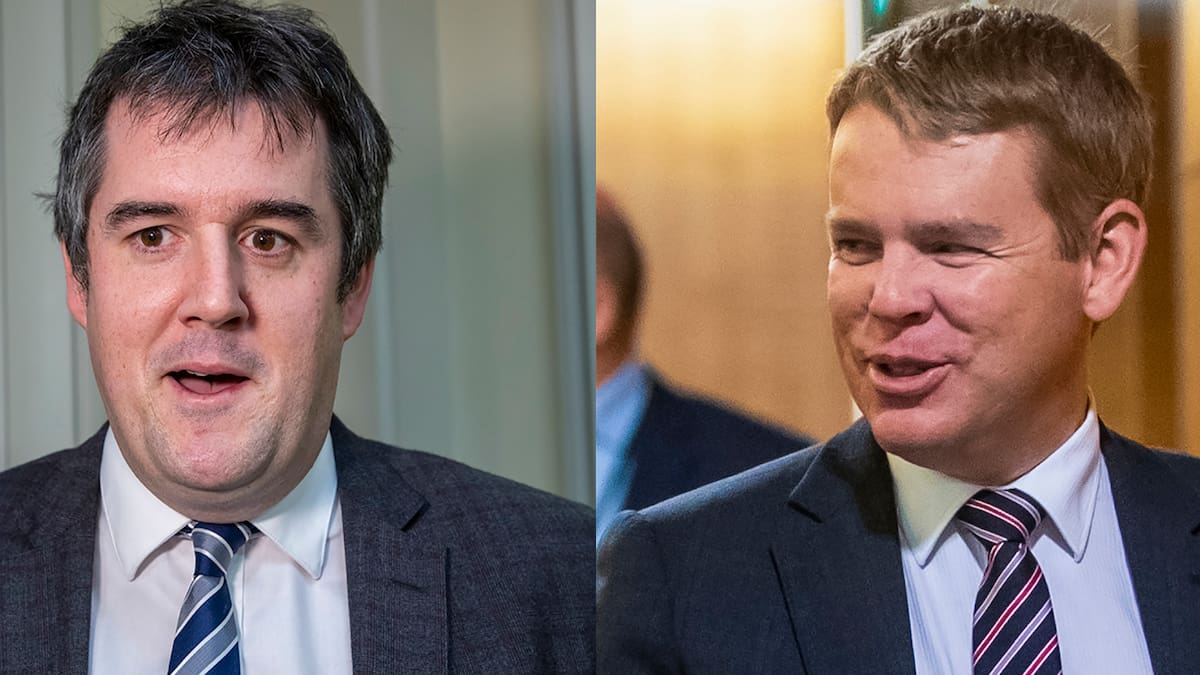
A U-turn is clearly brewing. At least the Chrisses from the Hutt can commiserate together.