
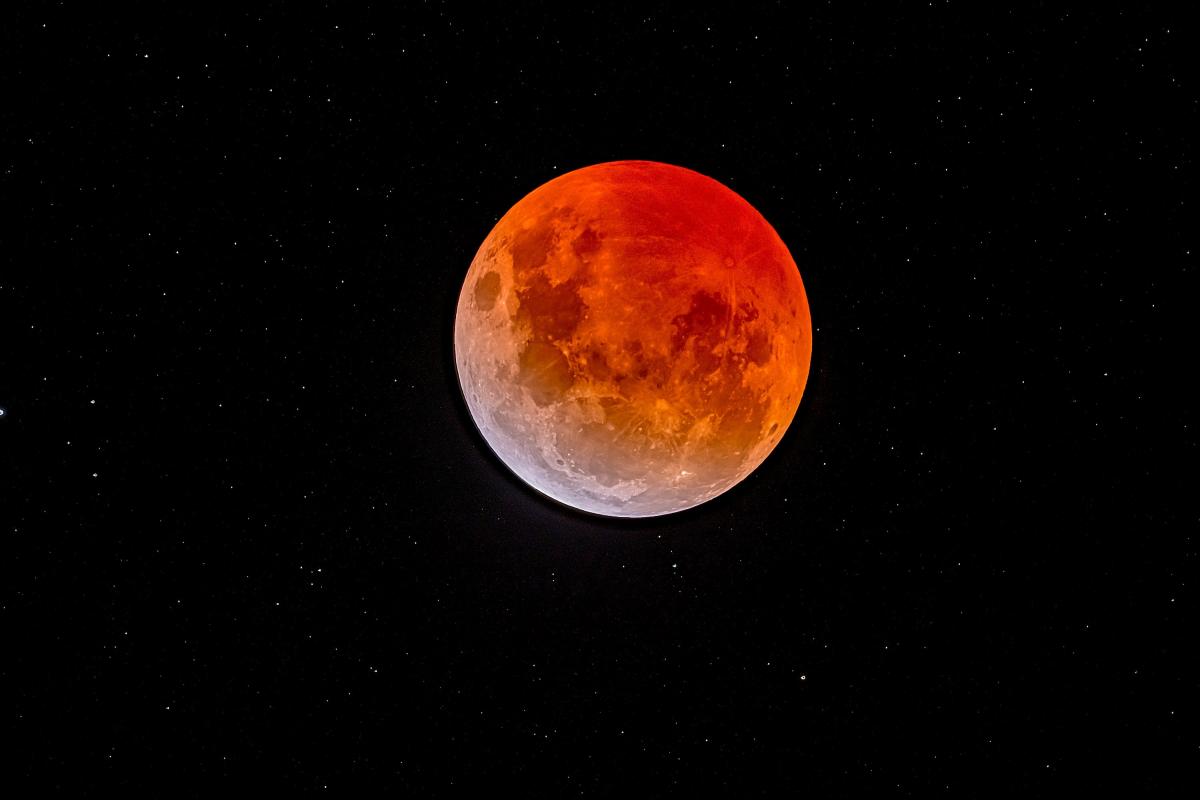
On Tuesday evening, as the last light fades over Otago Harbour and the first stars appear, something rather wonderful will begin. Quietly at first. Then unmistakably. The Moon will slip into Earth’s shadow.
This is the celestial highlight of the year: a total lunar eclipse perfectly placed for New Zealand on the night of March 3-4. We will not see another total lunar eclipse from here until December 2028.
The Moon will sit in the constellation Leo. At 9.44pm the penumbral phase begins, as the Moon brushes the faint outer edge of Earth’s shadow. You may notice little at first. Twilight will linger, and the Moon, low in the east-northeast, will look deceptively unchanged.
By 10.50pm, the real drama starts. A dark notch appears on the Moon’s edge — Earth’s umbra, our planet’s true shadow, advancing steadily across the lunar surface. Slowly, the familiar bright face is dimmed, as though someone is turning down a cosmic light.
At 12.04am totality begins. The Moon is fully immersed in shadow. It does not disappear. Instead, it glows — copper, crimson, sometimes brick-red — suspended among the stars. At 12.33am, maximum eclipse, it will hang high in the north-northeast, deep within Earth’s shadow.
Why red? Because at that moment every sunrise and sunset on Earth is projected on to the Moon. Sunlight, filtered and reddened by our atmosphere, is bent into the shadow and softly illuminates the lunar surface. The same scattering that paints our evening skies in gold and rose now bathes the Moon in subdued, otherworldly light. It is a quiet reminder that we live on a world with air and oceans — a world capable of both beauty and shadow.
Totality lasts until 1.02am. The bright limb then re-emerges. By 2.17am the partial phase ends, and at 3.23am the Moon finally leaves the penumbra. The night’s geometry is complete.
You need no telescope. Just a clear northern sky, warm clothing, and perhaps a thermos. Binoculars will enrich the colours; a camera on a tripod will record the slow choreography. But the essential instrument is patience.
On Tuesday, step outside. Look north. Watch the Moon turn red — and remember you are standing on the very world casting the shadow.