
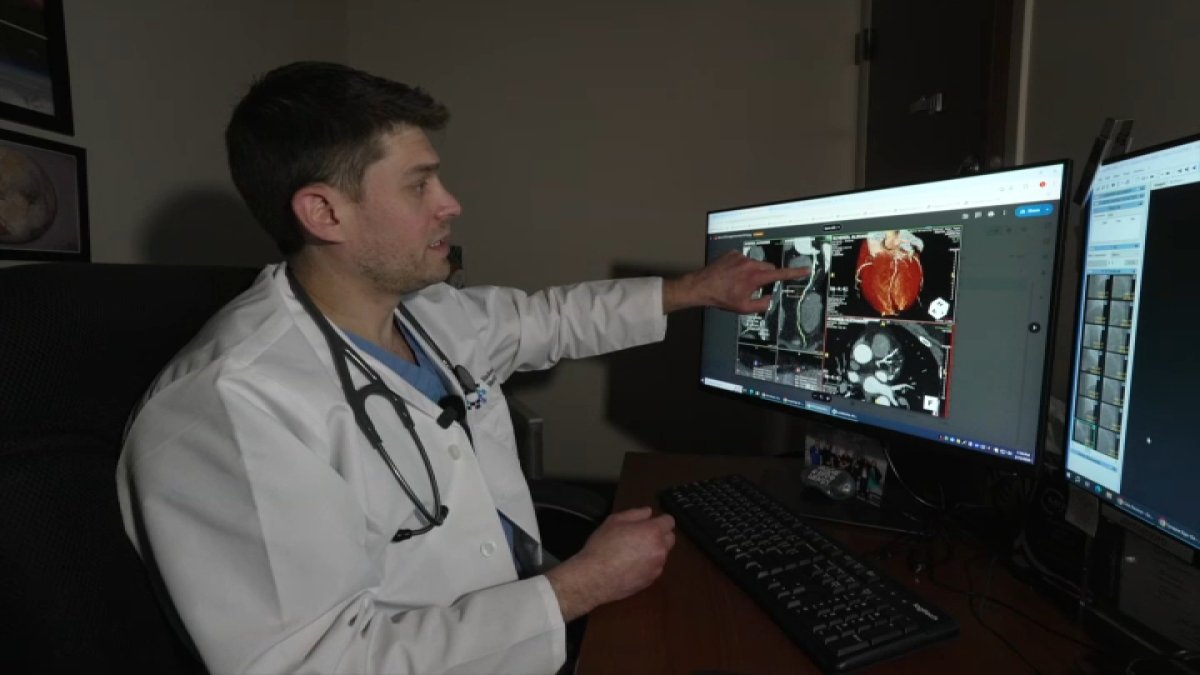
Artificial intelligence is playing a growing role in helping people improve their health and the technology along with cutting edge imaging are providing a clearer focus that could save lives.
During a long career in law enforcement, Alex Scherer has searched for answers to help solve other people’s toughest problems.
The 59-year-old retired Toms River police detective now works at the Ocean County Prosecutor’s Office and was recently confronted with a deeply personal case involving a heart-breaking legacy of loss involving his own family.
“I got very scared and concerned that, you know, I was a walking time bomb,” Scherer said.
His father and grandfather were both in their 50s when they each died of heart disease. Then, just over one year ago his sister Patricia was 68 when she passed away from a sudden heart attack.
““Her passing really made me aware of my own health,” Scherer explained. “At times my legs would swell up, get a shortness of breath going upstairs.”
Newly acquired advancements in cardiac screenings at Jersey Shore University Medical Center revealed severe blockages from calcium and plaque build up choking off blood flow in two of Scherer’s coronary arteries.
This was putting him at a high risk for heart attack.
A high-resolution photon-counting CT scanner is the first to go live in New Jersey and it helped interventional cardiologist Jeffrey Selan to pinpoint details about the location, severity and composition of the blockages.
The imaging, along with AI-assisted analysis, gives doctors critical guidance that is far more precise than traditional scans for both diagnostic tests and treatment.
“It can allow for early detection of coronary disease,” Dr. Selan said. “It serves as a phenomenal, detailed roadmap so that when we go in to the procedure, we know exactly what we’re going to be treating and what tools we’ll need to treat it.”
The scans are usually covered by insurance.
According to the manufacturer, about 20 similar photon-counting CT scanners are being used in the greater Philadelphia and New York City regions and they’re steadily becoming available at more hospitals and health care facilities.
“I think in the future, this will become the standard of care and the gold standard for all non invasive cardiac imaging,” Dr. Selan explained.