
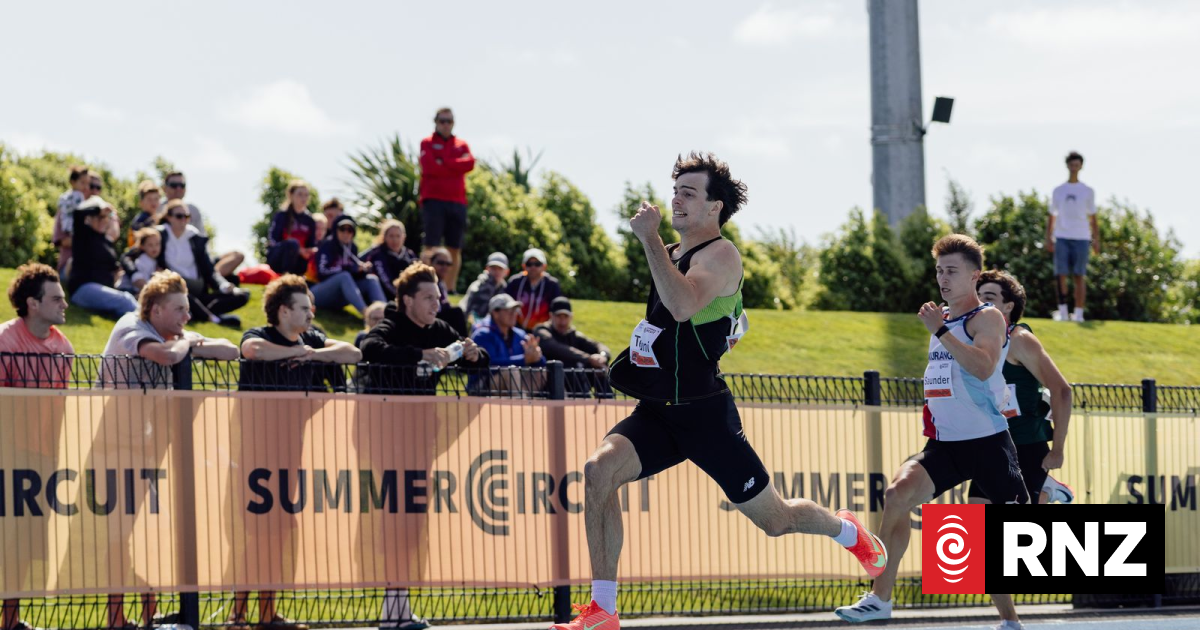
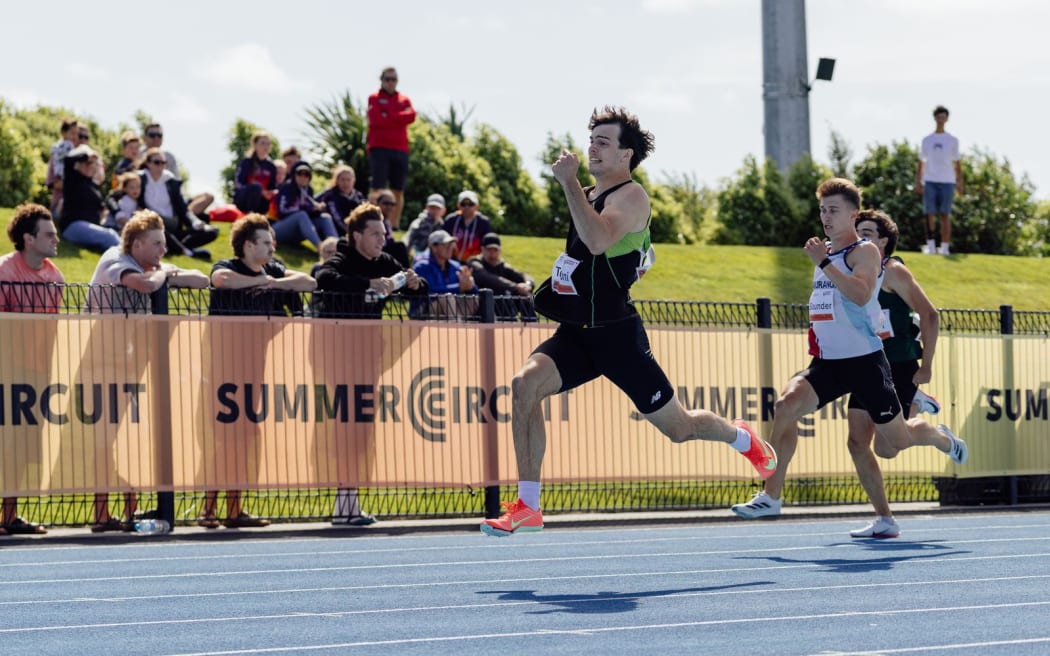
Tommy Te Puni en route to his national record.
Photo: supplied
Two years have passed, but Tommy Te Puni finally has his name in the record books.
Last weekend, the Auckland speedster claimed the national 200 metres mark, when he tore around a bend – but not THE bend – at Christchurch’s Nga Puna Wai Sports Hub and crossed the finish line in 20.35s, slicing two-hundredths of a second off the previous standard.
“It means a lot,” he told RNZ. “Coming off a bit of bad luck and a lot of injuries, it’s pretty good to get one of those on the board.
“Being a New Zealand record, it’s special, not just for me, but for all the people who have supported me, like my family and especially my coach, who sets up all the programmes, and deals with the ups and downs just as much as me.
“I’m really happy, not just for myself, but for everyone else around me that have helped me along the way.”
In November 2023, Te Puni was the victim of a timing malfunction that some believe cost him the first sub-46-second 400m by a Kiwi male at a local club meet.
Since then, he has battled a variety of injuries that have stymied his hopes of ever reaching his potential – until now.
Ironically, one of those injuries seems to have played a part in his current run of form.
Te Puni, 23, broke his foot during a northern hemisphere campaign that included the World University Games in Germany, which delayed his return to the track until the new year.
Instead of running his best times before Christmas, then hitting a wall afterwards, he is only now reaching a peak at the business end of the season.
His performance at the International Track Meet came off the back of a series of quick times over the preceding month. A 10.36s 100m personal best at the Douglas International in Auckland was followed by a solid 10.40s/20.89s double into slight headwinds at Hamilton’s Porritt Classic.
“This was the first week I actually felt fresh,” he explained. “For me, it usually takes quite a few weeks to freshen up, so even leading into Porritt, I wasn’t really feeling that good.
“In New Zealand, it’s a big thing to run 20-point, but it didn’t feel that good. I was overstriding, and I didn’t feel that fresh, so we went back to the drawing board.”
Personal bests over 150m in training had him and coach Elena Brown believing something special was near.
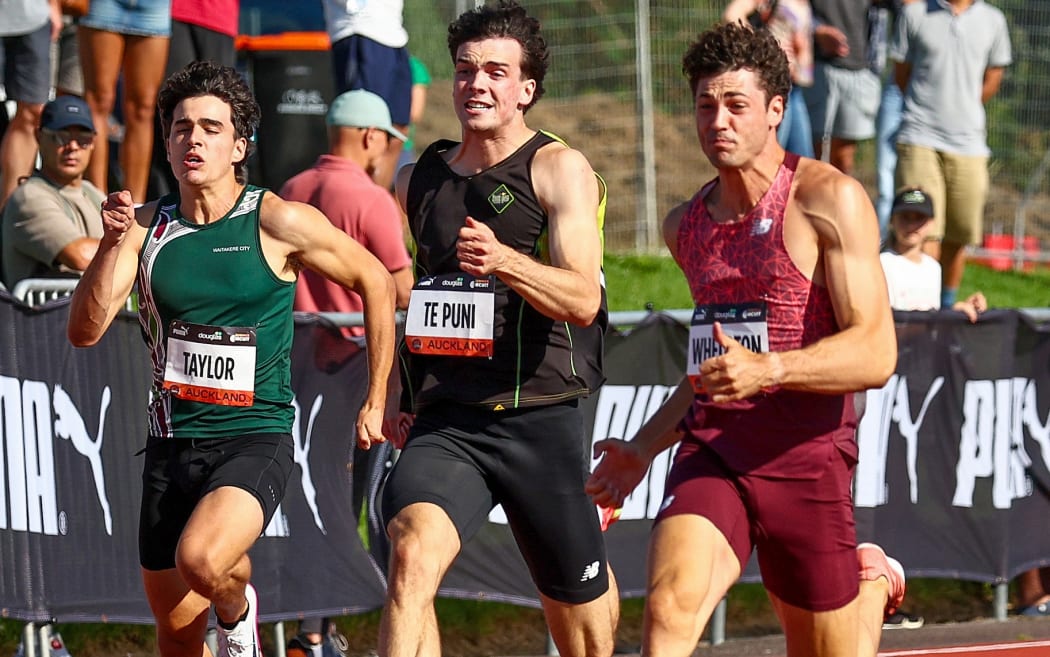
Tommy Te Puni races to a 100 metres behind Tiaan Whelpton at Sir Graeme Douglas International.
Photo: David Rowland/Photosport
“We were thinking high 20.4s was what I was showing, so 20.35 was a pleasant surprise.”
Te Puni tuned up for his record run with a wind-assisted 10.26s 100m, although wind readings only told half the story. While winner Tiaan Whelpton clocked 10.01s with a 4.9m/s tailwind, four minutes before, the women supposedly ran into a 3.4m/s headwind.
In reality, the wind was a swirling side, so meet organisers switched the 200m start to take advantage of conditions around the bend. Three years ago, they did the same for Rosie Elliott, when she clocked a 22.81s national women’s record.
The maximum allowable tailwind for record purposes is 2.0 m/s. Te Puni’s 200m wind was 1.2 m/s.
“It’s a northwesterly, a true tailwind around the bend, but not helping you too much down the straight,” he said. “You come off the curve, you slingshot and just hold that momentum through to the finish line.
“The wind is coming from a direction that it doesn’t fully hit the wind metre, which is really good.”
Te Puni’s achievement sets up the unique prospect of all three men’s sprint records falling in the same season.
Whelpton has now gone under the 100m standard twice with excessive winds, while clocking 10.10s – 0.02s outside the national mark – legally. He only needs the right wind to break the record and possibly crack 10 seconds.
Last season, Lex Revell-Lewis broke 46 seconds for the 400m (45.88s) and showed he was capable of faster still, when he clocked 10.36w/20.49s at Christchurch.
Six runners beat 10.50s over 100m at the ITM, albeit wind-assisted. In seventh, 14-year-old Vern Toaloamai-Holden recorded 10.67s.
Four runners beat 21.00 seconds over 200 metres, another slice of NZ sprinting history.
Why is NZ sprinting enjoying a resurgence?
“It’s a good question,” Te Puni mused. “I think it’s just a question of timing, when everyone’s around a similar point, but you also have trailblazers like Tiaan, trying to get that 9.99s.
“It’s inspiring for people, and you want to chase those top guys. When I ran the 200m, they’re all chasing me, but it’s not like there’s someone who’s clear and above everyone else that you lose motivation.
“There’s a bit of luck with the depth, and everyone wants to beat each other.”
For their part, meet organisers have done their best to provide optimal conditions for performances.
“I’m sure all athletes will agree with me, but when you turn up to a race and there’s no hope of them flipping the track, and you have to run into a three-metre headwind… that’s not much fun.
“If they flip the track and the wind’s blowing at three, but I might get lucky, and get a 1.5 and new PB (personal best). Psychologically, that just gets you more amped up to race.
“They did it at Cooks [Whanganui], they did it at Sir Graeme [Douglas International], they did it at Christchurch… I’m pretty sure they’ll do it for the 100s and hopefully 200s at nationals.”
A community initiative to promote national relay teams has also created a collective approach to what was previously an individual sport, while fostering competition within the squad.
Early attempts at a men’s 4x100m record have seen Te Puni miss out on the top foursome, but current form may force a selection rethink.
“It gives a lot of athletes more opportunity to potentially get onto that world stage, but it also ties into wanting to be in that team and getting that spot,” he said. “The relays elevate the competition, because you don’t want that guy or that girl to get your spot, so you want to perform the best you can.”
Te Puni hasn’t contested the 400m this summer, but wouldn’t rule out another shot at that record in the future.
.
“We’re trying to work out where to get one in, but because I only really started running at the start of this month, there wasn’t really time to fit in a 400,” he said. “We were thinking about Sir Graeme Douglas, but stuck with the short sprints, because that was where my shape was at the moment.
“We’re keen to get one in March maybe. I’m not sure, but it would be nice to run another one, because my speed is at an all-time high at the moment and that typically bodes well for a quick 400.
“At the moment, it’s just 200, especially with nationals.”
Sign up for Ngā Pitopito Kōrero, a daily newsletter curated by our editors and delivered straight to your inbox every weekday.