


Saturday, 28 February 2026, 8:04 pm
Article: The Conversation
Laura
Revell, University
of Canterbury; Michele
Bannister, University
of Canterbury, and Samantha
Lawler, University
of Regina
When we look up at the
night sky and see a satellite glide past, we might not
consider climate change or the ozone layer.
Space
may feel separate from the environmental systems that
sustain life on Earth. But increasingly, the way we build,
launch and dispose of satellites is starting to change
that.
Over the past few years, the number of
satellite launches has skyrocketed.
There are now nearly
15,000 active satellites in orbit around the Earth, most
of them part of “mega-constellations” in which each
satellite has a service life of only a few
years.
New satellites must be quickly launched as
replacements. To avoid leaving old, dead satellites in
Earth’s already-crowded low orbits, most satellite
operators deliberately de-orbit them into Earth’s upper
atmosphere.
Advertisement – scroll to continue reading
Here, they burn up or break apart into
smaller pieces: a process known as “demisability”. In
effect, satellites have become part of throwaway
culture.
That approach is now being taken to a
vastly larger scale. We are concerned about the implications
for Earth’s climate and atmosphere.
A sleeper
risk for our climate and ozone layer
Last month,
SpaceX applied
to the US Federal Communications Commission (FCC) for
permission to launch one million more satellites for untested “AI data
centres”.
That sheer number isn’t the only
issue. SpaceX’s Starlink
V2 “mini” satellites happen to weigh about 800
kilograms (kg) – roughly the mass of a small car – with
later versions expected to reach around 1,250 kg. The
planned V3 satellites are
larger still, comparable in scale to a Boeing 737
airliner.
Rocket launches already contribute to
climate change and ozone
depletion. Scaling them up to deploy a million
aircraft-sized satellites would push upper-atmosphere
heating and ozone loss far
beyond previous estimates, with the steady burn-up of
dead satellites compounding the impacts.
This comes
as burnt satellite dust is already being found in the
atmosphere. In 2023, scientists studying aerosols in the
upper atmosphere found
metals from re-entering spacecraft. Just recently, lithium
has been detected from the uncontrolled re-entry of a
Falcon 9 rocket.
This is just a fraction of what is
to come if planned megaconstellations go ahead – and
SpaceX is far from the only player. Other operators
worldwide have already asked for a
combined total of over one million
satellites.
All the while, the full
environmental consequences remain poorly understood because
satellite builders rarely disclose what their spacecraft are
made of.
Scientists assume a large fraction is aluminium,
which burns up into alumina particles, but the exact mix of
materials – and the size of the particles produced –
remains poorly constrained.
But we know the very
smallest particles, finer than a human hair, can stay
suspended in the atmosphere for years, contributing
to ozone depletion and climate change.
Following
similar assumptions to a previous
study, we estimate that a million satellites could mean
that a teragram (one billion kgs) of alumina accumulates in
the upper atmosphere – enough, alongside launch emissions,
to significantly alter atmospheric chemistry and heating in
dramatic ways we do not yet understand.
There is no
public mandate for a single company in one country to make
changes on that scale to the planet’s
atmosphere.
The consequences are not confined to
the atmosphere. Not all re-entering satellites burn up;
debris is already
hitting the ground and the chance of a casualty from
megaconstellation re-entries is now about 40% per five-year
cycle – rising for both people and aircraft
as more satellites are added to orbit.
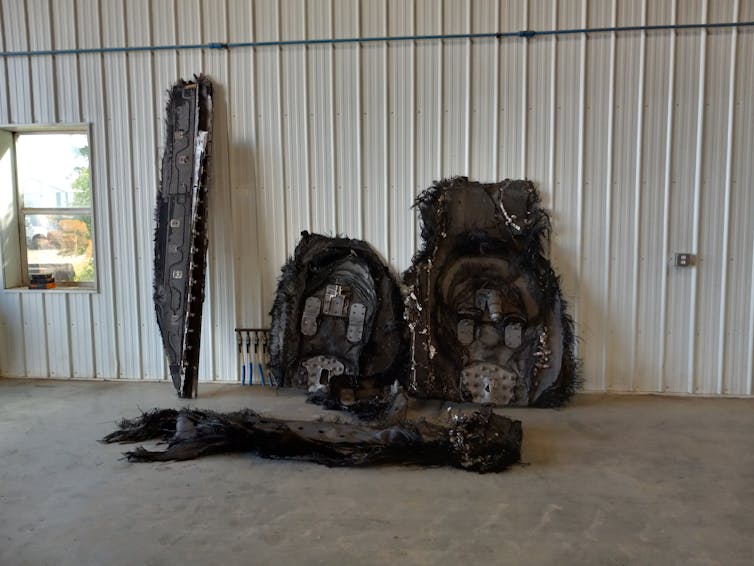
These
pieces of shredded debris, which came from an expendable
trunk module attached to one of SpaceX’s Dragon
spacecraft, fell on farmland in Saskatchewan, Canada, in
April 2024.
Samantha
Lawler, CC
BY-NC
In space, the picture is no less stark: the
Outer Space Institute’s CRASH
Clock suggests a collision would occur within 3.8 days
if satellites stopped avoiding each other.
Many
experts agree
we are in the early stages of the Kessler
Syndrome: a cascading chain reaction of collisions that
multiplies space debris.
Our skies are not a
dumping ground
Our night sky, especially cherished
in
New Zealand, is one of the few things everyone on Earth
still shares.
According to simulations
built by astronomers, constellations on the scale proposed
by SpaceX would fill the sky with many thousands of
satellites visible to the naked eye anywhere on Earth.
Eventually, there could be more visible satellites than visible
stars.
For scientists, observing the deaths
of stars and searching for new
planets would become much harder. Stargazing,
astrotourism and cultural
astronomy would similarly be disrupted
worldwide.
All of this means the FCC’s ruling on
the SpaceX proposal,
now open
to public submissions, could affect everyone – whether
through changes to the atmosphere, growing collision risks
in orbit or the loss of an unspoilt night sky.
One
solution being discussed is to dispose of dead satellites in
orbits away from Earth. But this would require much more
fuel per satellite to escape Earth’s gravity, increasing
both payload and the environmental impact of rocket
launches. Some debris would still
return to Earth.
With SpaceX and others
planning rapid expansion, global regulation is needed: in an
uncapped system, regulating one firm just shifts the problem
elsewhere. As the largest operator, SpaceX is best placed to
lead on an environmentally sustainable solution, just as Du
Pont did with phasing
out CFCs in the 1980s.
A first step is to
define a safe atmospheric carrying capacity for satellite
launches and re-entries. Environmental assessments should
cover the full lifecycle, including atmospheric effects, and
address both orbital safety and impacts on cultural
and research astronomy.
Whatever the regulatory
outcome, using the atmosphere as a crematorium for
satellites at this scale cannot be a solution.
Laura
Revell, Professor of Atmospheric Chemistry, University
of Canterbury; Michele
Bannister, Associate Professor in Planetary Astronomy,
University
of Canterbury, and Samantha
Lawler, Associate Professor, Astronomy, University
of Regina
This article is
republished from The
Conversation under a Creative Commons license. Read the
original
article.