
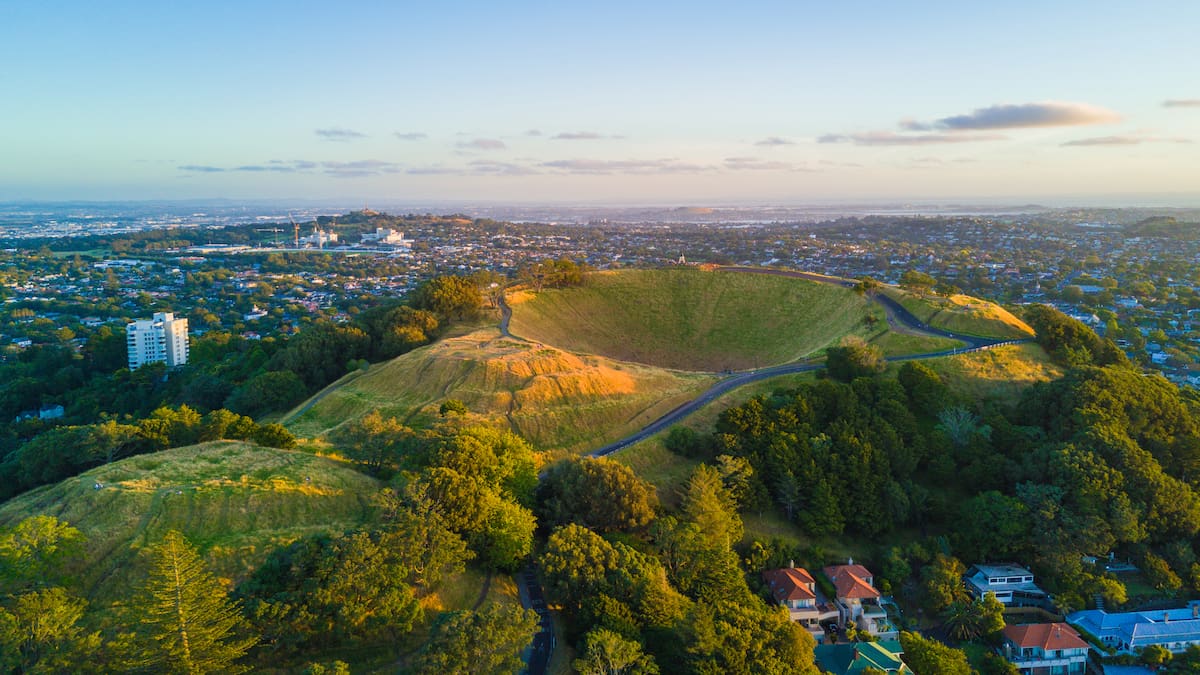
In the first of a two-part series, Steve Braunias, armed only with a bus pass, a flask of coffee and a shopping bag sets out to scale all of Auckland’s remaining volcanoes.
An epic journey to walk every peak of a very beautiful and almost dainty volcanic wonderland started
out as a hangover cure. I had survived an eight-hour drinking shift with Tom and Jonesy on a Friday night, crawling from one bar to the next on a humid evening even though it was late winter – subtropical Auckland is the lucky city, I remember thinking, and the lights of the city shone like diamonds on black velvet. I woke up Saturday morning with no way to hold my head that didn’t hurt. I needed to clear it. I thought of clean air, altitude, something rising above woe and alcohol. Not two hours later, I was restored to full health on top of a volcano.
The happiness and sense of wonder I felt after walking to the summit of one of Auckland’s distinctive volcanic cones inspired the idea to conquer the entire range; to climb every maunga. I have since gone about it with a bus card, a Thermos of instant coffee and a copy of the indispensable 1964 classic City of Volcanoes: A Geology of Auckland by Ernie Searle. The mission is not yet complete. There are at least two volcanic islands to get to in the Hauraki Gulf and I cannot be entirely sure whether some so-called volcanic cones in South Auckland can with any accuracy be defined as anything resembling a volcanic cone. The exact number of how many there are in Auckland is difficult to resolve.
The official count is that 53 volcanoes erupted within 20km of Auckland’s city centre. But this includes damp and essentially unclimbable voids such as craters, lagoons, swamps and basins, as well as geologically interesting features like reefs.
As far as I am concerned, the only way is up. You can’t climb a reef. And you can’t climb a volcano that is no longer there. Completists of the Auckland volcanic range trek dutifully out to the stadium at Mt Smart. John Walker ran his 100th sub-four-minute mile at Mt Smart. I saw Guns N’ Roses in their bitchin’ pomp in 1993 at Mt Smart. But barely any of the actual Mt Smart can be seen, its cone long since quarried and flattened.
And that’s the thing about the Auckland volcanic field: it’s in Auckland, forming the very hinges of New Zealand’s biggest city, a detailed little masterpiece of magma and thrust, of lava and vent, held within suburbs and commerce and industry, surrounded by people, people everywhere, in cars and houses and office towers – we yearn for undisturbed nature, for no one around, just wind in the trees, but disturbed nature is the essence of Auckland; its everyday happiness. Searle writes an excellent sentence in his introduction to City of Volcanoes: “Auckland is a city nurtured in a nest of volcanoes – a thriving, striving, bustling city uniquely founded on a site of natural turbulence.”
He expands on the same point, perhaps with less flair, in his later summary of volcanic activity from the Pleistocene era to the last eruption about 600 years ago (Rangitoto). “The Auckland volcanic field is notable on two counts: first for the very large number of individual volcanoes set in so small an area, and secondly for the small size of the individual volcanoes. In comparison with other volcanic fields the local volcanoes are miniature editions. What makes the Auckland field unique, however, is not their size or number but the fact that a great city has been built around and among them.”
I loved Searle’s “miniature editions”. No maunga takes more than an hour to reach its summit. They are lumps, humps, grassy knolls. It was all so easy and accessible. Half way through my quest, I went to Queenstown on literary business and stared at the Remarkables. What a bore! I missed the miniatures of Auckland. To live in a volcanic field is a tremendous stroke of fortune. To walk each of its cones was to gain an intimate feeling and understanding of Auckland, footfall after footfall. I set out on my march across the lucky city with no need for the mountaineering nonsense of crampons or skis or thermals; this was not the boring endurance of the Te Araroa trail; I arrived at each destination by bus or train, a city commuter passing the time of day by travelling to his next volcano.
Maungarei / Mt Wellington
Maungarei / Mount Wellington looking over Panmure. Photo / Getty Images.
My hangover evaporated at the summit, departed like moths or a bad memory, unable to compete with the stunning loveliness of life at the top of Mt Wellington, very possibly the prettiest maunga in the entire Auckland field. It looks gorgeous from every angle. It looks like a great green lion at rest, its head titled to the sun. It only takes about 30 minutes to ascend on a single steep-ish path cut like a zip up and across the smooth cloth of its eastern bank. I got there on the Eastern line train from Britomart to Panmure Station, then cut through a used-car lot to the gates, past the happy sight of Skateland, home of the Mt Wellington Roller Sports Club at 66 Mountain Rd. There may be a nearby pet shelter as well. I could hear dogs howling from the summit. They were as inconsequential as the hangover; the views were superb, with the particular joy of looking down upon the wide circle of the Panmure Basin, a volcanic crater that fills and empties with the tide.
Te Pane o Mataoho / Te Ara Pueru / Māngere Mountain
Te Pane o Mataoho / Te Ara Pueru / Māngere Mountain. Photo / Getty Images
I headed south on the train to Onehunga and walked across the Ngā Hau Māngere footbridge, beneath its stunning arch, to Māngere Bridge village. Media were out in force at Onehunga. I ran into Newsroom’s Jonathan Milne, and two minutes later ran into New Zealand Woman’s Weekly editor Marilynn McLachlan. She said, “Why are you carrying a shopping bag and not a backpack?” I stomped over the bridge in a self-conscious rage and cursed the Woman’s Weekly. But it was hard to maintain these dark spirits in the sunny riviera of Māngere village. The mountain looms over it as a warm and friendly presence, all purring slopes and gulleys and cones; I nominate it as the happiest maunga in the field.
Pukewīwī / Puketāpapa / Mt Roskill
I strapped on a backpack on a Thursday in early spring and took the bus to industrial Carr Rd, one of the main drags in Mt Roskill, a plain suburb which has a quintessence of Auckland within its hard-working, religiously devout (churches, mosques, temples) and rubbish-strewn streets, then rode an e-scooter to cross the pretty spiral of the Keith Hay Park footbridge over SH20 and along the edges of the park (scene of the terrible so-called “Innocent Agent” murder case of 2017) to the gates of the maunga. I drank my coffee at the summit and looked down at a house backing on to the mountain. Its windows were two thin vertical strips. Strange how the New Zealand colonial tradition was to build houses on riverbanks and coasts with small, narrow windows, blind to the view; see Timaru, Whanganui, Seatoun. Striking to see it in practice on a volcano.
Ōhinerau / Mt Hobson
Ōhinerau / Mt Hobson. Photo / Getty Images
This was stage one of an audacious hat-trick: three maunga in one day, all within a very tight radius in the centre of the isthmus. I took the 75 bus to Remuera Rd to walk Mt Hobson, one of the richest maunga in Auckland; a grid of swimming pools and tennis courts occupies the foothills. Vast wealth always acts as a sedative on my central nervous system and I stood on the summit in a state of tranquillity resembling bliss. But it could have been the fabulous views. The next two maunga on my list seemed so close they looked like stepping stones in a stream.
Te Kōpuke / Tītīkōpuke / Mt St John
Ōhinerau / Mt Hobson. Photo / Getty Images
I’d never heard of it. It was only a few blocks walk from Mt Hobson, and it looked very appealing, something small and perfectly formed, but the reality was a bit disappointing. There was hardly anywhere to sit at the summit apart from a bench positioned directly in front of a stand of trees, like a screen. Poor show.
Maungawhau / Mt Eden
An aerial view of Maungawhau / Mt Eden. Photo / Getty Images
The hat-trick was completed on Auckland’s highest and most popular mountain. It’s a classic and it lives up to the billing. You see a complete panorama of the city: its two harbours, its volcanic field, its whole entire cheerful metropolis of tangata, tangata, tangata stuck in traffic. I rode an e-scooter there from Mt St John and the walk up its steep southern bank was a killer. Never again.
Te Tātua a Riukiuta / Big King
Te Tātua a Riukiuta / Big King. Photo / Supplied
The story of Auckland’s volcanoes is the story of another kind of violent and devastating eruption. Almost every cone has been hacked and clawed at by quarrying. There’s something beautiful about it: the volcanoes were quarried for scoria to build the roads – it’s as though they have been turned inside out – and pave the streets of the isthmus. The volcanoes got Auckland moving. But mainly there is something obviously depressing about it, and one of the worst examples is Big King in the suburb still known as Three Kings, despite the fact that two of the so-called kings, on a three-coned maunga, have long been quarried to death. Only one cone remains. It’s quite nice. There’s a massive round water tower squatting like a graveyard crow on the summit.
Ōwairaka / Te Ahi-kā-a-Rakataura / Mt Albert
Ōwairaka / Te Ahi-kā-a-Rakataura / Mt Albert. Photo / Getty Images
This large, central-isthmus volcano is where a woman with Down syndrome, Lena Zhang Harrap, was violently and sadistically murdered on September 22, 2021. There were cards and ribbons in her memory on a tree by a dark path. I walked in silence.
Takarunga / Mt Victoria
Another hat-trick: I climbed the three volcanoes of Devonport (Victoria, Cambria, North Head) in one outing, and the experience confirmed my long-held belief that the North Shore is at once an idyllic lotus-eating paradise and kind of fucked in the head. I caught the ferry to Devonport and marched through the back streets, including the colonial doll’s houses of Anne St, to ascend Mt Victoria, the central feature of Devonport; its guardian angel. I ran into Te Araroa national trail founder Geoff Chapple at the summit. He had bicycled up. His action-man, fiercely independent spirit was at odds with the volcano’s administration. A sign on the gates of the radar station instructed, THERE ARE NO PUBLIC TOILETS AVAILABLE AT THIS LOCATION. A great many signs banged on about the mountain’s military fortifications in the 19th and 20th centuries. There was something obedient and pathetic about this history but I hadn’t seen anything yet. Anyway, the views of beaches and the Hauraki Gulf were stupendous.
Devonport’s volcanic cones. Photos / Getty Images
Taka-a-raro / Takararo / Mt Cambria
I’d never heard of it. “The skeleton of a former scoria mound lies in front of Mt Victoria,” Searle writes in City of Volcanoes. “Little more than 100 feet high, it was formerly known by the attractive name of the Hill of Sheep. It has been quarried away and little now remains of this small volcano.” But it’s the prettiest skeleton you ever saw, a lovely rolling park between Devonport’s two outstanding volcanoes, just about the quietest volcanic spot in all of Auckland. It has a succulent garden, and a flock of yellowheads ate seed on the lawns. Everything felt exact in this most miniature of Auckland’s miniature editions.
Maungauika / North Head
I e-scootered along the waterfront to North Head and saw what seemed to be tree trunks on the beach. I got closer and realised they were Navy recruits lounging around dressed in camouflage uniforms, eating white-bread sandwiches. All of North Head was a zone of defence, from bottom to top: there were barracks at the summit, guns, bunkers, tunnels, concrete reinforcements, flags, propaganda – the whole joint stank of the armed forces. There is such conformity in the North Shore, mind. It’s a Tory bastion, and the root of it may be in the military madness spread all over its volcanoes. Anyway, the view was fabulous, right on Rangitoto’s doorstep.
The conquering of the North Shore marked an end to the volcanoes in plain sight. Mt Eden, Mt Roskill, Mt Victoria – everyone knows these jolly green giants. It was time to head into the dark interior of obscure but just-as-crucial maunga. I had to call on help.
Part two will appear next week.
SaveShare this article
Reminder, this is a Premium article and requires a subscription to read.
Copy LinkEmailFacebookTwitter/XLinkedInReddit