
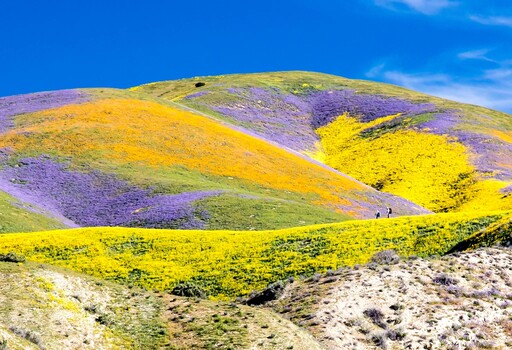
Death Valley National Park declared an above-average bloom year on February 22, and park officials are warming up to the word nobody wants to use prematurely: superbloom. The last time the park saw a display at this scale was 2016, a full decade ago. Unusually heavy rainfall in late 2025 (the Furnace Creek Visitor Center area recorded roughly 2.4 inches between November and early winter alone, far more than the park typically receives during those months) soaked deep into desert soils that had been waiting for exactly this kind of event. The result is miles of desert gold, brown-eyed evening primrose, sand verbena, and phacelia carpeting valley floors and alluvial fans that were bare rock and sand six months ago.
And Death Valley is only one piece of it. Anza-Borrego Desert State Park, 85 miles northeast of San Diego, is already showing robust bloom activity. Joshua Tree National Park is reporting early wildflowers near Hidden Valley and the Belle and Ryan campgrounds. Antelope Valley California Poppy Reserve, Mojave National Preserve, and Carrizo Plain National Monument are all expected to peak between March and April. Parts of Nevada and Arizona are joining the show. This is not a localized event. The entire Western desert is waking up at once, and for photographers, the window will be measured in weeks, not months.
If you are reading this and planning a trip, good. You should go. A superbloom at this scale is one of the most visually extraordinary things you can witness in the American landscape, and it happens so rarely that missing it means waiting years for the next chance. But if you are reading this and planning a trip, you also need to understand what happened the last two times photographers and content creators descended on California’s wildflower fields. Because the track record is ugly, and the flowers paid the price.
What Happened Last Time
The pattern of social-media-driven damage to wildflower areas has been building for years. As early as 2017, reports emerged of visitors trampling fields, wandering off designated trails to find “untouched” patches, and picking blooms for flat-lay photos and hair accessories. The after-effects were visible long after the flowers faded. In some areas, the damage to the soil and root systems was severe enough that habitat had to be reinforced and replanted by hand.
Then came 2019, and it got worse. Walker Canyon near Lake Elsinore experienced what the media called the “Poppy Apocalypse.” An estimated 150,000 visitors overwhelmed a small community that had no infrastructure for that kind of traffic. Interstate 15 backed up for miles. People climbed over barriers, left trails, trampled flowers by the thousands, and pulled entire plants out of the ground by the roots. The city of Lake Elsinore was forced to shut down access to Walker Canyon entirely. The city has continued to enact strict closures during subsequent bloom seasons, including 2023 and 2024, specifically to prevent a repeat, and the area’s status during any given spring remains uncertain. A city official told the Los Angeles Times that prior to 2017, the social media dimension simply did not exist at that scale. They were not prepared. Nobody was.
The ecological consequences extend beyond aesthetics. A single California poppy can produce hundreds of seeds. When hundreds of people cut off that life cycle by trampling plants before they go to seed, the math compounds fast. Tens of thousands of seeds never enter the soil bank. The next bloom is diminished. The one after that is diminished further. Ecologists have warned that repeated trampling in fragile desert ecosystems damages not just the current bloom but the soil seed bank that future blooms depend on, and that the combination of climate stress, development, and visitor impact is putting increasing pressure on California’s wildflower habitats.
Who Actually Caused the Damage
Here is where the narrative gets uncomfortable, and where I think the photography community needs to be honest about what happened.
The people who destroyed Walker Canyon were not landscape photographers with L-brackets and graduated ND filters. They were not the people reading this article. The overwhelming majority of the damage was caused by casual visitors, social media users, and influencers who treated wildflower fields as content backdrops. People who wanted to be in the photo, not behind the camera. Couples who hired budget photographers who either did not know about trail boundaries or did not care. Influencers who uprooted flowers for styled shots and then posted them to audiences of tens of thousands. The destruction was driven by the pursuit of personal content, not by the pursuit of a good photograph. There is a meaningful difference.
But that does not let the rest of us off the hook.
Someone took the original photo that went viral. Someone composed an image of a person standing waist-deep in a poppy field with golden light raking across the hills, and that image set the visual template that everyone else tried to replicate. Someone geotagged the exact trailhead. Someone posted coordinates. The enthusiast and professional photography community sets the visual standard for what a “good” wildflower photo looks like, and when that standard includes humans posed inside the flowers rather than observing them from a respectful distance, the casual shooters follow. We may not be the ones who trampled Walker Canyon into closure, but we are often the ones who drew the map that led people there and showed them what to do when they arrived.
That is worth sitting with for a moment before you post your superbloom images this spring.
How to Shoot It Without Destroying It
The good news is that responsible superbloom photography is not a compromise. It is better photography. The images that require you to wade into a flower field are, almost without exception, the least interesting ones. They are the cliché: person in flowers, flowers in hair, flowers from above. They are the shots that look identical to ten thousand other shots because they are all taken from the same position, which is standing in the middle of the thing you are supposed to be documenting.
The more compelling work comes from constraint.
Telephoto compression from a designated trail or road produces more dramatic flower density than a wide angle shot from inside the field. A 70-200mm or even a 100-400mm aimed across a blooming hillside will compress the layers of color, collapsing foreground and background together so the display looks denser and more vivid than it appears to the naked eye. You gain that stacked, painterly quality where the blooms seem to fill every inch of the frame, and you gain atmosphere from heat haze that reinforces the sense of scale. This is not a garden; it is a geological event.
Low angles from trail edges with a wider lens create the illusion of immersion without leaving the path. Get low, let foreground flowers fill the bottom of the frame, and let the landscape recede behind them. The viewer’s brain fills in the gap and assumes you were surrounded. You were not. You were on your knees at the edge of a gravel path, and the image is stronger for it because the flowers in front of you were undisturbed and upright rather than bent and broken.
Macro details tell a story that sweeping vistas cannot. Death Valley rangers talk about what they call “belly flowers,” the tiny species that most visitors walk right past because they are too small to see from standing height. These are the blooms you have to crouch or lie flat on a trail to notice, and they reward the effort. A tight shot of a single desert five-spot or a cluster of phacelia with morning dew says something about the fragility and precision of the event that a wide panorama of yellow hillsides never will. The belly flowers are invisible to someone stomping through the middle of a field. They are only visible to someone who slowed down enough to look. If you want to sharpen your macro technique for subjects like these, Fstoppers’ Mastering Macro Photography tutorial covers everything from focus stacking to lighting at close range.
And if you fly a drone, check the regulations first. Many of the parks and preserves where superblooms occur prohibit drone use entirely, and even where drones are technically permitted, the noise and rotor wash can disturb both wildlife and other visitors. The overhead drone shot of a flower field is already a visual cliché. Leave it alone.
Photo by Bluesnote, CC 4.0.
The Fire Follower Opportunity
There is one more dimension to 2026’s bloom season that most coverage is overlooking, and it may produce the most photographically interesting images of the entire spring.
After the devastating 2025 Los Angeles-area wildfires, burned areas in the Santa Monica Mountains and Altadena foothills are primed for a different kind of bloom: fire followers. These are native wildflower species whose seeds sit quietly in the soil for years or even decades, germinating only after fire strips away the canopy of competing plants above them. When it finally burns, they emerge in force. Fire poppies, Plummer’s mariposa lily, whispering bells, native snapdragons, and dense lupine stands are all fire followers that could appear this spring in areas that were devastated just months ago.
These species are rarer than the standard superbloom fare. Some of them, like the fire poppy, are so strongly associated with post-fire conditions that they are almost never encountered otherwise. The visual contrast of vibrant new growth against charred landscape is striking in a way that a field of poppies against brown hills simply is not. And the story these images tell, about resilience, about cycles, about life returning to damaged ground, is more compelling than another golden-hour portrait session.
But the ethical stakes in fire-damaged areas are even higher. The soil is unstable. The root systems that held hillsides together are gone. Foot traffic in burned areas can accelerate erosion and damage the very regrowth you are there to photograph. Respect all area closures. Stay on established paths. The fire followers are doing important ecological work, and they do not need your help.
Before You Go
The Theodore Payne Foundation’s Wildflower Hotline returns on March 6 and runs through May, with weekly updates available online and as a podcast. Use it. Plan your visits for weekday mornings before the crowds arrive. Confirm current access status for any location before you drive; Walker Canyon’s repeated bloom-season closures have caught visitors off guard in previous years, and conditions change.
A few things worth remembering: it is illegal to pick wildflowers in national parks and California state parks. Regulations exist specifically so that plants can produce seeds for future seasons. Do not leave designated trails. Do not lie in flower fields. Do not pull plants for styled shots. Think carefully before geotagging precise locations for fragile or lesser-known sites. The locations that can handle crowds (Antelope Valley, the main roads through Death Valley, the established trails at Anza-Borrego) are well-known enough that geotagging adds nothing. The locations that cannot handle crowds are the ones that get destroyed when the coordinates go viral.
And here is one more thing to consider before you post: a single wildflower that completes its life cycle can drop hundreds of seeds into the soil. Those seeds can persist in the soil for years until the right combination of rain and temperature finally triggers germination. When someone steps on that plant before it seeds, the loss is not just this year’s bloom. It is a withdrawal from a seed bank that the desert cannot replenish on any predictable schedule. Superblooms are not cyclical events that arrive on a timetable; they are driven entirely by the right combination of rainfall, temperature, and timing. The next one could be three years away. It could be fifteen.
The 2026 superblooms are extraordinary. Go see them. Photograph them. Share them. But share them in a way that does not invite the next Flowergeddon, and photograph them in a way that leaves the flowers standing for the person who comes after you. The best image you can make this spring is one where no wildflowers were harmed in the process. That is not a limitation. It is a creative challenge, and it is one that will produce better work than the alternative ever did.
For photographers looking to develop their landscape skills before heading out, Fstoppers’ Photographing the World: Landscape Photography and Post-Processing with Elia Locardi is a comprehensive guide to scouting, shooting, and editing the kinds of images that do justice to scenes like these.
Lead image by Bob Wick, BLM (public domain).