
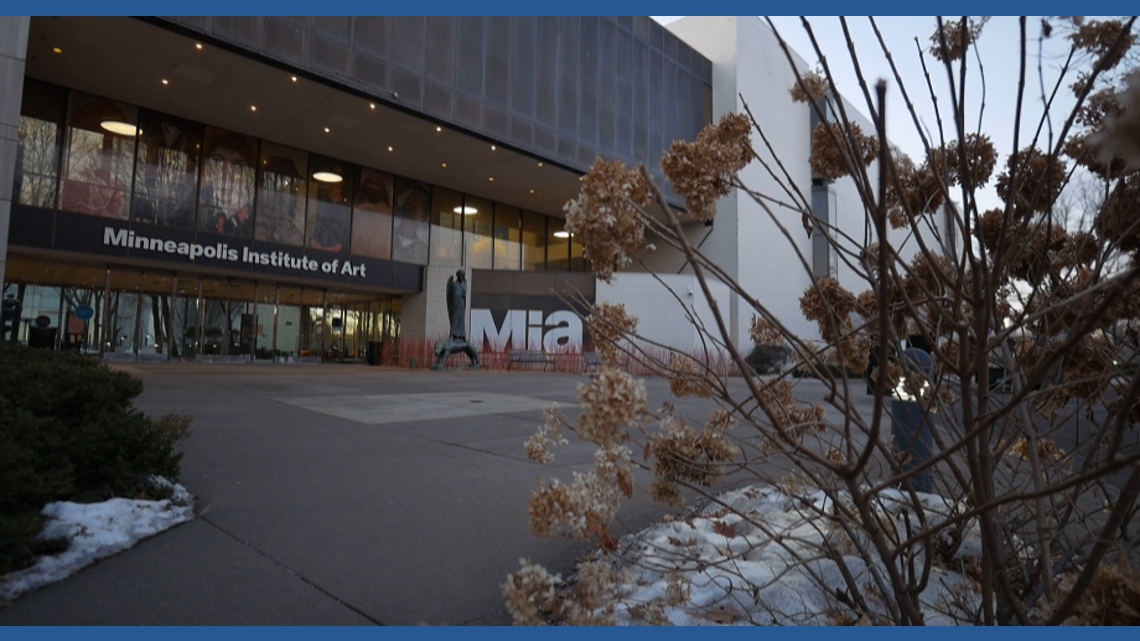
Bobby Rogers said his team is in charge of the look and feel of the museum.
MINNEAPOLIS — The little things people don’t think about in a museum often tie the entire place together. From the font to exhibit room colors, one team at the Minneapolis Institute of Art (Mia) is responsible for the museum’s look and feel.
“So, we are sort of the arbiters of the brand, anything you see that’s visual go out and a lot of things editorially written that you see go out, comes through my team before it goes out,” said Bobby Rogers, Mia’s head of design and editorial.
Rogers said he is the first person they’ve hired for the role, but he’s not new to creating a new path. Before he worked at Mia, he said he was Target’s first senior art director of Black audiences. He worked there for four years, while building his own studio, The Bureau. His work at Target and with The Bureau caught the attention of Mia.
“We are looking to be the most attractive when it comes to getting peoples’ attention. We realize that we’re in a museum, but even though we are a museum we are competing on a global scale,” Rogers said.
He said when you’re competing with so many entities, the smallest details can set you a part, especially when the goal is to reach one million visitors by 2030.
“With the goal of attracting new audiences that have never been here before to me using the same font for everything doesn’t signal the amount of change that’s happened here,” he said.
Rogers said a lot of museums have their own font, but he challenges them to use different fonts when appropriate. He said color is also important.
“We try to think about how all the colors themselves signal change from each gallery from season to season but how they all work in relation to each other, and then how the fonts again help you when it comes to that emotional sort of connection for people,” Rogers said.
He said when a new exhibition arrives, his team is in charge of the branding. Rogers said his team also thinks big when it comes to the museum’s brand outside of Mia’s walls.
“Whenever you see billboards, or you see ads come across your Instagram or Facebook, or you might even see a newsletter thing like that our team is in charge of making sure all of that is on brand,” he said. “In this world where we are all vying for attention we have to figure out how to make ourselves stand out and I think that becomes one of the most important aspects for any brand, for any institution, like how do you stand out, how do you become attractive to the audience.”
Rogers said he has a “propensity for creativity for aesthetics,” a lot of which he credits to his unorthodox path.
He grew up drawing Pokémon, went to school to become an illustrator, and then he started learning the art of photography.
“I would sort of like barter and trade at different moments. I would go to the barber shop be like ‘yo, I’ll take photos for your social media, if you give me free haircuts’,” he said.
His photography work landed him a job at the Walker Art Center, which for him was a full circle moment.
“I remember posting about how I applied for a job at the Walker when I graduated and they never hit me back up, and then this project came along,” he said.
With Mia, he said he’s pushing them to think outside the box and try things they’ve never done before. He said one of the new elements he’s introduced is campaigns. He produces three big campaigns every year focusing on different things, but all with the same goal of attracting more people to the museum.
Rogers said it’s important to him to bring soul to everything he does.
“With Black creatives we have a perspective that is extremely nuanced, but we also have a perspective that’s also very hardworking, and we have a perspective that’s very like community sort of centric,” Rogers said.
His team’s latest project is coming up with the identity of a new exhibit. They’re using different fonts, and an olive green and pick color scheme. The exhibit, Modern Art and Politics in Germany 1910–1945, will open in March. So, when you walk through the exhibit or see the timeline panels, now you know who helped spearhead the design.