

Abilitopia and White Noise are two startling and provocative productions exploring the interface with AI and disability expressed in art form.
Touch Compass is New Zealand’s leading professional disability-led arts organisation championing accessible arts performance. They champion crip-led, disability-led work, culture, diversity, accessibility, and identity. This is a platform for disabled and non-disabled artists, creatives, choreographers and production personnel.
Abilitopia. Director Dr Suzanne Cowan
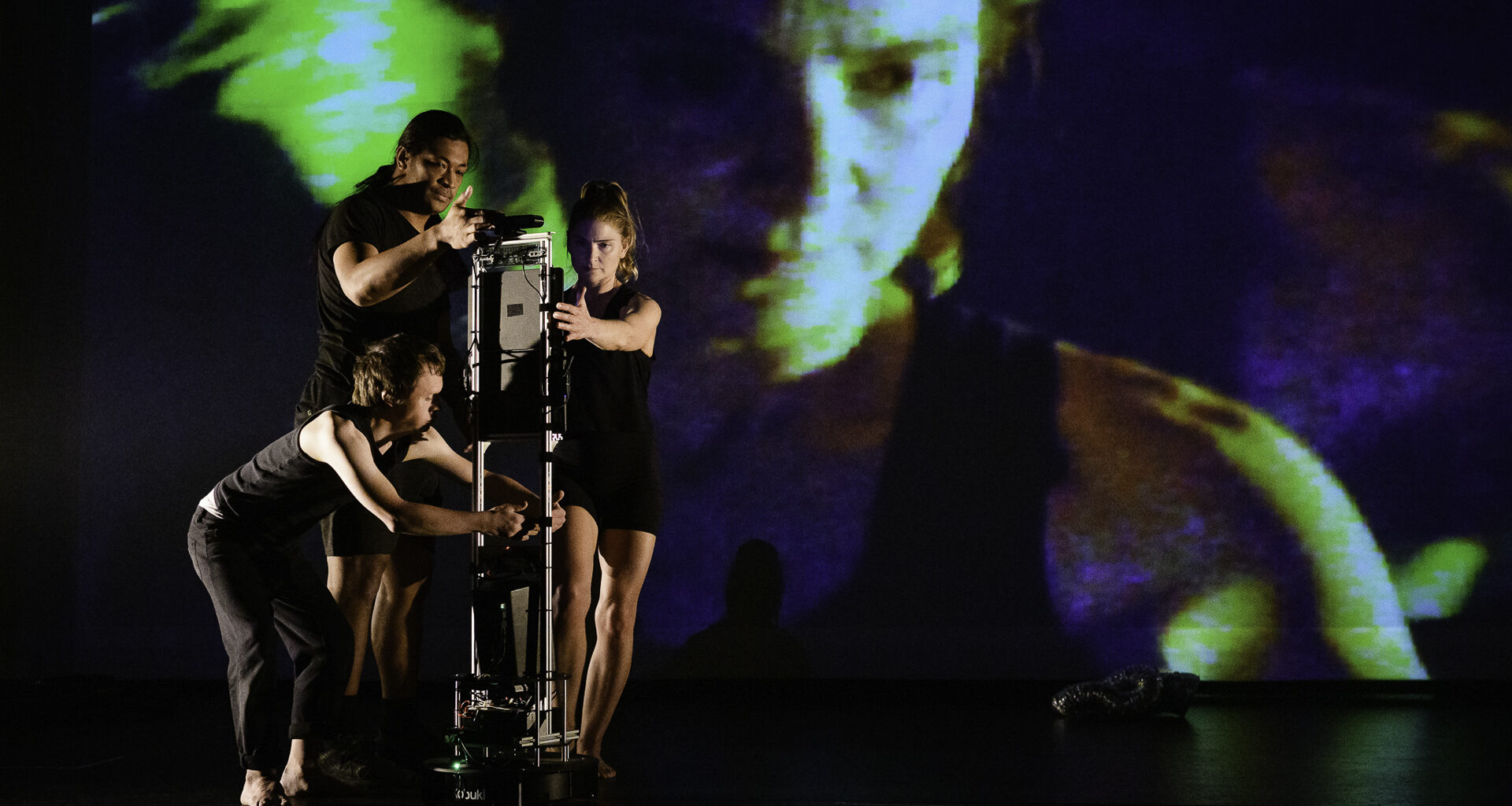
There is an expectant tension as the Robot traverses the theatre space. Its head is an old-style television screen, and on it a huge cyclops eye. What the eye sees is the gathered audience projected on to the large back screen and several people react by waving.
As familiar in its effect as any large sports event. Designer and operators of this AI are Adam Ben-Dror and Futian Zhou, and their robotic construct is an essential fourth player in this 40-minute performance.

The human players arrive at first in solo dance cameos, eventually moving in harmony as a triumvirate.
Reaching into each other and morphing states a modulated and effects-laden voice.
Duncan Armstrong dances like a nightclub patron in front of the robot. Julie Van Renen moves her body in sensuous waves. Raven Afoa-Purcell is the tallest of the three and lifts the others as their dance unfolds.
Minimalist music with strong elements of techno and electronic ambience merging into modified world music. The influence of Brain Eno and Philip Glass are pervasive, from sound designer Kristian Larsen.

Gradually the theatre becomes a dreamscape projected out from the robot’s eye.
Shadow puppetry from hands becomes witchy and spidery and starts to resemble the Expressionist theatre of the original F.W. Murnau Nosferatu from the 1920’s.
A tangle of long cords and ropes becomes a psychedelic-coloured octopus. What is being projected through the eye of the robot now appears as if enhanced by psychotropic drugs.
At one point Julie is entwined in the ropes and the eye turns the image to monochromatic black and white. Even the audience are shape-shifted into David Cronenberg styled special effects.

As the performance progresses, the themes of interdependence and connection are brought up. As if the role of artificial intelligence here is to meld with the creative intent and expression of the human artists, and separation is hard to define.
The program mentions the increasing role of AI in assisting disabled people. This theatrical production breaks that interface down further to add an essential component into artistic expression.
It was a forty-minute experience in total, but it surprisingly contained multitudes.
White Noise
The second feature was quite different being a solo performance from Alisha McLennan Marler.
Marler holds the stage for the whole performance and bares her soul in a cathartic and often visceral way.
There is a wheelchair centre stage, but it is used more as a prop than a necessity.
The performance starts with white noise and is often loud, jarring and uncomfortable.
Marler is on her feet at least half the time and is quite well-coordinated in her simple dance routines.

Sometimes I feel like I’m shouting at the wind/ Sometimes I feel like I’m shouting at the entire world/ Sometimes I feel like I’m talking to statues.
Lots of abrasive and jarring tones. She scrapes the wheels of her chair across her microphone. Much of the discordant noise is also translated by the deaf interpreter (present for both productions).
Swimming on the floor and the sound gives way to driving and insistent alternative Metal music with dominant drumbeats overlaid with an effects-laden guitar. The most melodic part of the performance.

We hear the foetal heartbeats from an ultrasound scan, signalling the advent of pregnancy. The Doppler sound is persistent.
Hanging white drapes which featured in Abilitopia are also present here, and she is off her feet and billowing in amongst the fabric.
Although a lot of the auditory experience of this performance is harsh and confrontational at times, Marler generally moves through this performance with an elegant grace and style.
Close to the denouement and she states, sometimes I need a hug.
Abilitopia does get wildly surreal. White Noise is a personal journey balancing raw experience with tenderness.
Rev. Orange Peel
Like this:
Like Loading…
Related