
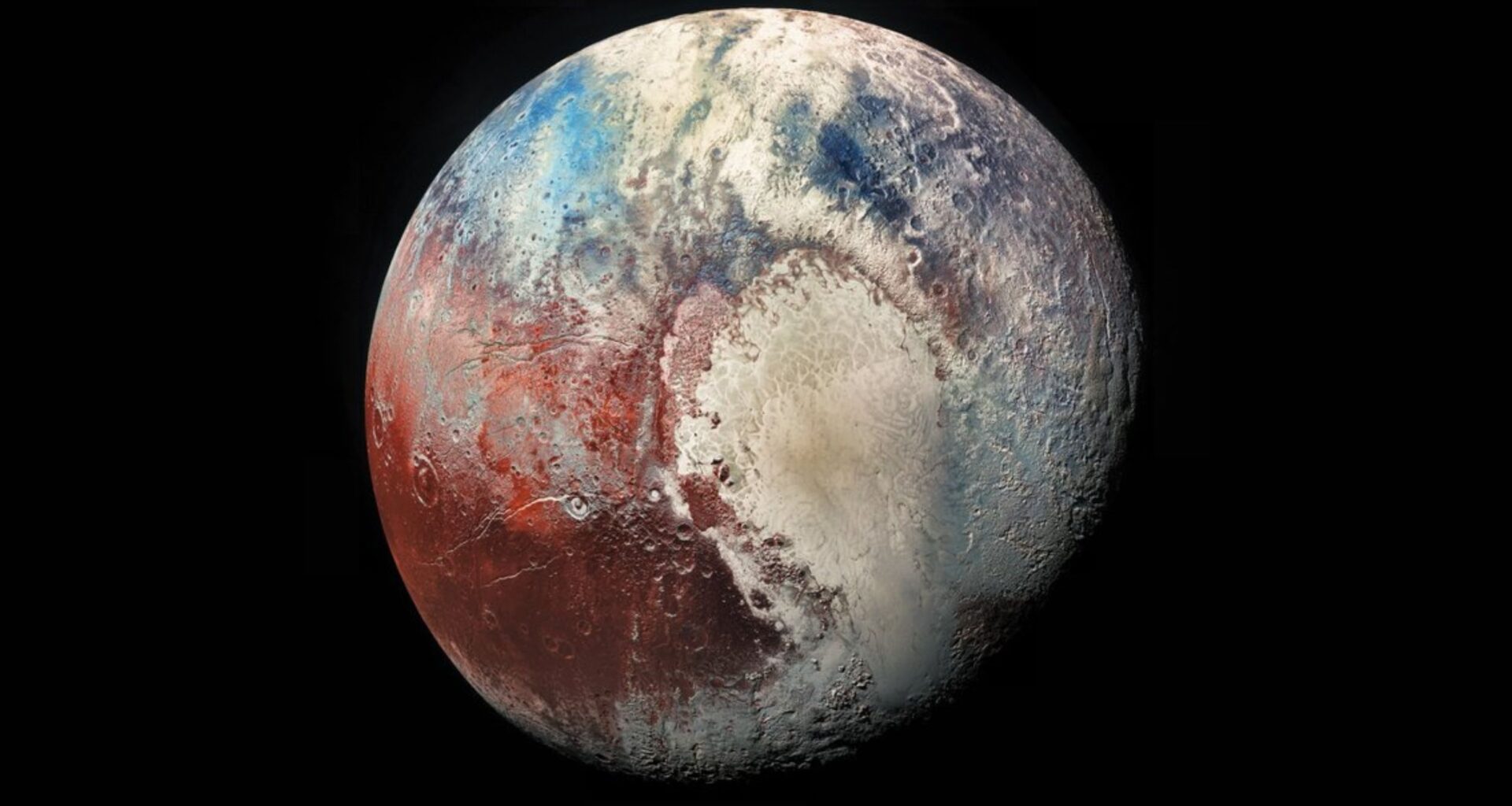
Astronomers have determined that on March 23, 2178, Pluto will finish its first full trip around the Sun since its 1930 discovery.
That unfinished lap has already carried Pluto from celebrated ninth planet to reclassified outsider, long before it could mark a single birthday.
One year on Pluto

Pluto takes 248 Earth years to circle the Sun, stretching a single year far beyond any human lifetime.
Over that span, the dwarf world sweeps billions of miles from the Sun before arcing back inward along a tilted, elongated path.
Such an extended, uneven orbit helps explain why its first full year has outlasted generations, and why its route stands apart from the planets that demoted it.
Pluto’s tilted path
Tilt and stretch shape Pluto’s path, and its perihelion, the point closest to the Sun, changes how close it gets.
At one end of its oval, Pluto can be about 4.6 billion miles (7.4 billion kilometers) from the Sun, then swing inward.
“From 1979 to 1999, Pluto was near perihelion, when it is closest to the Sun,” NASA explains.
For those two decades, Pluto sat nearer the Sun than Neptune, without the two worlds sharing the same space.
The hunt begins
In northern Arizona, the Lowell Observatory kept chasing a predicted ninth planet by photographing the same star fields.
Clyde Tombaugh checked each pair with a blink comparator, a viewer that flips between two sky photos, until something moved.
On February 18, 1930, two plates taken days apart showed him a tiny movement that sealed the find.
After that morning, Pluto was no longer a rumor on paper, and a name soon had to follow.
Naming Planet Nine
Over breakfast in England, 11-year-old Venetia Burney suggested Pluto, and adults at the observatory accepted it.
Roman myth tied Pluto to the underworld, so the new world arrived with a name built for darkness.
“Venetia’s interest and success in naming Pluto as a schoolgirl caught the attention of the world and earned her a place in the history of planetary astronomy that lives on,” said Alan Stern, the principal investigator for NASA’s New Horizons mission that flew by Pluto on July 14, 2015.
That name lasted, but Pluto’s label did not, because new discoveries forced scientists to define what planet means.
Losing planet status
In 2006, astronomers drew a new line for planets, and Pluto ended up on the wrong side.
A 2006 resolution from the International Astronomical Union listed Pluto as a dwarf planet, a round world that has not cleared its orbit.
Clearing an orbit means sweeping up nearby bodies, and Pluto still shares its path with other large objects.
For many people, that wording sounded cold, and Pluto stayed famous anyway because schoolbooks and memories lag behind.
Five moons in tow
Even so, Pluto kept company, and small moons circle it while Charon dominates the scene.
“Pluto is orbited by five known moons, the largest of which is Charon,” NASA explains.
Nearly half Pluto’s size, Charon stays fixed in the sky through tidal locking, one face always points toward the same partner.
Such a tight moon system may trace back to an early crash, leaving Pluto with a companion that acts like a partner.
Long days, dim light
One Pluto day lasts about 153 hours, so the Sun hangs in place for days at a time.
With an axis tilted 57 degrees, Pluto spins almost on its side, so seasons land unevenly across the surface.
Instead of turning the usual way, Pluto shows retrograde rotation, spinning east to west instead of west to east.
For scientists tracking the distant world, that slow spin stretches observations, and it also changes how frost moves.
An atmosphere on ice
Pluto carries a thin atmosphere that swells when it warms and shrinks when it cools, year after year.
Sunlight can make surface ices sublimate, changing directly from solid ice to gas, and that gas builds the air.
Mostly nitrogen, with traces of methane and carbon monoxide, the air can freeze and fall back as snow.
Farther from the Sun, weaker heat means less gas stays aloft, and Pluto’s surface ends up coated again.
New Horizons close-up
A close-up image from New Horizons caught Pluto’s heart from 476,000 miles (766,000 kilometers) away, just before closest approach.
About 1,000 miles (1,600 kilometers) across, the heart looked bright and oddly smooth, hinting that geology kept reshaping parts of Pluto.
A 2015 paper described a water-ice crust and young plains shaped by moving ices, wind streaks, and haze.
Beyond Pluto, the spacecraft New Horizons continued deeper into the Kuiper Belt, a distant region of icy objects beyond Neptune, where more small worlds remain.
What the clock means
That calendar date matters less as an event than as proof of how slowly the outer solar system runs.
Future observers can keep rechecking Pluto’s behavior, but the first full anniversary still sits out there, untouched.
—–
Like what you read? Subscribe to our newsletter for engaging articles, exclusive content, and the latest updates.
Check us out on EarthSnap, a free app brought to you by Eric Ralls and Earth.com.
—–