
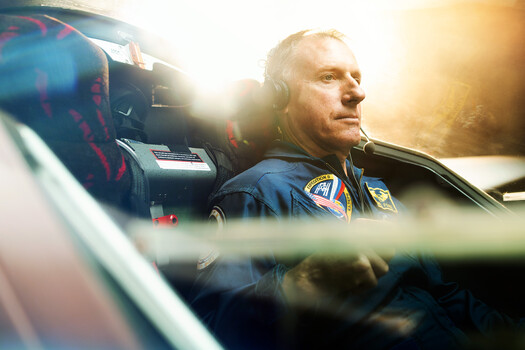
On the developing the skills that enabled him to work with Sony PlayStation, Monster Energy, Husqvarna, Bosch Global, Fujifilm USA, and why you should always spit out your gum before shooting.
What Are Must-Carry Items Always in Your Bag?
I’ve been a Fujifilm ambassador for over four years now and I always have a GFX body in my kit, now the GFX100 II. Typically, I reach for a prime lens like the GF 80mm f/1.7 and an all-around zoom like the GF 32-64mm f/4. When I’m walking around or with the fam, I typically have my X100V close by and use it all the time for BTS. Also, gum! I always have gum in my bag to make sure I’m as fresh as can be! Pro Tip: I chew the gum right before going on set and then try to throw it out before we start so I’m not smacking gum by the talent!
Shot for Sony PlayStation, on a Hollywood set, mixing flash and ambient light.
What Is the Most Underrated Photo Skill?
Networking. It might not sound like a photo skill, but if you’re not good at networking and meeting new people, you don’t get to use any of your other photo skills. It will also serve you well on set because networking is all about earning trust and creating rapport, which you need on set with talent, clients, and crew.
What Technique Do You Use Too Often?
Flare and haze. I’m a sucker for some flare and haze; it’s gotten me in trouble before. I do my best to move around and change angles, but when the flare is poppin’, I just can’t help myself. Haze gets a little out of control sometimes, too, but done well, it creates such a cinematic feel that I almost always have it running.
Anderson found bull rider Jordan Halverson online. “I just find people that are interesting to me and reach out on Instagram.” He said he leans on flare too often, but the results are no bull.
What Photo Skill Do You Wish You Were Better At?
Simplicity. Even at the beginning of my career, I was always checking out huge amounts of equipment and hauling it around San Francisco. It seems to be how I see the world, but I have been really working on simplicity lately, trying to tackle problems with natural light or one light when I can. I still love putting up a bunch of lights and making something awesome, but simplicity is a skill I do wish I was better at.
Photographers Are Always Told to Develop a Style or Find a Voice, but There Is Little Advice on How to Find That Voice. What Guidance Can You Offer?
Start with what you know and create often. Many times, the best photographers start creating inside of something they know well: a rock climber, a soccer player, an athlete, a musician, etc. You typically have more access and trust in the arenas that you’ve already been a part of. It can even be as simple as photographing your cycling club that you ride with every weekend. The other advice, which is not new, is to create often. Constantly push yourself to create, assess what you’ve created, and create more. The more you create, the more you’ll see your voice emerging. Listen to it. Listen to your taste as you see it coming to the surface. Be gracious to yourself in this process; it takes a long time and a lot of work, but slowly you’ll emerge, and it’ll be beautiful.
Anderson approached actor and stunt rider Macedonio Elías through Instagram and then experimented, pushing the limits of his dramatic aesthetic.
After a Camera, What Are the Next Three Pieces of Equipment You Would Advise a Photographer to Invest In?
Lighting, modifiers, and grip. When I first started, I would buy a new C-stand after every paid project so that I would have what I needed over time. Now I have almost everything I need to do a medium-to-large-sized production with minimal rental. This allows you to make money off your equipment and to create higher-end personal projects.
Do You Have Anything That Is a Daily Practice or Habit?
I make a cup of coffee (just one cup using a pour-over) and use the “One Minute Pause” app from Wild at Heart every day. This really helps me to find focus and teaches me to approach the day ahead with my mind and heart centered. I also try to journal most days and go for walks with my wife every day. Typically, we walk between 1–2 miles a day and talk; it’s been a huge blessing when things get busy to process and be together while getting some movement and fresh air.
Anderson’s first campaign for Brave Star Selvage, with owner Mik Serfontaine serving as model.
What Art Books Should Every Photographer Own?
I actually don’t own art books because they are so big, and we live in an RV (books are heavy!), but I’ve had a subscription to Vogue for as long as I can remember, and I find it so inspiring. Typically, I will cut out the images that inspire me and put them in a binder, making it easy to have a large dose of inspiration! I’m also a huge fan of going to art museums wherever we are; seeing the masters of lighting and composition at a large scale is incredible.
Where Do You Find Inspiration for an Image?
My main inspiration for most of the images I create is the story. Usually, it’s the story of the person I am photographing, but it can be from anywhere. Once I understand the story, it helps me to imagine how it would look or feel. I’m always trying to figure out how we can create something beautiful while honoring a story. Integrating things like clocks, hands, phones—you name it—to create Easter eggs inside of an image that further the story is something I really love to do.
For this shot of runner Jaide Stepter, Anderson called on inspiration from an Annie Leibovitz shoot with runner Allyson Felix—but don’t overlook museums as a source to stimulate creativity.
If You Were Starting, What Would You Do Differently? Or What Advice Would You Give a Photographer Just Starting Out?
My first piece of advice would be: if you decide to go to school, find a school that has a killer business program and a minor in photography. It took me a while to figure out that photography is only like 10% of what you do as a freelancer; most of it is business. Start networking now. So many people I talked to were waiting until they graduated or until the portfolio was better, but you should be meeting people all the time. It can be assistants, stylists, producers, potential clients, mentors—there are so many people you need to know in order to thrive in this business, and you need to start today, not tomorrow. Finally, be kind. Your ability to get hired consistently has a lot to do with how fun you are to be around. If you get a reputation for being a dick early on, you might as well get a different career.
Aaron Anderson on the other side of the lens.
Bio
Aaron Anderson is a Colorado- and California-based visual storyteller who crafts images with creative, cinematic flair. Since launching Aaron Anderson Visuals in 2009, he’s collaborated with top-tier brands like Sony PlayStation, Monster Energy, and Bosch.
After attending the Academy of Art in San Francisco, Anderson took up retouching at Sugar Digital, where working on images for exacting clients such as Coca-Cola, ESPN, and Google refined his eye and taught him technical precision. His portfolio spans portraiture, sports, lifestyle, and motion.
When he’s not behind the lens, Anderson explores America in an RV with his wife and three kids, always chasing the next great story—or the perfect cup of coffee.
Explore his work at andersonvisuals.com and on Instagram: @aaronandersonvisuals.
All photos by permission Aaron Anderson.