
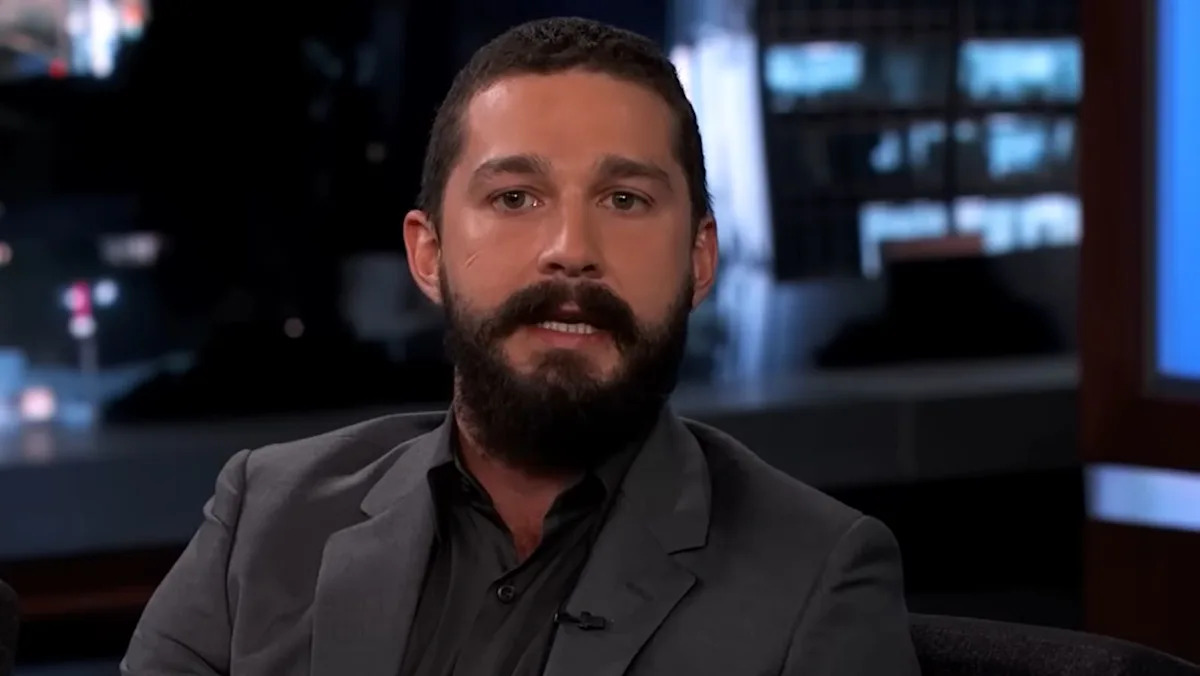
Shia LaBeouf sat down for a YouTube interview on Saturday and told the world he does not have a drinking problem. He said his real issue is ego. He said rehab was not for him. He said big gay men scare him. He said he would figure it out himself.
Hours later, he was arrested again.
Not for a new, unrelated incident. For an additional misdemeanor battery charge tied to the same Mardi Gras altercation that already had him in court. On Saturday, he voluntarily turned himself in, posted a $5,000 bond, and was released.
The timeline matters because it collapses the usual celebrity redemption arc into a single weekend. Explanation first. Consequences still waiting at the door.
What He Actually Said
The Channel 5 interview with Andrew Callaghan is worth watching in full because LaBeouf’s own words are the story.
On the drinking: “I don’t think I have a drinking problem. I think I have a different problem, and I’m gonna address it. I think I have a small man complex. Some kind of Napoleonic, I don’t know what it is. I think it’s something that has to do with anger and ego more than my drinking.”
On the court-ordered rehab: “Does that mean I gotta go to rehab again? I’m just not into it, bro. I don’t think my answers are there.”
On what triggered the New Orleans incident: “I’ll be honest with you, big gay people are scary to me. I’m like, standing by myself, and three gay dudes are next to me, touching my leg, I get scared. I’m sorry if that’s homophobic. Then I’m that.”
On jail: “Who gives a f**k? It’s another experience, another adventure.”
This is the contradiction at the center of the interview. He tries to separate his behavior from alcohol. He frames the origin story as panic. Then he acknowledges the end result. He touched people. He escalated. He was wrong. Then he turned jail into a punchline as the legal fallout continued.
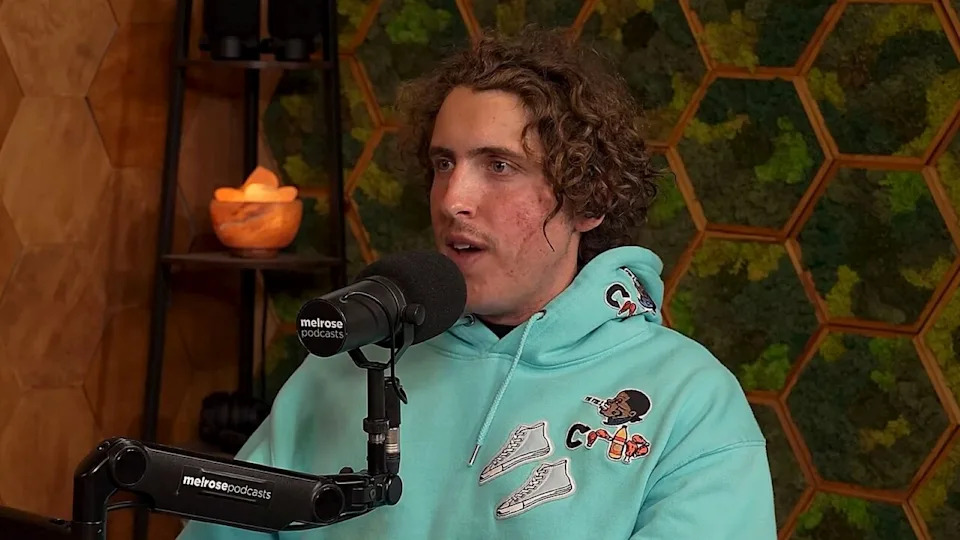
Andrew Callaghan’s Channel 5 interview with LaBeouf reignited debate over accountability, rehab, and excuses.
Credit: Neal Brennan, CC BY 3.0, via Wikimedia Commons.
What the Record Actually Shows
Police and court reporting describe a night that looks less like a fear response and more like sustained aggression.
LaBeouf was arrested and charged with two counts of misdemeanor battery tied to a Feb. 17 incident outside the Royal Street Inn and R Bar during Mardi Gras. Police reports allege he punched at least two men with closed fists. One alleged victim told officers he was hit in the face and pushed his nose back into place. Police reports also allege he repeatedly used an anti-gay slur during the altercation and while being arrested.
One line attributed to the police report is blunt. LaBeouf allegedly complained, “These f-ggots put me in jail. I’m a Catholic.” That is not a fear response. That is a statement of grievance.
At a subsequent hearing, Orleans Parish Criminal Court Judge Simone Levine raised the total bond to $100,000 and ordered him to return to drug and alcohol rehabilitation, along with weekly testing. She cited public safety and the risk to a marginalized community that has “gone through so much terror.” She also said the court did not believe he takes his “alcohol addiction” seriously. The judge reviewed test results showing no illegal drugs but an alcohol marker indicating recent drinking.
Then came the follow-up warrant. LaBeouf surrendered, picked up an additional misdemeanor battery count tied to the same Feb. 17 incident, and walked back out after posting $5,000.
His attorney argued that he is being treated more harshly because he is famous. That may be true. It still does not answer the core issue.

he French Quarter in New Orleans, where LaBeouf was arrested on February 17, 2026, following a brawl outside R Bar. Credit: Kaylin Idora Photography, CC BY 2.0, via Wikimedia Commons.
The Diagnosis That Doesn’t Exist
A Napoleon complex is not a clinical diagnosis. It is pop-psych shorthand. It is not a medical diagnosis.
The label is slippery. It can sound like accountability while functioning as insulation.
If LaBeouf is telling the truth about what sets him off, the harder truth still follows. Fear does not excuse violence. Even if unwanted touching occurred, the response still matters. The legal system is not weighing his metaphor. It is weighing the alleged conduct.
This is why the “it’s a deeper issue” defense lands wrong with the public. People hear a story that starts with self-diagnosis and ends with someone else being injured. They treat the diagnosis as narrative control. Online reaction was immediate. “Like clockwork with him,” one commenter wrote. “Every time he gets busted doing some f***ed up shit he goes on a big excuse tour. Been doing this shit for damn near 20 years.”
The Pattern the Interview Reveals
LaBeouf has been in this cycle before. Public incident. Public explanation. Public debate over whether the explanation is growth or spin.
What makes this week different is the compression. The follow-up charge arrived while the interview was still circulating. The timeline collapsed the arc before it could be written.
He said he would figure it out. He said rehab was not for him. He said alcohol is not the real problem.
The question the record keeps asking — and that his own interview keeps circling without answering — is whether figuring it out on your own terms is still a valid position once other people are the collateral.