
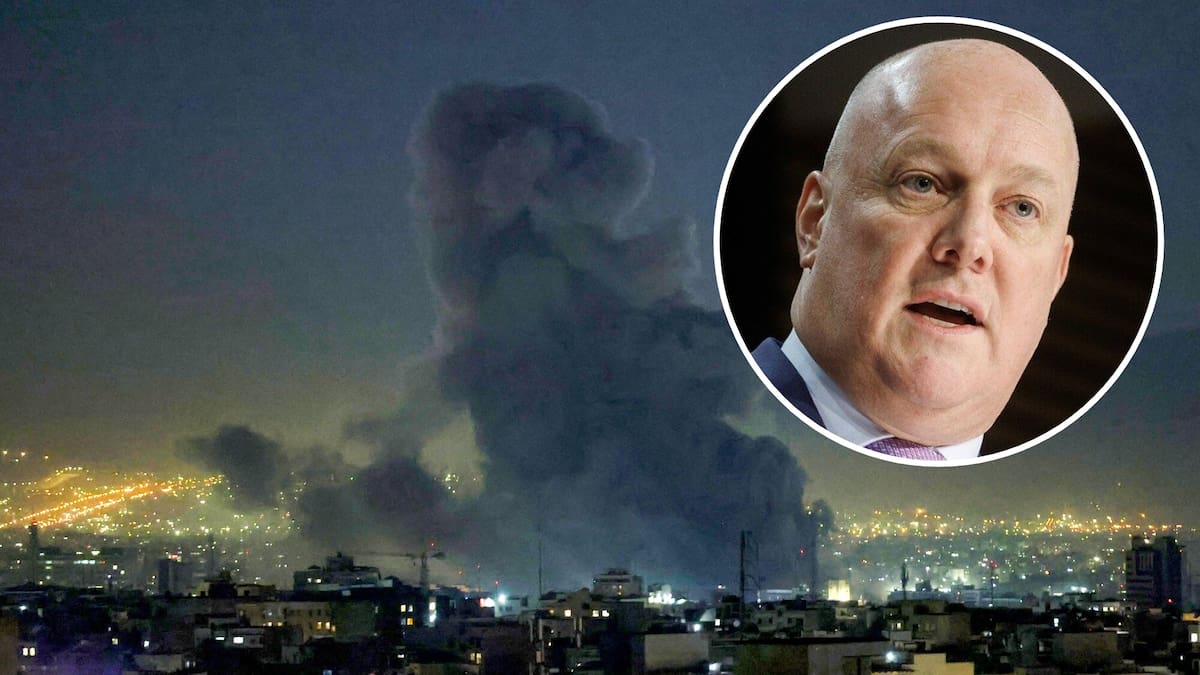
But taking questions on his Monday morning media round, and later at his post-Cabinet press conference, Luxon struggled to articulate where New Zealand stood on the conflict, what it meant for the country today, and the world in which New Zealanders live.
And that is a problem.
On Sunday, Luxon and Foreign Minister Winston Peters said the Government “acknowledge[d]” the action the US and Israel had taken, but wouldn’t say whether the Government supported it.
In the spectrum of statements from America-friendly nations, that put New Zealand slightly behind Australia and Canada, but ahead of some European nations.
Asked to explain what acknowledgment even means in this context, over about five agonising minutes on RNZ’s Morning Report, Luxon couldn’t really articulate a response, beyond saying that New Zealand abhorred the “evil” Iranian regime and how it treated its people.
It’s surprising Luxon did not have a more eloquent answer to this question, which is the most pertinent one for New Zealand.
Almost no one in this country supports the Iranian regime.
Many, having read of the death of 22-year-old Mahsa Amini at the hands of Iran’s morality police for not wearing a hijab, would agree with Luxon that the regime is indeed “evil”.
Many would also fear Iran’s likely pursuit of a nuclear weapon and funding of terrorism in the Middle East and around the world, and would also conclude that the regime posed a threat, not just to its own citizens, but to people outside Iran’s borders, including New Zealanders.
But these factors: domestic repression, external aggression, and the pursuit of nuclear weapons, do not in and of themselves justify military intervention.
Iran, sadly, is one of many despotic and aggressive regimes.
North Korea represses its own people far more than Iran (not that it’s a competition), and it actually has nuclear weapons.
No one is suggesting a pre-emptive strike there. New Zealand has been critical of many “evil” regimes across the decades. That doesn’t also mean we agree (or in this case “acknowledge”) action to topple them.
The reason these two questions are distinct is an important one.
Many regimes are, in the eyes of their enemies, “evil” – and there’s certainly evidence the Iranian regime clears this bar.
But if the wickedness of a regime and its potential to possess threatening weapons is the bar for offensive strikes, that is a recipe for international anarchy, in which the cost of global instability is greater than any benefit gained from the demise of an evil regime (and let’s not forget, the Iranian regime hasn’t yet been deposed).
That is why international law puts a high threshold on international intervention.
There will be increased pressure on the Government to come up with a view on the legality of these strikes. Attacks made in self-defence can be legal, but there is no evidence that Iran was immediately planning to make war on Israel or the US, which would justify a “self-defence” argument.
That “immediately” part is important because pre-emptive self-defence has an incredibly narrow definition in international law, established by the century-old Caroline doctrine, which holds that the threat must be “instant, overwhelming, and leaving no choice of means and no moment for deliberation”.
An intercepted projectile falls into the sea near Dubai’s Palm Jumeirah archipelago. Photo / AFP
Now, it may be the case that the US and Israel have strong intelligence that this test was met, or other intelligence that justified this intervention.
But on Monday, Luxon said he had not seen any intelligence, hadn’t asked for any, and didn’t plan to do so beyond regular officials meetings.
“Ultimately it’s for our officials to have those discussions,” Luxon said.
Asked whether he would be asking for any intelligence, Luxon replied, “again, those are to be determined”.
We can guess at the logic of the Government’s moves.
It’s clearly decided to drift closer to the US on matters of defence and security in response to China flexing its muscle in our region.
You can also guess that in order to give effect to that policy, it’s decided to hold its collective tongue when the US does something New Zealand could reasonably disagree with, or could at least call into question.
You can guess that most of the Cabinet probably, deep down, disagrees with these strikes (even those who detest Iran), but the strategy this week appears to be to nod politely in the direction of Washington, say as little as possible and hope no one notices.
If this is the case, if New Zealand’s defence policy is to slouch further in the direction of Washington, the public is entitled to an explanation, and an honest airing of the costs and benefits of such an approach.
Instead, Luxon denies this American tilt is taking place.
“I think there’s nothing that’s changed,” Luxon said when asked whether his Government was more pro-American than its predecessor, a fact which seems obvious.
The challenge with this tilt towards the US, is that its current administration is so volatile and capricious that any potential security dividend from drawing closer could be more than undermined by the damage to NZ’s standing in the rest of the world, if we are seen to back or “acknowledge” a country that regularly and wantonly undermines the global order.
Justifying his foreign policy today, Luxon pointed to his State of the Nation speech, in which he quoted, without attribution, MFAT’s 2023 strategic assessment of the international picture.
“The international rules-based system is breaking down,” Luxon said, with nations choosing to assert themselves with “power” instead of abiding by “rules”.
The original MFAT line was critical of this shift, warning the end of these rules would threaten small countries like New Zealand.
The risk of Luxon’s remarks today is that they are at best silent on that shift, and at worst a tacit endorsement of it.
It’s one thing to prepare for a world in which rules give way to power, it’s quite another to aid it into being.