

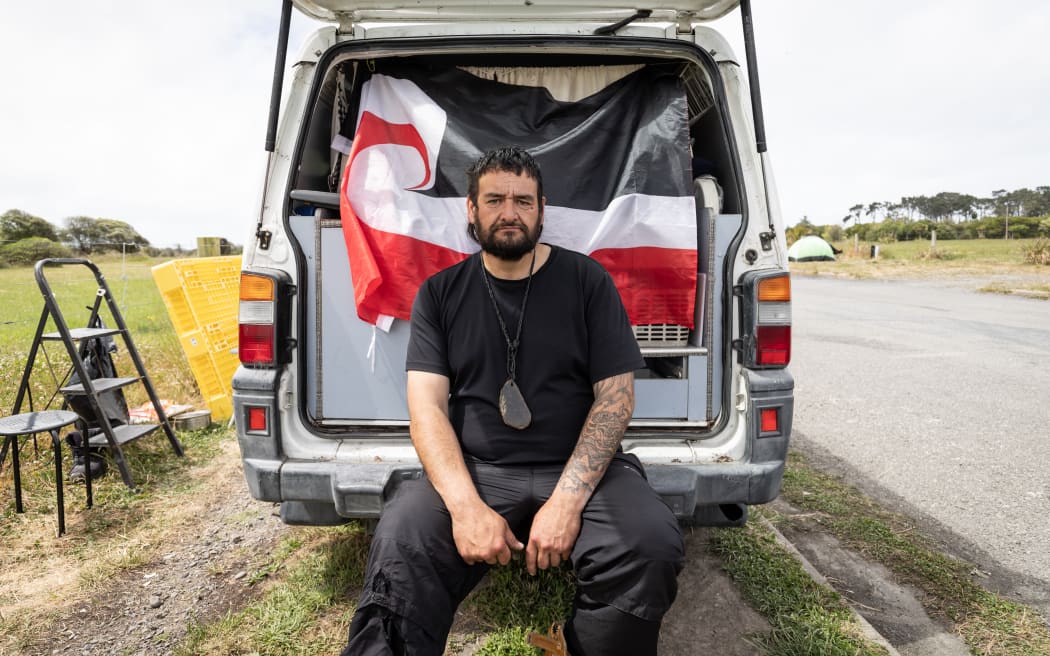
Moko, who wanted to be identified by his first name only, had been living at Wetlands Grove for about 18 months.
Photo: RNZ / Nate McKinnon
At Bexley’s Wetlands Grove, three dogs in a caravan bark enthusiastically, shoving their heads through an open window, jostling to see who has arrived at their Christchurch red zone home.
The deserted street is the last remaining road leading to the old Pacific Park subdivision overlooking the Avon River and the Avon Heathcote Ihutai Estuary, which was largely cleared of homes because of liquefaction after the 2011 earthquake.
The caravan’s owner shut the dogs away and directed RNZ to Moko, the informal leader of a ramshackle street community that had sprung up around buses, vans and cars.
Moko, who wanted to be identified by his first name only, had been living at Wetlands Grove for about 18 months, with numbers growing from three to 40 over that time.
“Some people work, some people don’t. Some people are here because mainly there is no availability (of homes). They’ve got pets, they got too many kids. It’s too hard to afford cause you gotta pay rent, and then you also got to pay power, phone, internet, and then food,” he said.
Moko was living in emergency housing when he was the victim of a home invasion.
His request to move was turned down, so he started living in his van four years ago.
Moko worked full-time as part of an on-call road crew and while his set up worked for him for now, he was finding it difficult to return to housing.
“It’s getting picked as suitable. There is a lot of judgment,” he said.
“You turn up to a viewing and you’ve got 30 other families there. We’ve got families down here, actual families. There is a lady with three or four kids that has to live out of her bus.
“We’ve got people coming down here who work but they live in a tent. It shouldn’t be happening.”
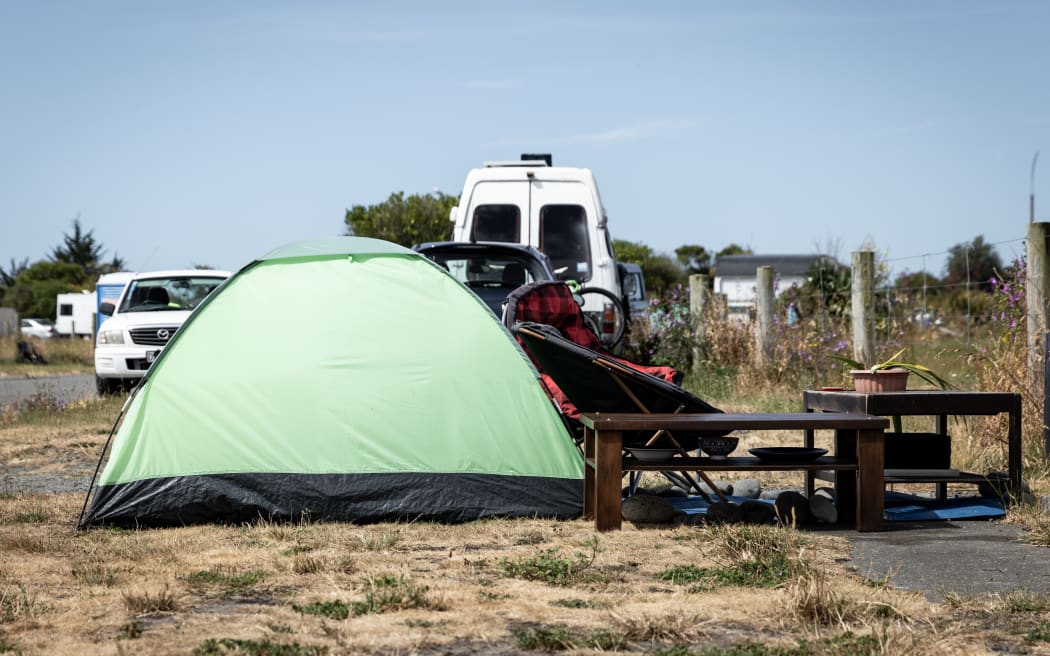
Bexley’s Wetlands Grove is the last remaining road leading to the old Pacific Park subdivision.
Photo: RNZ / Nate McKinnon
The council regularly removed rubbish and had delivered portaloos, Moko said.
“It’s better than walking 25 minutes to the closest one, only to find it has been shut because it has been tagged up or someone is sleeping rough in it,” he said.
One house remained in the red zone on Velsheda Street near Wetlands Grove after the owners turned down the Crown’s initial buy-out offer.
The house was sold to the council and quickly demolished in February.
Moko believed the owners had no issue with people living on the street, although the Wetlands Grove community has had problems with others who object to their presence.
“We’ve had people come down and try and do stuff, come down and throw eggs at our vehicles. I caught two young fellas just about to vandalise the portaloo, and their excuse? ‘My mum told us to, cause we don’t like you people’,” he said.
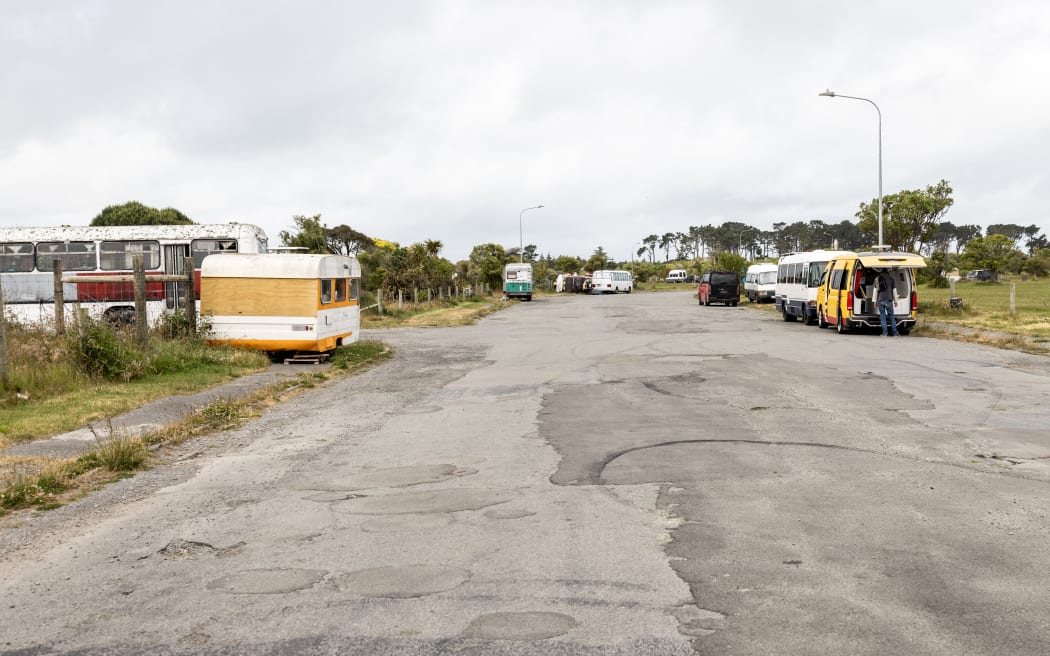
Bexley’s Wetlands Grove is the last remaining road leading to the old Pacific Park subdivision.
Photo: RNZ / Nate McKinnon
‘This is freedom’
Down the road, the windows of Ngawai Timu’s tidy campervan were trimmed with curtains and her home on wheels had running water, lights, a fridge, television and a chemical toilet.
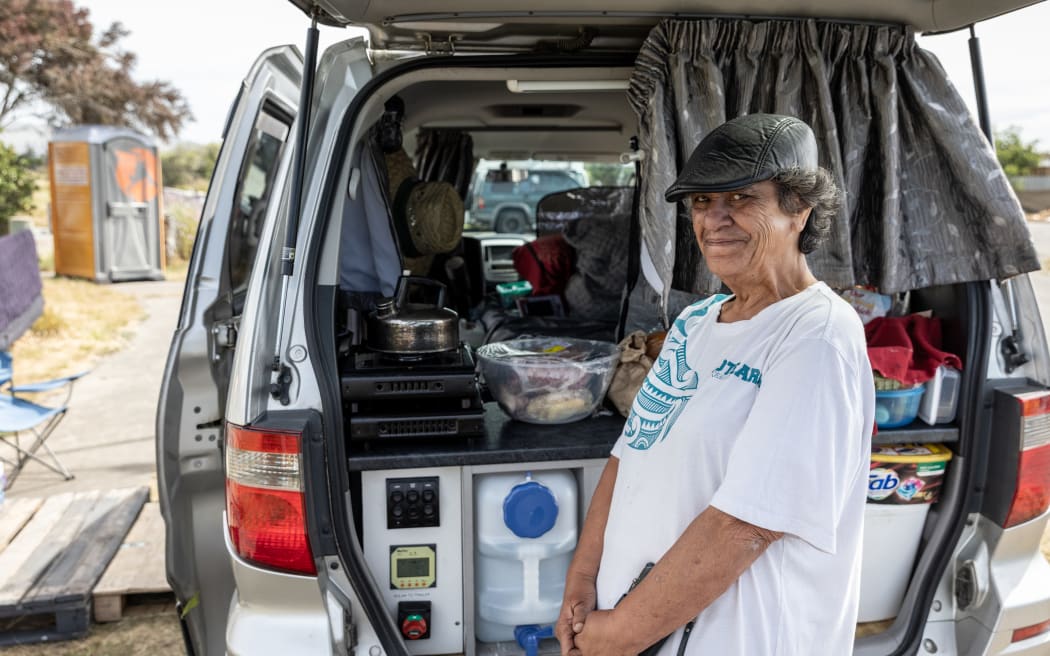
Ngawai Timu.
Photo: RNZ / Nate McKinnon
Timu started living in a car before upgrading to her campervan a couple of years ago after deciding $470 per week rental payments were too much.
“All I felt was I was paying for somebody’s mortgage,” she said.
“I’ve paid my way and did my work and paid my taxes and all my life of hard work and still paying high rent. So I’ve come from Auckland, Hamilton to Christchurch to live for free,” she said.
“I have water, running, and can have a TV, and also my lights, my fridge. I have a dirty big fridge, everything I need is in this van.”
Ngawai said she was recently offered a short-term one-bedroom house as part of Kainga Ora transitional housing programme but rules and restrictions, including the frequent checks and not being able to bring her fridge or have space for her two vehicles meant she moved back into her van.
Many members of Timu’s family, including some of her children, had moved to Australia although a son lived nearby and being close to her mokopuna was important.
For now, van life was okay.
Timu looks out over the open land and the view of the ever-changing estuary and distant Port Hills.
“I’ve gone back to being eight, nine-years-old and living out in the country. This is what I’ve known to be freedom. Look at it, nothing there,” she said.
Between Timu’s van and the sweeping Canterbury landscape was a stark reminder of tougher times, with a small, one-man tent just visible in the long grass.
In the depths of winter, when Wetlands Grove was icy cold, his neighbours helped him to an old broken-down car to sleep.
‘Refugees in our own country’
Polly Stewart is sitting in the sun chatting to a friend when RNZ arrives, with a short blonde bob, colourful dress and immaculate make-up.
“I’m transgender. My former partner asked me to leave because she couldn’t cope with the idea, and as Fats Domino sang ‘I’ve found my freedom’,” she said, singing the words.
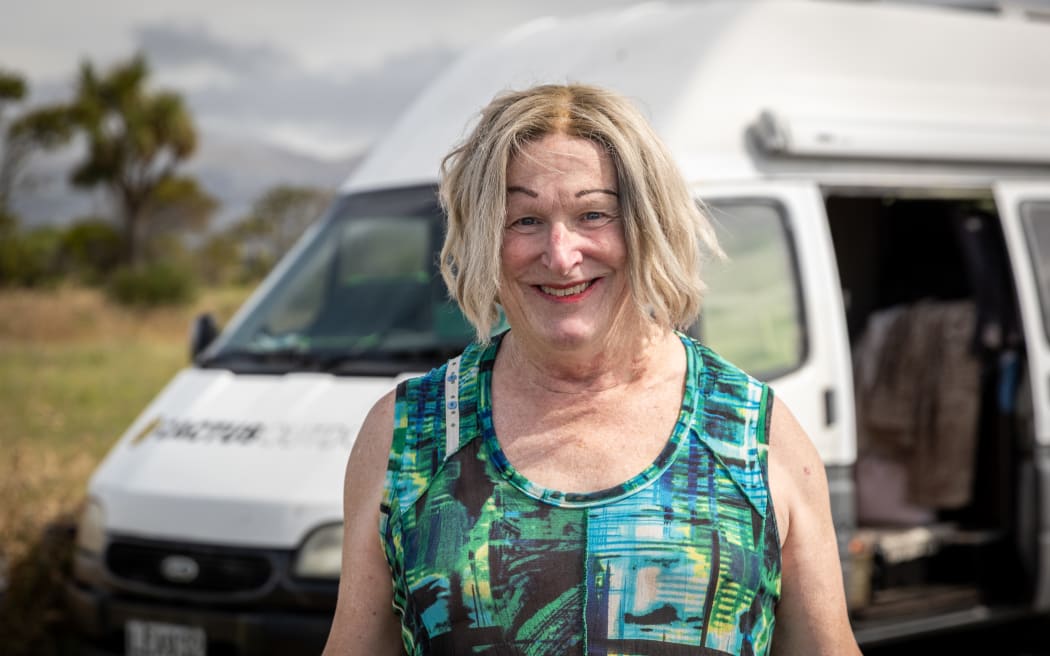
Polly Stewart.
Photo: RNZ / Nate McKinnon
Stewart said the cost of housing kept her in her bus, with the pension enough to cover expenses and a few savings.
She said the prospect of a Kaianga Ora home was unappealing.
“Being here is sort of freedom for me. Whereas living in a Kaianga Ora apartment, no. It’s like being in prison,” she said.
Other people living at Wetlands Grove did not wish to speak to RNZ, including a man who said there was no point because news coverage would not change a thing.
“We’re not homeless by the way, we’re refugees in our own country,” he said.
Christchurch Mayor Phil Mauger said some people would criticise the council for paying for portaloos and rubbish collection in Wetlands Grove, but the council needed to keep conditions safe.
“It makes sense to me that you should because that’s sanitary stuff. You imagine if it wasn’t there,” he said.
“The piece of road they are parking on is out of the way, so to speak, it’s high, it’s dry. It’s not down in the bits that flood, or anything like that. I understand it still has street lights running on it. If that is where they have ended up, sadly at this stage, we have to do something to make sure it is sanitary otherwise it could turn into an absolute disaster.”

Christchurch Mayor Phil Mauger said some people would criticise the council for paying for portaloos and rubbish collection in Wetlands Grove, but the council needed to keep conditions safe.
Photo: RNZ / Nate McKinnon
The council’s citizens and community general manager, Andrew Rutledge, said there was no set end date for the provision of portaloos and rubbish collection.
“We have been clear that this is a temporary situation as that space will be needed for ecological restoration works in the future,” he said.
With Pacific Park’s final house now gone, the council had started work on its plans for the area.
Rutledge said the river regeneration plan detailed the restoration of tidal wetlands in the area.
All infrastructure such as roads, power, water and wastewater services would be removed in the next 12 to 18 months and the council would soon start the process of closing all remaining roads.
Wetlands Grove would become wetlands once more, so Moko, Timu, Stewart and others would once again need to move on.
Five housing providers – Comcare, Emerge Aotearoa, Christchurch City Mission, Housing First Otautahi and the Christchurch Methodist Mission – work together to try to help people who are homeless.
Housing First Otautahi spokeswoman Nicola Fleming said there had been a massive jump in housing waiting lists since the Covid-19 pandemic.
“We’ve got 103 on that wait list at the moment, which is horrendous. Before Covid it sat at about 70, after Covid it’s jumping and just jumps all the time. We can’t house people fast enough,” she said.
That wait list was only for people who were classified as chronically homeless, which meant they had been without a home for at least a year.
In addition to community housing, Housing First Otautahi also helped people into private rentals and supported them as they re-adjusted to home life.
Fleming said a lack of housing remained a key problem and while more central or local government-supplied housing was much-needed, a quicker fix could be found in private landlords working with providers.
“They get rent paid every week by the government through MSD and they get market rent paid. It’s never missed whether the property is vacant or not, so that’s a massive bonus for someone,” she said.
“They don’t have to manage the property and don’t need a property management firm, we do that through our community housing providers. We visit with really great kaimahi, staff, who visit once or twice or sometimes four times a week if someone is in crisis.
“There is the other side that you are doing something great for someone in your community and you feel good that you can offer someone a home. So it’s a really lovely thing to do.”
At Wetlands Grove, a communal tent had been set up to create a more homely feel.
Moko wanted to make more of the expanse of green land around him, with dreams of putting in sheep to keep the grass down and provide food.
He pointed to a break down in mental health and housing services as reasons the Wetlands Grove population would keep growing.
Asked what Moko wanted for himself and others he replied, “humbleness and love”.
“It is okay to be not okay but never judge a book by its cover, that’s all. If you want to come down and talk to us, come down and talk to us. We’re not bad people,” he said.
Sign up for Ngā Pitopito Kōrero, a daily newsletter curated by our editors and delivered straight to your inbox every weekday.