
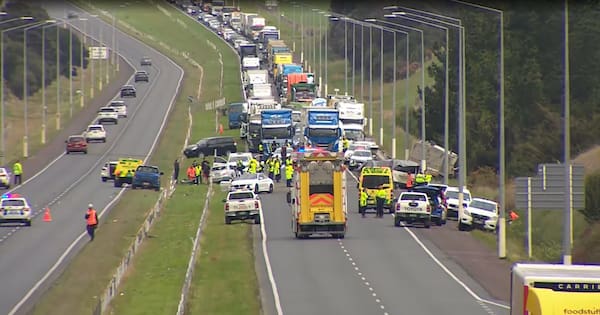
The deaths of three Samoan seasonal workers in a van crash as they were about to return home could have been prevented with more modern median barriers, a coroner says.
Uili Faaofo, aged 45; Taavao Tolala Kelemete, aged 32; and Leauga Jerry Leauga, aged 37, all died on August 26, 2024 when a fully laden truck with a blown-out tyre drove through the centre barrier of the southern motorway in Ramarama, Auckland, and collided with the van they were travelling in. The truck also hit two cars.
A fourth man in the van was seriously injured.
In a report released today, Coroner Alison Mills examined the events before, during, and after the crash – and gave recommendations and comments about how the deaths could have been prevented.
The crash
The morning of the crash, Faaofo left home at about 4am to head to Ōpōtiki to pick up his nephews, Leauga and Tolala Kelemete, and four other Samoan seasonal workers and bring them back to Auckland.
The six men were described as happy and in good spirits as they were about to return home to Samoa after spending six months working in New Zealand.
They had various plans for their remaining time in the country, including visiting Aotearoa-based family and having a short holiday prior to their departure home.
All passengers in the van were wearing seatbelts. Those who had survived the crash said they had no concerns about Faaofo’s driving or about the condition of the van.
At about 1.40pm, Faaofo was driving north on State Highway 1 on the Ramarama straights – about 900m from the Ramarama offramp.
He was in the right-hand lane, nearest to the central wire barrier. The road had been described as quite busy at the time, and the weather conditions were good.
This section of motorway is divided by a wide grass berm, about 7.9m wide, with a three-strand wire crash barrier on both sides of the berm, according to the report.
On the far southbound lane, a 2015 DAF CF truck owned by TDM Construction Ltd was heading south and had just driven under the Ramarama interchange when its right front steering tyre blew out.
This caused the truck to veer sharply towards the right, the coroner said, where it then hit the rear of a Toyota Mark X travelling just in front of the truck in the next lane. This car was then pushed into the wire median barrier.
The truck then continued and ploughed through both the southbound and northbound central median wires. It then hit the rear of a BMW driving in front of Faaofo’s van.
The impact caused the BMW to spin and connect with the rear axle tyres of another truck and trailer unit heading north.
The truck then hit Faaofo’s van – where it continued to move forward until it hit the left side road barrier.
Faaofo, Tolala Kelemete, and Leauga all died at the scene of the crash. Leauga’s younger brother, Lapi, was taken into hospital in a serious condition. He suffered long-term and permanent brain injuries.
The driver and passenger of the Toyota Mark X were injured and admitted to hospital with minor to moderate injuries.
Findings
The serious crash unit investigated the crash and concluded the two wire crash barriers on the central grass berm were not of a sufficient safety rating to be able to capture and redirect the on-coming truck away from the northbound lanes.
The investigator advised that in their opinion, the barriers should have been replaced with barriers with a higher safety rating – which would have been more conducive to the type of vehicles which travel on State Highway 1.
“Stone drilling” was identified on the front left steer tyre, which the serious crash unit investigator concluded was likely the cause of the blowout on the right steer tyre.
Police said the crash near Ramarama was reported at around 1.47pm, with early indications suggesting multiple people critically injured. (Source: 1News)
Although the truck was overloaded with an excess weight of 3170kg, its weight limit was not exceeded and the investigator concluded it was not a contributing factor to the blowout.
During the investigation into the crash, police identified the truck driver, Mr Lauder, had not been adhering to the truck drivers’ work-time and logbook rules.
The coroner said the driver regularly failed to take his required 30-minute break after his five and a half hours of work time, and/or had falsely recorded his breaks in his logbook.
While there was no suggestion this directly contributed to the crash, Lauder received two $450 fines for exceeding his continuous work time and making a false statement in a logbook.
Meanwhile, TDM Construction was handed down a $625 fine for exceeding weight on two axles in a tandem axle set and exceeding the permitted maximum gross weight.
In her concluding remarks, Mills acknowledged the “devastating impact the death of these three men have had on so many people both here in Aotearoa/NZ and in Samoa”.
“I extend my very sincere condolences to their ’aiga, their friends and all those who knew and loved them.”
Recommendations
Modern median barriers have been able to successfully prevent heavy laden trucks from crossing into oncoming traffic, the coroner said, adding that it was “highly likely” that higher performing barriers would have prevented the truck from crossing over.
New Zealand Transport Agency Waka Kotahi advised there were 5533m of legacy barriers on the state highway network which did not meet current safety standards. NZTA said the “funding constrained environment” had led to longer wait times for the barriers to be replaced.
In her report, the coroner acknowledged the constraints as he recommended the transport agency “urgently prioritise the replacement of all remaining ‘legacy barrier’ systems on the state highway network”.
NZTA responded to the recommendation and advised that, subject to funding availability, it would undertake an audit of the median barriers on the network to confirm the extent and condition of the legacy barrier systems.
It also proposed to “programme the prioritised replacement of legacy barrier systems with appropriate, currently approved tested systems, considering location, specific risks and available funding”. NZTA suggested the coroner’s recommendation be amended to reflect their proposed action.
In response, the coroner said while they acknowledged NZTA’s proposed course of action, it was clear the legacy barrier systems were inadequate from today’s environment.
“Replacing them only when they are unable to be repaired and subject to funding, in my view, is not sufficient, given the devastating consequence when they fail.”
The coroner also said the risk of a tyre blowout, while always an unexpected event, can be mitigated by having a robust maintenance schedule.
Therefore, the coroner also made the following recommendations directed at the trucking industry and the tyre service industry at large:
– All operators of heavy motor vehicles review their current tyre maintenance schedules and ensure they are fit for purpose and reflect the type of terrain, load and use the tyres are exposed to. Tyre maintenance schedules should take into account that super single steer tyres are more sensitive to wear and may require additional attention.
– Operators keep an accurate record of their tyre maintenance schedules included when purchased, mileage, usage, repairs undertaken, rotation of tyres, alignment and tyre pressure checks.
– Truck drivers are reminded of and educated about pre-trip inspections of tyres, checking tyre pressure, and how speed can increase the risk of premature wear for “super single” steer tyres during long trips or heavy loads. Drivers need to adhere to the maximum speed recommendations from the tyre manufacturer to mitigate this risk, the coroner said.
The morning’s headlines in 90 seconds, including why Trump says the Iran war isn’t “boring”, and Liam Lawson’s new lessons for the F1 season. (Source: Breakfast)