
His new album, The Romantic, plays to the star’s strengths as a time-displaced funk impressionist while painting him into a corner.
Photo: Bruno Mars via YouTube
Bruno Mars has been on a mission of late to return to his post as modern music’s main supplier for wedding receptions and supermarkets. Following recent team ups with Lady Gaga (the torch song “Die With a Smile”) and Rosé (the meet-cute “APT.”), he’s back with his lush, saccharine fourth solo album, The Romantic, leaning into the tightness of the hit-heavy, not-much-changing set list from his Las Vegas residency. In July, rumors swirled that he played the Park MGM for nine years to subsidize gambling debt, which he and the casino deny: “I love the lore that I’m a Las Vegas lounge singer in debt to the mob,” he told the Las Vegas Review-Journal in 2024. The Romantic looks to recenter our view of Mars in what he sees as his core contribution to the planet: love songs. It’s still the case that the pop perfectionist’s soul-man routine is by turns both alluringly and frustratingly dialed in to what worked in the past. On this album, he takes a confidently slippery trip into Michael Jackson’s afro period that is hamstrung by the bubbly boilerplate balladry of Mars’s most cloying smashes.
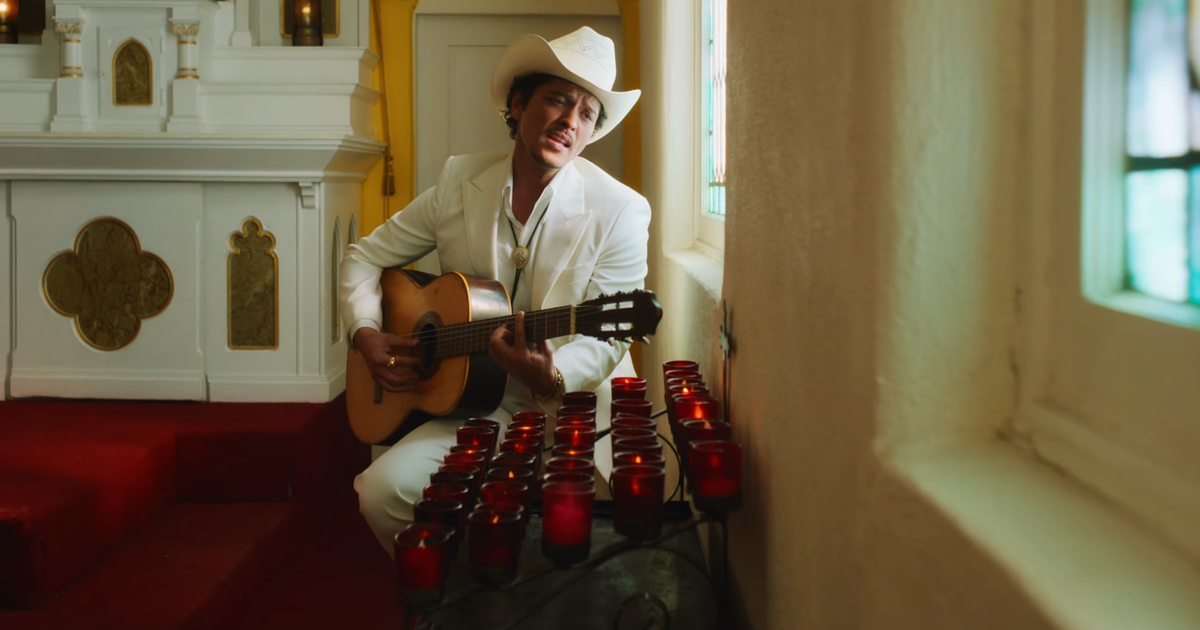
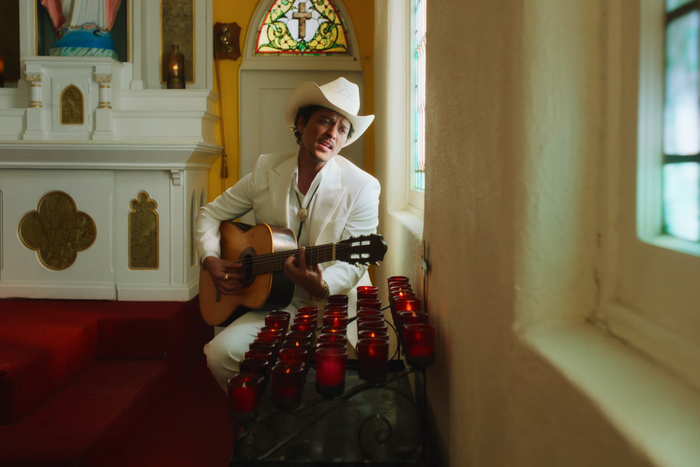
There’s nothing wrong with wanting to write songs that help people draft marital vows, his idyllic video for The Romantic’s opener, “Risk It All,” supposes. It sees an elderly couple reminiscing about their altar walk and early married life as Mars’s soft vocals are massaged by mariachi horns and bolero rhythms. Honoring the expressive delivery of Mexican bolero and pop vet Luis Miguel and the mewling simplicity of a Bryan Adams ballad, Mars aims for a timelessness that he comes close to while delivering more lover-man clichés. In 2010, he’d catch a grenade for you; in 2026, he’d climb, swim, and fly the mountains, oceans, and skies for you. While premiering the album in an iHeart Radio stream hours before its release, he admitted to rewriting “Risk It All” “over and over again … until it felt like love.” He likely intended to highlight how great love songs require time and pain, but what he said implies he endured an agonizing process only to arrive at “If your heart’s on the line / You could take mine.” It’s a beautiful song that’ll get played right where it wants as another spring and summer turns fiancés to newlyweds. But it is more refreshing as a stack of noises than a batch of lyrics.
This holds true of other hot spots on the album like the harmonically rich “God Was Showing Off” or the psychedelic “Nothing Left,” capable ’60s rock and soul jams whose lyrics lean into the same period-appropriate schmaltz of ’80s and ’90s R&B ballads that we heard on 2016’s 24K Magic, Mars’s last solo album. What sets all these songs apart from the oldies they reference — like the percussion in “Serious” resembling Santana’s “Evil Ways” or the pause before the chorus in “Cha Cha Cha” clearly nodding to the same section of the 1972 O’Jays heater “Back Stabbers” — is that Mars’s elders made music to address the moment, not to transport their crowds back to someone else’s. His band is polished and effective but Mars is consistently cruising closely to influences that he coyly avoided naming on iHeart, having been sued repeatedly by bands who felt 2014’s “Uptown Funk” cribbed from them. (“Music inspires me,” he told iHeart.) He’s making it known he’d just as soon top charts in 1966 or 1976 as 2026 without getting sued.
The Romantic plays to Mars’s strengths as a time-displaced funk impressionist while painting him into a corner as a lifetime merchant of essentially three strains of song: the one dripping in pickup lines, the one saluting the longtime flame, and the one wishing you wouldn’t leave. But the best genre-jamming exercises here are juxtapositions of sounds that speak to Mars’s history as much as to a vibe that he sees these auditory Hallmark cards as his life’s calling. It’s fair for the guy to feel like a career sentimentalist. He was born with doo-wop music playing in the hospital room at the insistence of his father, Peter “Dr. Doo Wop” Hernandez Sr., a singer-songwriter in the Love Notes, an a cappella group founded in Hawaii. Mars performed with his dad as a kid, adapting his uncle’s Elvis-impersonator act. (A Vegas hotel is not a shameful space for someone who grew up miming Elvis, whose career was reborn there.)
On The Romantic, Mars’s throwback wardrobe and mixture of Latin rhythms with rock and soul riffs conjures the New York City his father came up in before settling down in Hawaii, a time when Stevie Wonder and Jimi Hendrix touched the Zeitgeist in Manhattan studios and jazz great Eddie Palmieri saluted the Harlem River Drive. This album feels patterned after versatile but concise milestones in funk, soul, disco, psych, and more. Mars wants us to know it took ages to come together. Every gesture screams pedigree. But, basking in the affectations of that pocket of musical history, it wouldn’t hurt to try a song about relations between more than two people.
The Isleys’ Between the Sheets and Wonder’s Innervisions could juggle odes to couples in love with songs about death and disorder; Little Richard, whose flamboyant showmanship seems like a point of reference for Mars’s sense of style any year, was no stranger to caustic social commentary. But as much as The Romantic succeeds at gently contextualizing Mars in its genre explorations, resolving his early fear of being pigeonholed as a Latin artist — “Your last name’s Hernandez, maybe you should do the Latin music, this Spanish music,” he told GQ in 2013, referring to what he’d heard from labels, “… Enrique [Iglesias] is so hot right now” — he’s only ever batting around beggin’-music tropes on the mic. He’s just gonna “love you like you never been loved before.” He simply needs to know “Why You Wanna Fight?” whether you “want some pretty, brown Bruno babies.”
Funk, soul, and Latin rock are not merely groupings of syncopations, instrumentation, and vocal tics but melodic, rhythmic, and literary traditions that tap on every part of the human experience. Mars pries the social consciousness off, his ambition beginning and ending at the astute emulation of a production aesthetic. So The Romantic often sounds like the past; it’s sweetly arranged, a monument to workhorse soul revues. But its Motown-classic aspirations are thwarted by shrinking from the boldness of its predecessors as Mars aches to be enough of a question mark to transcend differences.
Sign up for The Critics
A weekly dispatch on the cultural discourse, for subscribers only.
Vox Media, LLC Terms and Privacy Notice
Related