
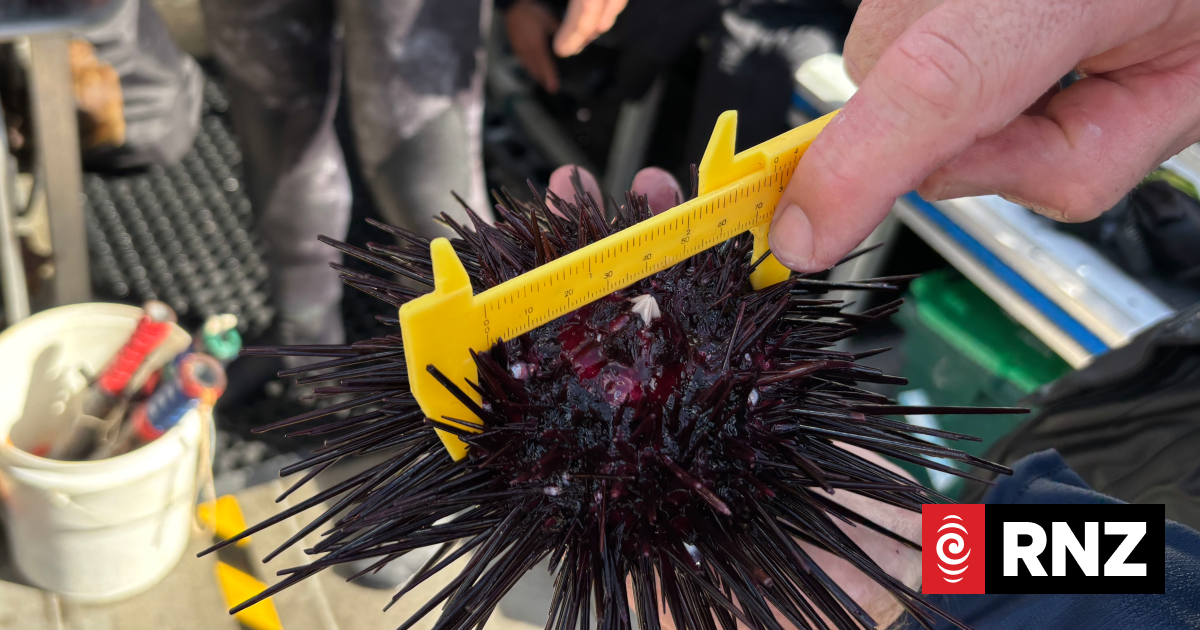
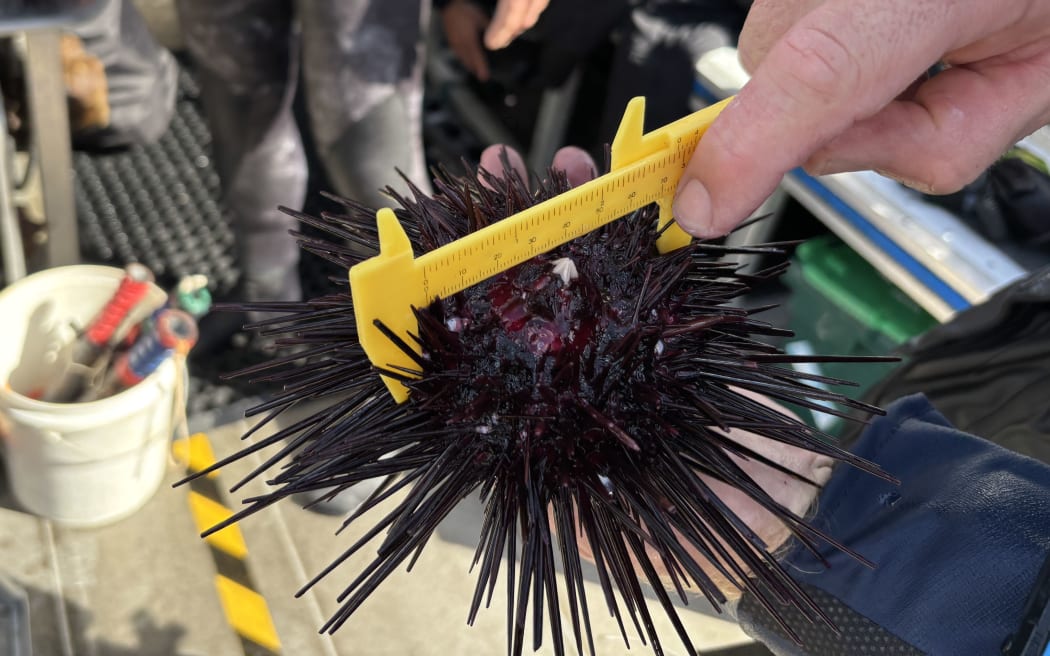
The numbers of centrostephanus rodgersii, or the purple long-spined urchin have increased in recent decades.
Photo: RNZ / Claire Concannon
Follow Our Changing World on Apple, Spotify, iHeartRadio or wherever you listen to your podcasts.
Off the Tutukākā coast of Northland, the Poor Knights Islands marine reserve is world-renowned as a special place to dive. Since it became a no-take marine reserve in 1998 (having been closed to commercial fishing since 1981), shoals of fish have bloomed to spectacular numbers.
Tourists also come to view the unique rock wall communities here – sponges, bryozoans, anemones, corals, sea squirts – these filter-feeding organisms cling to the underwater cave walls, seamounts and arches in a dazzling display of colour under the kelp.
But divers have noticed a change in recent years.
The colourful rock walls and kelp beds in some areas have been replaced by bare rock and one rapidly multiplying urchin species.
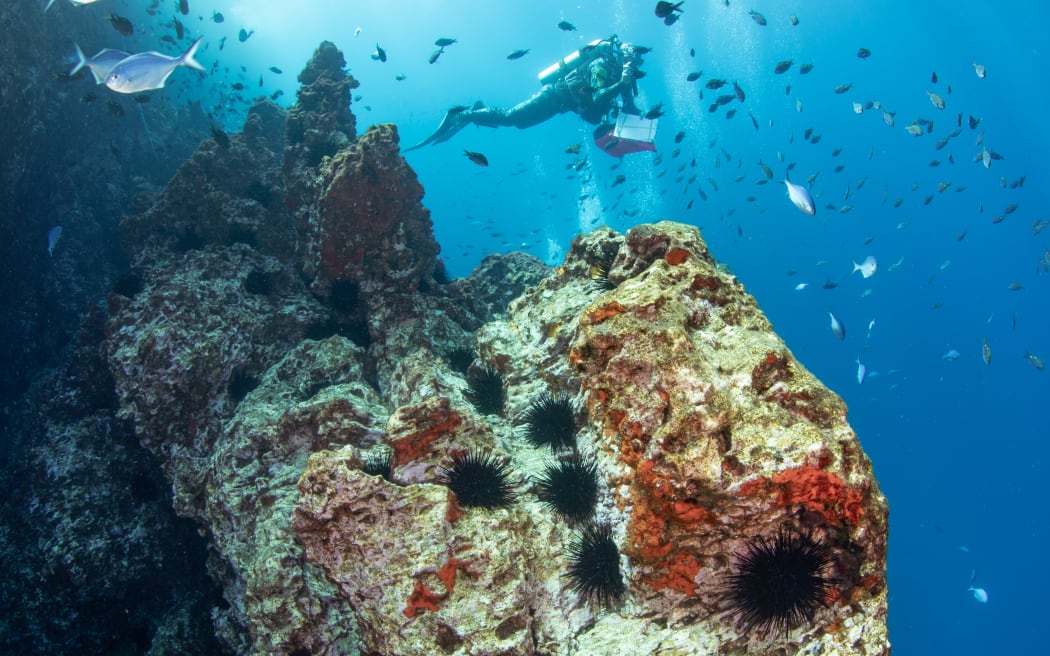
Dr Nick Shears surveys a centrostephanus barren at Ngoio rock in the Poor Knights Islands
Photo: Paul Caiger
The long-spined urchin
On the back deck of Te Kaihōpara, the University of Auckland’s research vessel, Dr Arie Spyksma holds a long-spined urchin or Centrostephanus rodgersii in this hand. Its spines move about as it desperately tries to find a dark nook under which to hide itself away.
The urchin itself is a beautiful thing – a stunning purple colour, with long, elegant spines powered by hydrolytic pressure. The length of its spines is a key difference to the endemic kina, Evechinus Chloroticus, alongside its different eating behaviours and depth range. Genetics suggest it originally drifted here from Australia, but it’s long been found in the Poor Knights Islands in low numbers and therefore considered native.
But in recent decades, as the waters at the Poor Knights Islands have warmed, the number of centrostephanus is estimated to have increased over nine-fold. They graze indiscriminately – stripping kelp and rock wall life alike. And as their numbers have grown, bare rock centrostephanus barrens have formed.
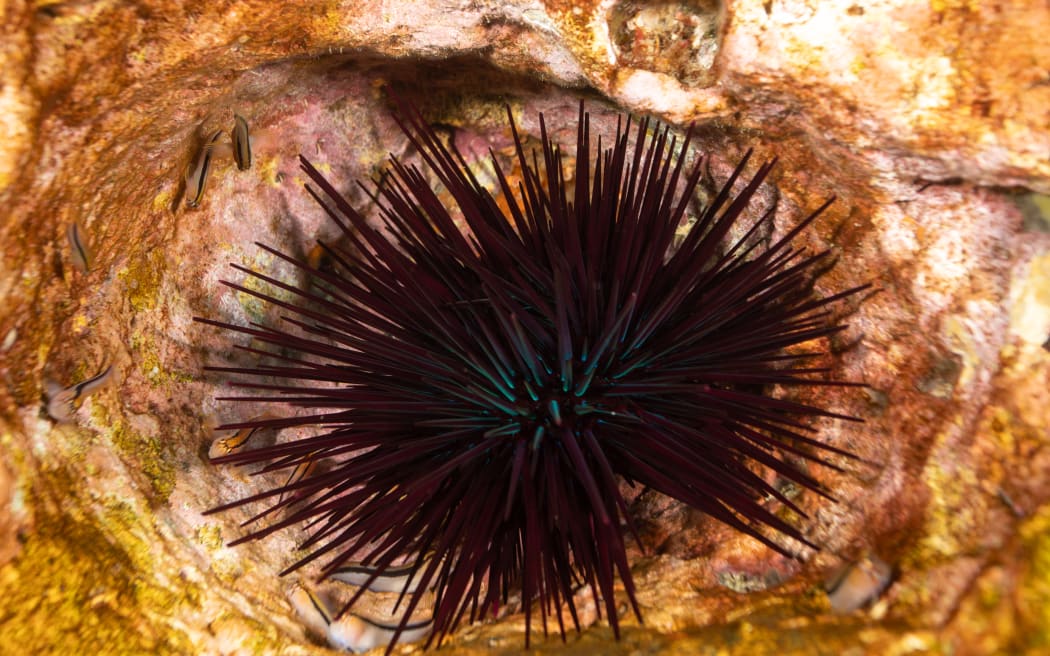
Centrostephanus rodgersii, the long-spined urchin
Photo: Paul Caiger
Arie is a research fellow in the Rocky Reef Lab. Led by Dr Nick Shears, the lab has been involved in ongoing monitoring of the Poor Knights Islands. Their own observations, coupled with those of divers witnessing these changes, triggered alarm bells for both the scientists and Department of Conservation (DOC) staff. With a local hapū, Te Whanau a Rangiwhakaahu, the decision was made to run a research trial on how these urchins might be managed through removal.
The removal trials
As the first native species management in a fully protected marine reserve, the decision was not made lightly, says Dr Sarah Meadows, DOC’s marine ecosystems team manager.
A look across the ditch was one of the factors taken on board, to the cautionary tale that is Tasmania’s reefs. Traditionally not found there, the purple urchin, as the Aussies call it, made its way south as the waters warmed. It was first spotted there in the 1970s, and by the 2010s numbers had grown to an estimated ~18 million urchins, decimating reef ecosystems.
“They can effectively clear out pretty healthy ecosystems if unchecked,” says Sarah. “We were concerned that the biodiversity values of the Poor Knights were at risk”.
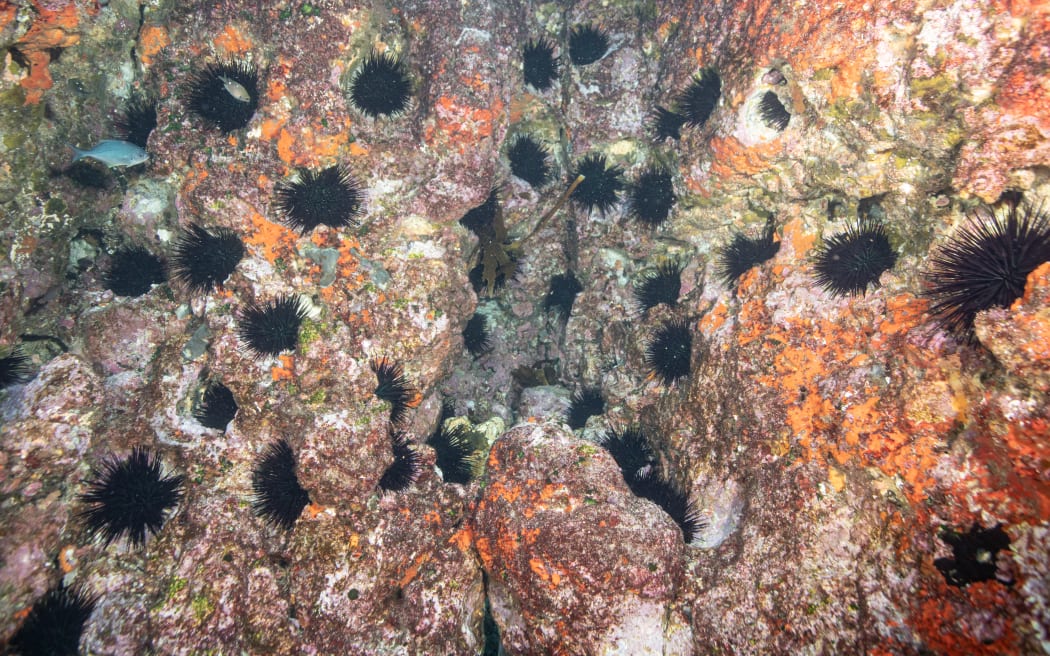
A centrostephanus barren. The long-spined urchins return to their ‘home scar’ in nooks in the rock to hide away during the day.
Photo: Paul Caiger
So, the removal trial aimed to answer some key questions, she says. Chief among them, whether it might be something they could use going forward.
“The level of effort that would require, what system rebound looks like and what the timelines on that are and whether it’s an effective tool in our arsenal to look after our marine reserves.”
In April 2023, they begun culling urchins on the reef at three small test sites. When monitoring showed rapid reef recovery they decided to scale up to five larger sites, a total of six hectares. Over three weeks in May 2025, a team of divers spent nearly 290 hours underwater removing as many long-spined urchins as they could. They estimated that this equates to 24% of the reserve’s barrens, says Sarah. It cost just under $140,000 and was funded by DOC, Fisheries New Zealand, and Northern Regional Council.
Monitoring of these larger sites is next, to see how quickly the reef life can recover. But the trial sites sit next to control areas with untouched centrostephanus barrens, so another important question is how long it will be before the urchin reinvades, says Arie.
“The reality is this alone is not ever going to stop the problem because there’s always going to be centro coming back into the site. We need to look at this as part of a broader picture of how we manage the ecosystem.”
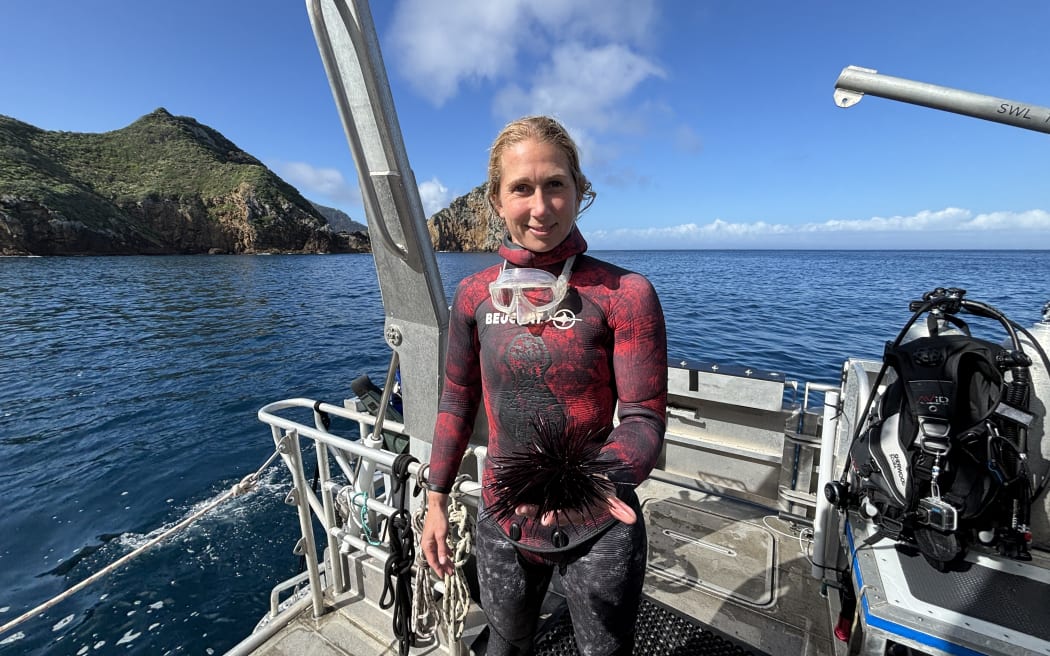
Dr Kelsey Miller holding a centrostephanus, long spined urchin
Photo: Claire Concannon
The broader picture
Before the Poor Knights Islands became a marine reserve, the endemic urchin, kina, had begun a similar expansion into barren-causing behaviour. Following protection, the numbers of large snapper increased. Able to get their jaws around this smaller urchin to snack on them, kina numbers were checked by this key predator, and the reefs recovered.
However, the long-spined urchin is simply too much of a challenge for snapper. Plus, it hides in nooks and crannies on the rock face during the day, only coming out at night to feed. The important predator at the Poor Knights Islands for centrostephanus is believed to be the rock lobster, whose numbers, unfortunately, have not increased in the marine reserve following protection.
In December 2025, the government announced a ban on commercial and recreational fishing for rock lobster off Northland’s east coast from 1st April 2026, for 5 years.
The hope is that will help, but as Arie explains, recovery could take time. “It’s a pretty complicated story with lobster recruitment. They have a hugely long larval duration, at least 12 months and anything’s got to hit a needle in a haystack to make its way back to the Poor Knights.”
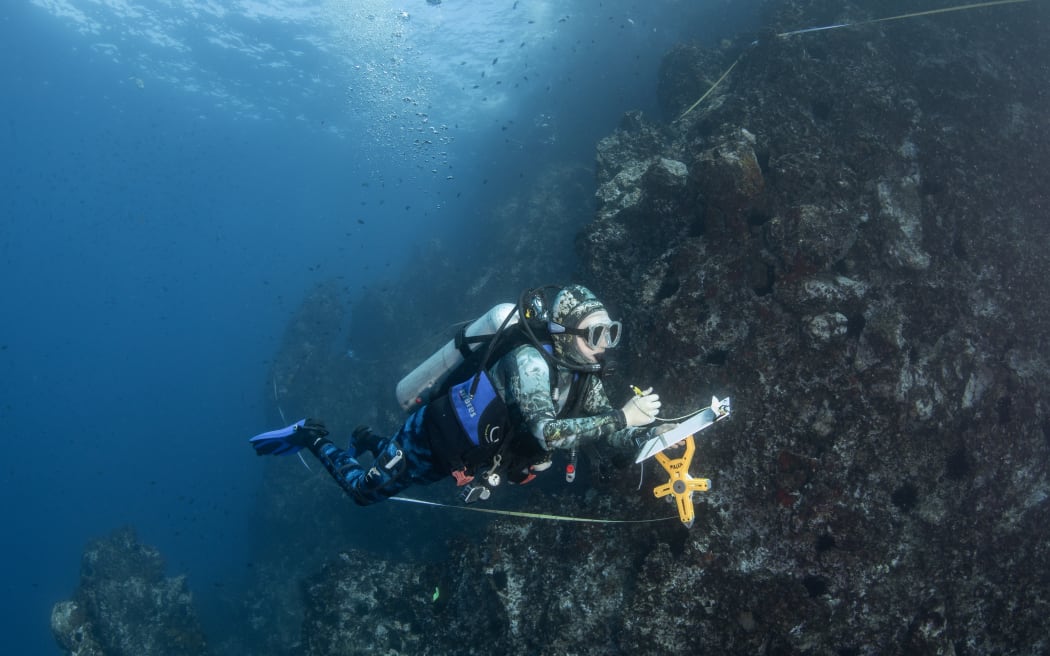
Dr Celia Balemi survey Ngoio rock in the Poor Knights Islands pre an urchin removal trial.
Photo: Paul Caiger
In July 2024, in response to expanding urchin barrens, the recreational catch limit for kina and long-spined urchins increased to 150 per day. At the same time, a new permit was established enabling groups to apply to do targeted removal or culling of urchins for marine habitat restoration.
But removal only works if it’s done right, says Arie. “It’s about 0.3 centrostephanus per meter squared that can control or maintain a barren state. So that’s why the systematic nature of the trials is kind of key, because if you’re not getting to that level you’re not actually likely to achieve anything in terms of proper recovery of those systems. There’ll still be a high enough density of urchins to trundle around and keep it in a pretty grazed state.”
In Tasmania, a government-subsidised centrostephanus fishery helped control the expansion of the urchin. Modelling shows it has been successful in keeping numbers lower than they would otherwise have been by now. However, with the roe not considered a ‘high-value product’, there are concerns about the long-term economic sustainability of such a fishery, says Arie.
In terms of the management trials to date, two and a half years after the initial small pilot sites were cleared, they show substantial recovery. The team will return in May this year to do fish transects and quadrat surveys of the larger sites and time-lapse cameras and hydrophones are continuously tracking the changes in kelp and animal life.
For Sandra Hawken, kaitiaki from local hapū, Te Whanau a Rangiwhakaahu, who has been involved with the trials, the recovery following removal has been exciting to witness.
“It was amazing to see the difference that that little bit of work made. And I’m a bull at a gate… I want to just get in there and do the whole island. But, you know, logistically that’s just not possible.”
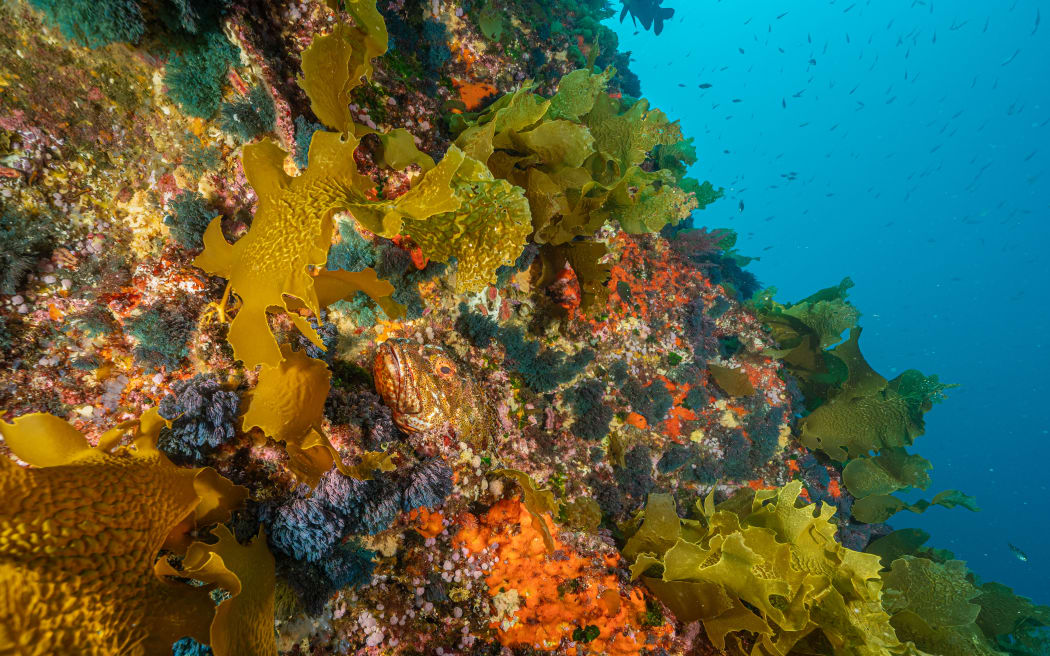
Ngoio Rock shows signs of recovering following the urchin removal trial.
Photo: Arie Spyksma
As they are in the monitoring phase, there are no decisions yet as to what happens next, says Dr Sarah Meadows. “We really want to make sure that… any decisions that are made re further activities are really informed by a pretty solid evidence base and we know what the kind of longer term ask might be”.
The Poor Knights Islands are not the only place where centrostephanus numbers are expanding, so the team also hope that what is learned here can help with management decisions as they become a problem elsewhere along the coast.
But economically, culturally and ecologically this marine reserve is quite special, says Sandra, and she hopes government resources and support are put towards this spikey problem.
“There’s none other like it in the world, so why on earth would you not protect it?”
Sign up to the Our Changing World monthly newsletter for episode backstories, science analysis and more.