
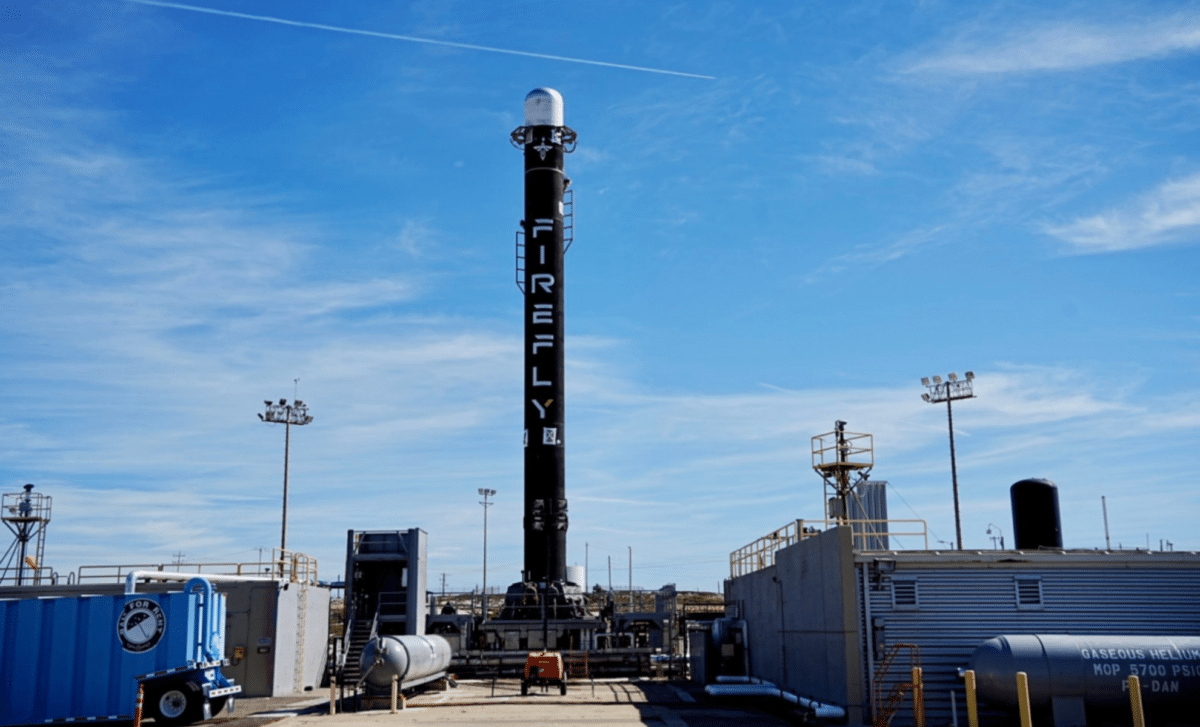
Firefly Aerospace’s Alpha rocket, an essential player in the company’s ambitious space exploration goals, was poised to return to flight on March 1, 2026, with the “Stairway to Seven” mission. However, due to high winds, the highly anticipated launch was postponed. This test mission, which will not carry any operational payloads, aims to address the critical systems of the Alpha rocket and lay the groundwork for future upgrades to its design.
The Importance of “Stairway to Seven” for Firefly Aerospace
The “Stairway to Seven” mission holds significant importance for Firefly Aerospace, a company committed to expanding space access through reliable and affordable rockets. According to the mission description provided by the company, “Stairway to Seven” won’t carry any operational payloads. Rather, it will serve “as a test flight, with the primary goal to achieve nominal first and second stage performance.” This distinction sets the mission apart from regular payload-delivery launches, as it places emphasis on testing and validating the core rocket systems. While this flight will not carry satellites or instruments, it will help ensure that the Alpha rocket performs as expected, marking a crucial step forward in Firefly’s progress.
Firefly Aerospace has faced several delays and challenges throughout the development of its Alpha rocket. In fact, the previous flight, known as “Message in a Booster,” ended in failure when the first-stage booster malfunctioned just after separation, leading to a catastrophic loss of the payload. After this incident, Firefly worked closely with the Federal Aviation Administration (FAA), who cleared the Alpha rocket for its return to flight in August 2025. The “Stairway to Seven” mission will be a critical opportunity to refine the rocket’s performance in real-world conditions, giving engineers valuable data to correct any issues before future operational missions.
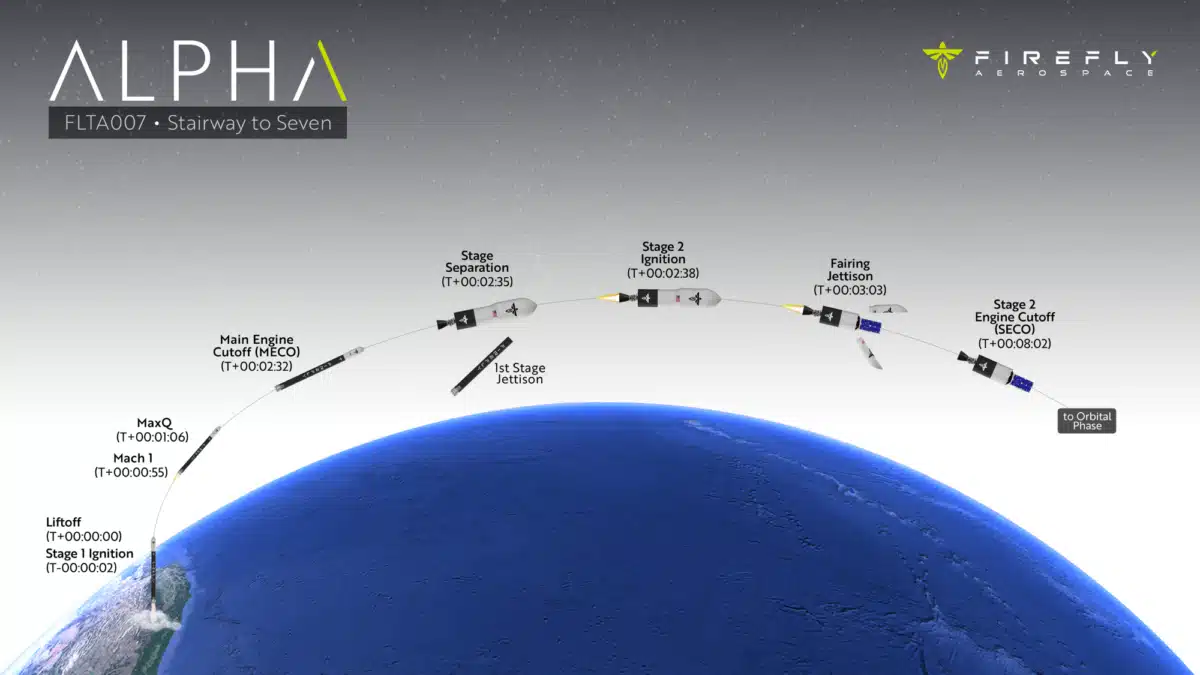 The following graphic shows an approximate timeline (HH:MM:SS) for the key mission milestones after liftoff.
Credit: Firefly Aerospace
The Significance of Alpha’s Block I and Block II Configurations
Firefly Aerospace’s mission architecture continues to evolve with each test flight. For this particular mission, Alpha will be using its Block I configuration, which is slated to be replaced with the upgraded Block II configuration in future launches. “Flight 7 will test and validate key systems ahead of Firefly’s Block II configuration upgrade on Flight 8 that’s designed to enhance reliability and manufacturability across the vehicle,” Firefly wrote in its mission description. These upgrades will not only improve the rocket’s overall performance but also streamline the manufacturing process to ensure more efficient production and scalability.
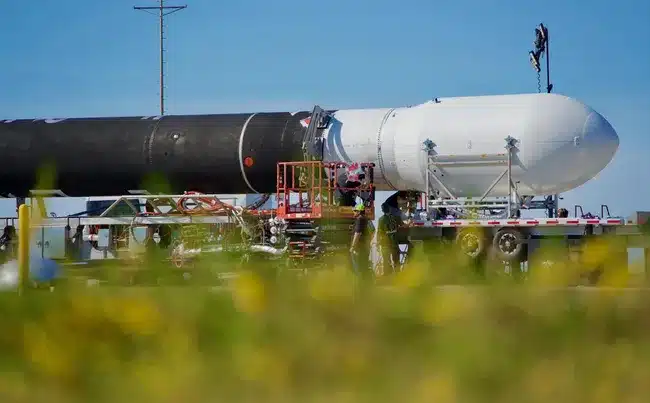 Firefly Aerospace rolls its Alpha rocket to the pad at Vandenberg Space Force Base in California for the “Stairway to Seven” launch, which is planned for March 1, 2026. (Image credit: Firefly Aerospace via X)
The transition from Block I to Block II is a significant leap forward for Firefly Aerospace. The Block II configuration includes several key improvements, such as a 7-foot increase to Alpha’s overall length, which will contribute to better fuel capacity and more efficient aerodynamics. Additionally, it will feature consolidated batteries and avionics that are built in-house, further improving the rocket’s electrical systems and reducing reliance on external suppliers. Another major upgrade is the enhanced thermal protection system, which will allow the rocket to endure the extreme heat conditions of launch and re-entry more effectively. Furthermore, the upgraded design incorporates stronger carbon composite structures built with automated machinery, making the rocket both more durable and more cost-effective to produce.