

Find winning stocks in any market cycle. Join 7 million investors using Simply Wall St’s investing ideas for FREE.
Nvidia announced $2 billion investments each in Coherent and Lumentum to secure advanced optics for next generation AI data centers and “AI factories.”
The company also unveiled new partnerships and pilot deployments for AI powered radio access networks with Nokia, LITEON, SynaXG and others.
Together, these moves expand Nvidia’s role beyond chips into optical components and telecom infrastructure for future AI centric networks.
Nvidia, ticker NasdaqGS:NVDA, is moving further into the plumbing of AI infrastructure with these optics and telecom related moves while its shares trade around $182.48. The stock has seen very large multi year gains, including a 57.4% return over the past year, which means many investors already have meaningful exposure baked into their portfolios.
For you, the key question is whether Nvidia’s push into optical technology and AI RAN changes how you think about its long term business mix and risk profile. These steps indicate management is aiming to tie the company more tightly to the build out of large scale AI data centers and future 5G and 6G networks, not just the GPUs that power them.
Stay updated on the most important news stories for NVIDIA by adding it to your watchlist or portfolio. Alternatively, explore our Community to discover new perspectives on NVIDIA.
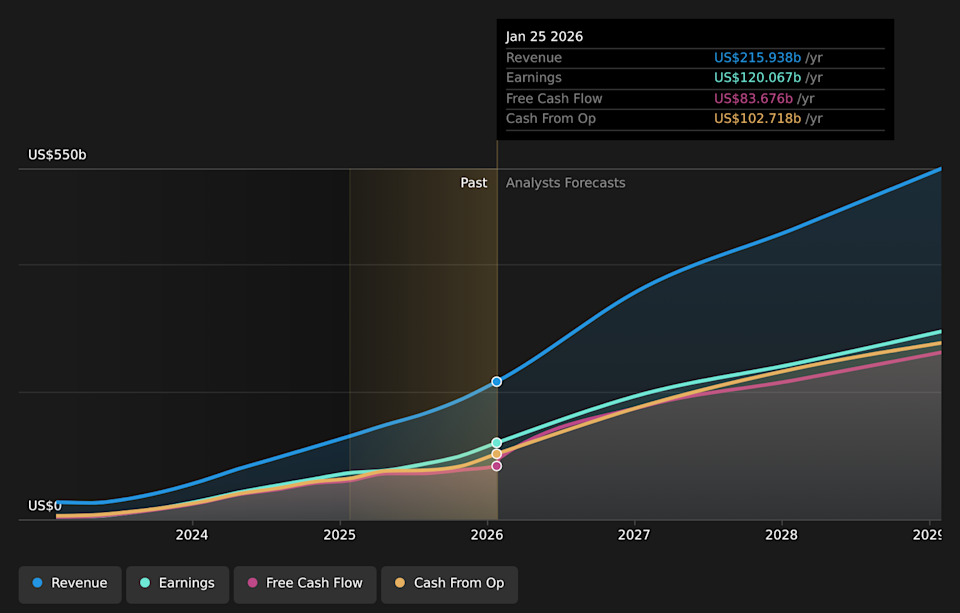 NasdaqGS:NVDA Earnings & Revenue Growth as at Mar 2026
4 things going right for NVIDIA that this headline doesn’t cover.
Nvidia’s move to commit $2 billion each to Coherent and Lumentum, plus deepening AI-RAN partnerships with Nokia, LITEON and SynaXG, pushes it further into the core components of AI data centers and telecom networks. Instead of only selling GPUs into someone else’s stack, Nvidia is tying its roadmap directly to key optical suppliers and radio-access partners. For you, that means more of Nvidia’s future may track the health of network spending cycles and carrier capex, not just cloud data center builds. Securing dedicated capacity and co-developing optics can help Nvidia manage supply risk and power efficiency at rack scale, but it also concentrates capital in a part of the supply chain that can be cyclical and technically demanding. On the telecom side, the Nokia and LITEON pilots suggest GPU-accelerated AI-RAN is moving from demos toward early commercial use, putting Nvidia closer to Ericsson, Huawei and other long-standing RAN vendors as a direct competitor or core supplier. If AI-RAN gains broader adoption, Nvidia’s GPUs and software could become a standard part of future 5G and 6G build-outs, but execution, interoperability and operator budgets all become more important variables to watch.
The optics investments and AI-RAN partnerships directly support the narrative that Nvidia wants to be a full-stack AI infrastructure provider spanning compute, networking and telecom, which lines up with the idea of an AI infrastructure supercycle.
At the same time, pushing into carrier networks exposes Nvidia to new forms of customer vertical integration and standards politics, which the narrative already flags as a risk when large buyers try to reduce dependence on a single vendor.
The specific bet on advanced optics capacity at Coherent and Lumentum, and the early AI-RAN traction with Nokia and partners, go beyond the original focus on data center GPUs and may not be fully reflected in existing expectations for how diversified Nvidia’s revenue mix could become.
Knowing what a company is worth starts with understanding its story. Check out one of the top narratives in the Simply Wall St Community for NVIDIA to help decide what it’s worth to you.
⚠️ Execution risk as Nvidia stretches beyond chips into optics, RAN software and telecom-grade systems where incumbents like Ericsson and Huawei have long operator relationships and different performance and reliability requirements.
⚠️ Higher capital commitments to suppliers and long-dated purchase agreements, including the Coherent and Lumentum deals, add exposure if AI data center or carrier spending slows or shifts toward alternative hardware.
🎁 Deeper integration into AI data centers through secured optical capacity and AI-RAN partnerships can strengthen Nvidia’s role in end to end AI infrastructure, potentially reinforcing its position with major cloud providers and telecom operators.
🎁 The early AI-RAN wins with Nokia, LITEON, SynaXG and others show GPU-based radio networks working in real-world tests, which supports the idea that Nvidia can extend its AI footprint from data centers into the network edge.
From here, you may want to watch how quickly Nvidia’s AI-RAN platform moves from pilots into large commercial deployments and whether carriers commit to scale-outs using GPUs instead of more custom silicon. On the optics side, monitor how much of Nvidia’s networking and systems business is tied to Coherent and Lumentum volume over the next few product cycles and whether those relationships translate into better system-level efficiency or pricing leverage versus rivals like AMD and Intel in AI data centers. Any commentary from Nvidia on orders tied specifically to AI-RAN or optics-enabled “AI factories” can help you judge whether these initiatives are becoming material drivers or mainly insurance against future bottlenecks.
To ensure you’re always in the loop on how the latest news impacts the investment narrative for NVIDIA, head to the community page for NVIDIA to never miss an update on the top community narratives.
This article by Simply Wall St is general in nature. We provide commentary based on historical data and analyst forecasts only using an unbiased methodology and our articles are not intended to be financial advice. It does not constitute a recommendation to buy or sell any stock, and does not take account of your objectives, or your financial situation. We aim to bring you long-term focused analysis driven by fundamental data. Note that our analysis may not factor in the latest price-sensitive company announcements or qualitative material. Simply Wall St has no position in any stocks mentioned.
Companies discussed in this article include NVDA.
Have feedback on this article? Concerned about the content? Get in touch with us directly. Alternatively, email editorial-team@simplywallst.com