
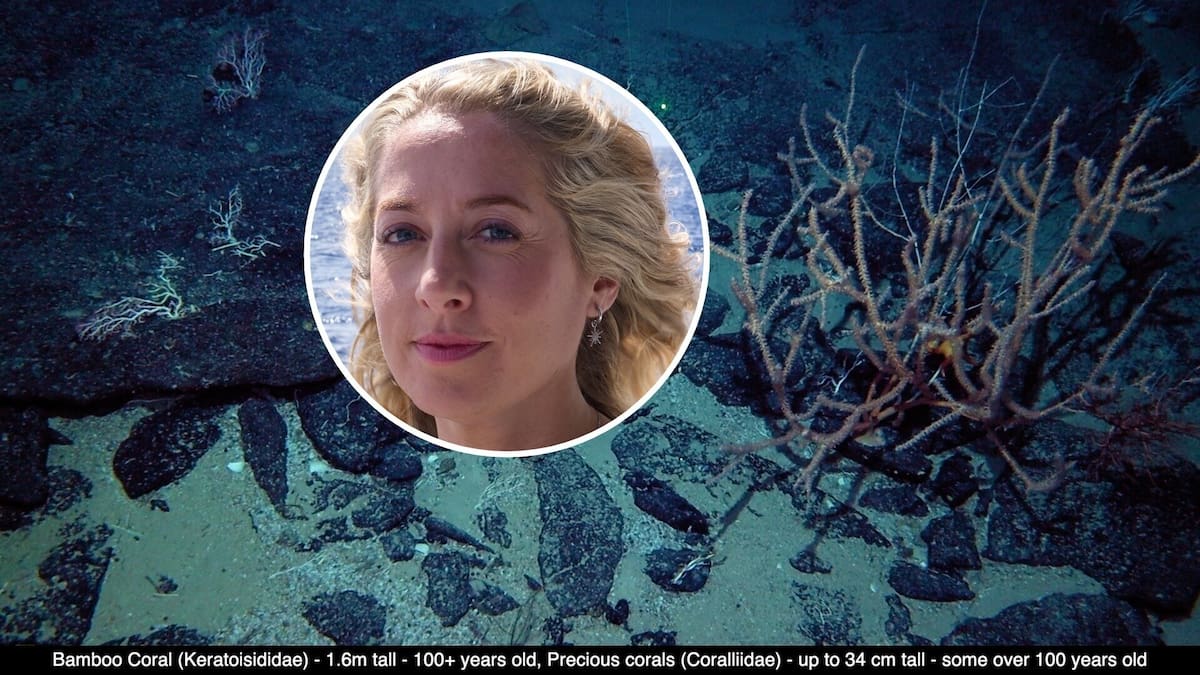
Greenpeace oceans campaigner Ellie Hopper said analysis of the footage provided first-of-its-kind evidence of the vulnerability of the area.
“It’s proof that there is a vulnerable marine system out there on the Lord Howe Rise and we’ve never had proof of that before,” she told the Herald.
Greenpeace oceans campaigner Ellie Hooper was part of a team that surveyed the seafloor at Lord Howe Rise.
The findings, which will be presented at the South Pacific Regional Fisheries Management (SPRFMO) meeting in Panama City this week, will clash with the position of New Zealand Government officials who are proposing to relax the rules for trawl boats that haul up coral while fishing.
Oceans and Fisheries Minister Shane Jones dismissed the significance of the Greenpeace research.
“Virtually nothing Greenpeace says or does will ever sway the way I approach New Zealand fisheries policy,” he told the Herald.
Deep-sea corals are often considered architects of ocean life because they create habitats for thousands of other species.
Oceans & Fisheries Minister Shane Jones directed MPI officials to propose increasing coral catch thresholds for commercial trawl vessels. Photo / Mike Scott.
While Greenpeace is putting up its research in an attempt to end bottom trawling at Lord Howe Rise, Jones told the Herald that he has directed the Ministry for Primary Industries (MPI) to argue for the opposite.
In fact, he’s asked MPI officials to propose to SPFRMO members that trawlers be allowed to land more than double the amount of coral they’re currently permitted to.
“I absolutely asked MPI officials to seek to increase the threshold for coral catch because in my view, it is far too low at present,” he said.
Current international rules mean that if a trawl vessel accidentally lands coral in international waters, and the weight exceeds 15kg, fishing must stop.
In 2024, Nelson-based trawler Tasman Viking caught coral weighing 37kg in Lord Howe Rise, which triggered a suspension to fishing in the area.
At the time, Jones told the Herald “I wouldn’t fuss about” it, before saying SPRFMO is an organisation that “doesn’t suit New Zealand’s interests”.
The New Zealand Government proposal, which will be tabled in Panama this week, argues that given New Zealand only has up to two vessels catching a few hundred tonnes of fish in SPRFMO areas, the risk to vulnerable marine ecosystems is low.
“The benefit of raising the thresholds is to potentially reduce the compliance burden and uncertainty for industry,” the proposal states.
New Zealand’s position ‘really problematic’
Lasers were used to estimate the height of coral filmed at the Lord Howe Rise. Photo / Greenpeace
Greenpeace’s video was filmed last year when the organisation chartered a vessel and towed cameras above the seafloor in areas where New Zealand trawlers operate.
During the deep-sea expedition, lasers were used to assess the size of coral and sponges spotted.
Analysis of video taken of the seafloor at Lord Howe Rise identified 350 corals and sponges some of which were estimated to be more than 100 years old. Photo / Greenpeace
New Zealand is the only country still bottom trawling in the South Pacific high seas. While Australia holds a permit to trawl for orange roughy, it ceased all activity years ago.
Hooper described New Zealand’s position – and that of the ministers – as “really problematic”.
“It’s really siding with commercial fishing rather than looking after ocean health, which is the exact opposite of the direction that we should be travelling in.”
Jones didn’t back away from the assertion that he is acting to support commercial fishing fleets.
“As the Oceans and Fisheries Minister, it is my job to ensure New Zealand’s rights as a fishing nation are upheld and promoted, including at an international level. Fishing is a backbone primary industry in New Zealand and as long as I am the minister, that will not change,” he said.
A spokeswoman for Seafood New Zealand noted only 1% of the South Pacific high seas is open for bottom trawling, with the rest being off limits.
“That’s an important fact that often gets lost in this debate,” she said.
She said the Greenpeace submission is not a peer-reviewed scientific paper and is yet to be assessed by SPRFMO’s scientific committee.
Michael Morrah is a senior investigative reporter/team leader at the Herald. He won News Journalist of the Year at the 2025 Voyager Media Awards and has twice been named reporter of the year at the NZ Television Awards. He has been a broadcast journalist for 20 years and joined the Herald’s video team in July 2024.