
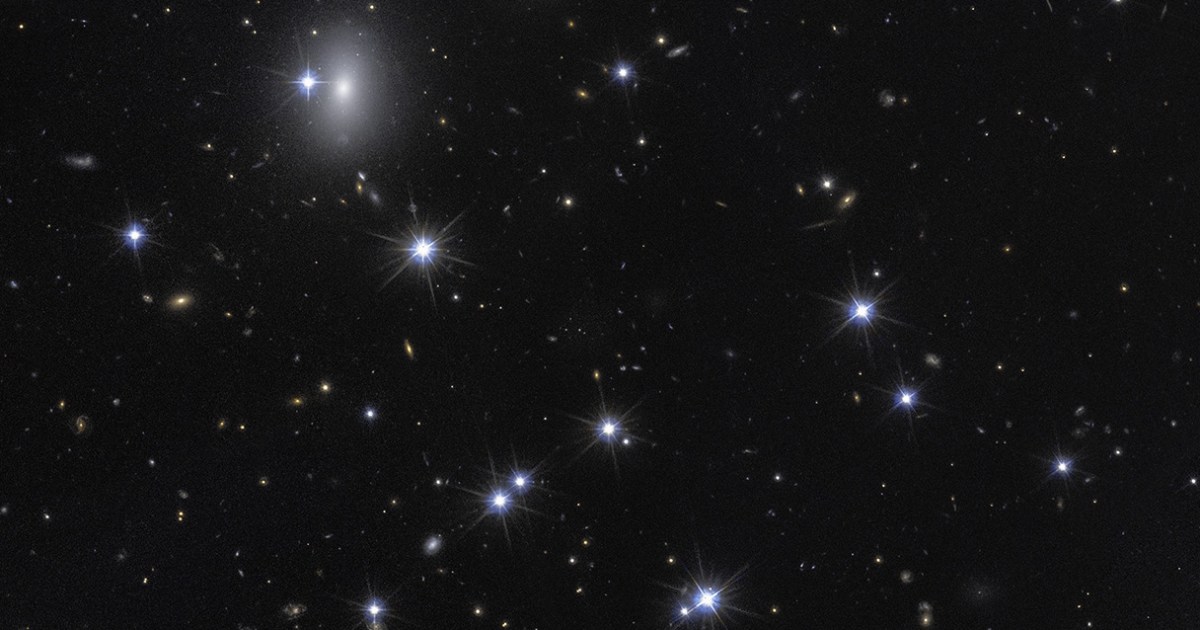
One of the most puzzling facets of our Universe is the apparent need for a new form of mass in our cosmos that isn’t made up of any of the particles we know of: dark matter. Whereas we’re fully aware of the full suite of Standard Model particles — quarks, charged leptons, neutrinos, their antiparticles, plus the photon, the gluons, the W-and-Z bosons, and the Higgs boson — dark matter must be composed of something else entirely: something novel and not yet directly detected. In order to explain the cosmic structures we see, from the CMB to individual galaxies to galaxy clusters and even the grand cosmic web, dark matter must not only be present, but must dominate the total matter content of the Universe.
However, there are several puzzles that arise. If dark matter is real, and if it dominates the matter content of the Universe, then there should be large numbers of satellite galaxies, small and low-mass collections of a few stars but mostly dark matter, all throughout intergalactic space. When those galaxies form stars from their normal matter, the low amount of total mass means that most of the gas within those galaxies should get expelled, leaving only a small population of stars embedded within a relatively large amount of dark matter.
These “almost dark” galaxies have been spotted before, but follow-ups have failed to reveal anything interesting. Until, that is, the recent discovery of CDG-2: candidate dark galaxy-2. Here’s its story so far, and what it means for the case for, and against, dark matter’s existence.
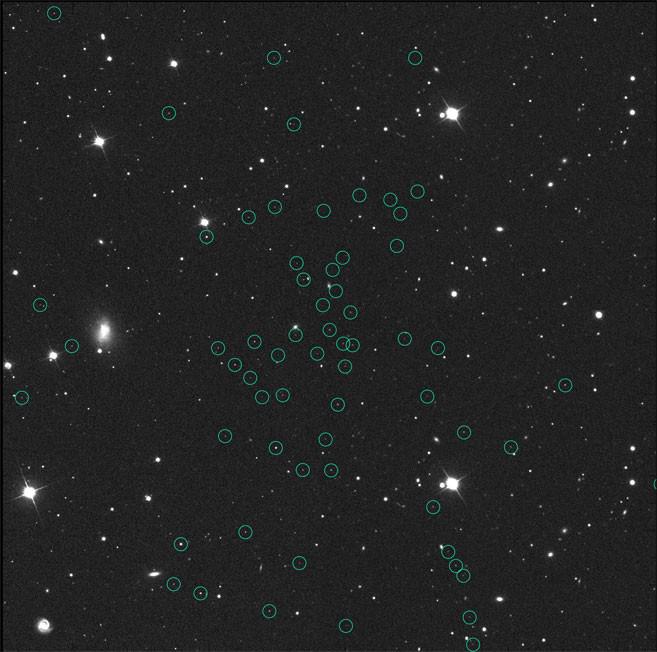
Only approximately 1000 stars, totaling ~175 solar masses, are present in the entirety of dwarf galaxies Segue 1 and Segue 3, the latter of which has a gravitational mass of an impressive 600,000 Suns. The stars making up the dwarf satellite Segue 1 are circled here. As we discover smaller, fainter galaxies with fewer numbers of stars, we begin to recognize just how common these small galaxies are as well as how elevated their dark matter-to-normal matter ratios can be; there may be as many as 100 for every galaxy similar to the Milky Way, with dark matter outmassing normal matter by factors of many hundreds or even more.
Credit: Marla Geha/Keck Observatory
The story starts back at the beginning of the hot Big Bang: when a spectrum of initial, seed fluctuations were imprinted on all cosmic scales. Atop a mostly uniform background, tiny overdensities and underdensities exist: typically at about the ~0.003% level only. While these might seem insignificantly small compared to the average density, gravitation causes the overdense regions to grow and attract matter into them over time, while the underdense regions similarly give up their matter to their more dense surroundings. On the smallest scales, structure gets washed out, while on larger scales, structure takes a long time to form, as larger scales plus the finite speed of gravity translate into longer timescales for collapse.
However, there ought to be a “sweet spot” where initial overdensities are large enough to survive thermalization within the early primeval plasma, but are small enough to begin collapsing before all other structures. That turns out to be scales with total masses of around 100,000 solar masses (or perhaps a few hundred thousand solar masses): less than one-millionth the mass of the modern Milky Way. It’s only in recent years that we’ve been able to find these small, faint galaxies, both within our Local Group (above) as well as far away (below). A combination of deep imaging, along with confirming that the luminous sources thought to be within these objects are all co-located together, has been required to reveal them.
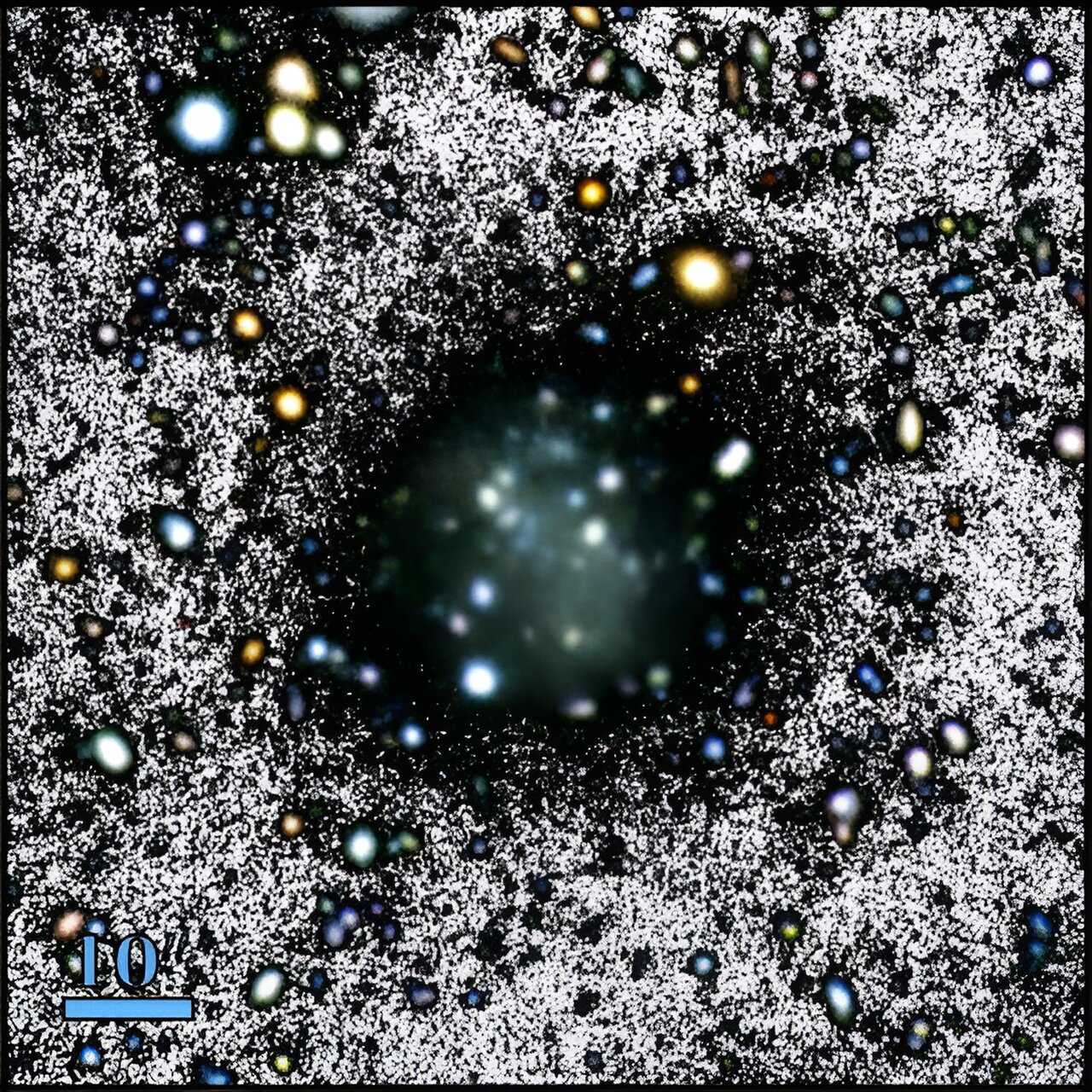
This “almost dark” galaxy, nicknamed Nube, is an incredibly diffuse galaxy found within a grouping of many other galaxies. It is thought that this ultra-diffuse galaxy, which has only a small smattering of stars inside a large mass of neutral hydrogen, owes its properties due to environmental factors. With so much hydrogen and so few stars, it represents a fascinating outlier among conventionally known galaxies. Its past star-formation history has been largely erased over the billions of years that have passed since its most recent major star-formation episode.
Credit: M. Montes et al., A&A accepted, 2023
Around practically all galaxies are collections of mostly ancient stars known as globular clusters. From up close, globular clusters look like enormous collections of stars: from thousands to hundreds of thousands or more, all concentrated within a few dozen light-years of the center. However, if we look at where globular clusters are found, they’re most commonly spotted surrounding galaxies, and large, massive galaxies in particular. The Milky Way has around 150 globular clusters in its halo, whereas a giant elliptical galaxy like Messier 87, at the heart of the Virgo Cluster, might have upward of 10,000. Isolated ones, on the contrary, are normally only found inside galaxy clusters, where they were likely ripped out of their host galaxies by gravitational interactions.
We know, from both our theories of structure formation as well as observations of our nearby globular clusters, that they must have formed early on, with the majority of globular clusters (and the stars within them) forming during the first 1-2 billion years of cosmic history. We also know that the globular clusters within the Milky Way were “brought in” over time by the accretion and mergers of smaller, satellite galaxies with our own galaxy over the course of cosmic history. The number of globular clusters around the Milky Way today, for example, is so large because of all the smaller galaxies that we’ve gobbled up over the course of cosmic history.
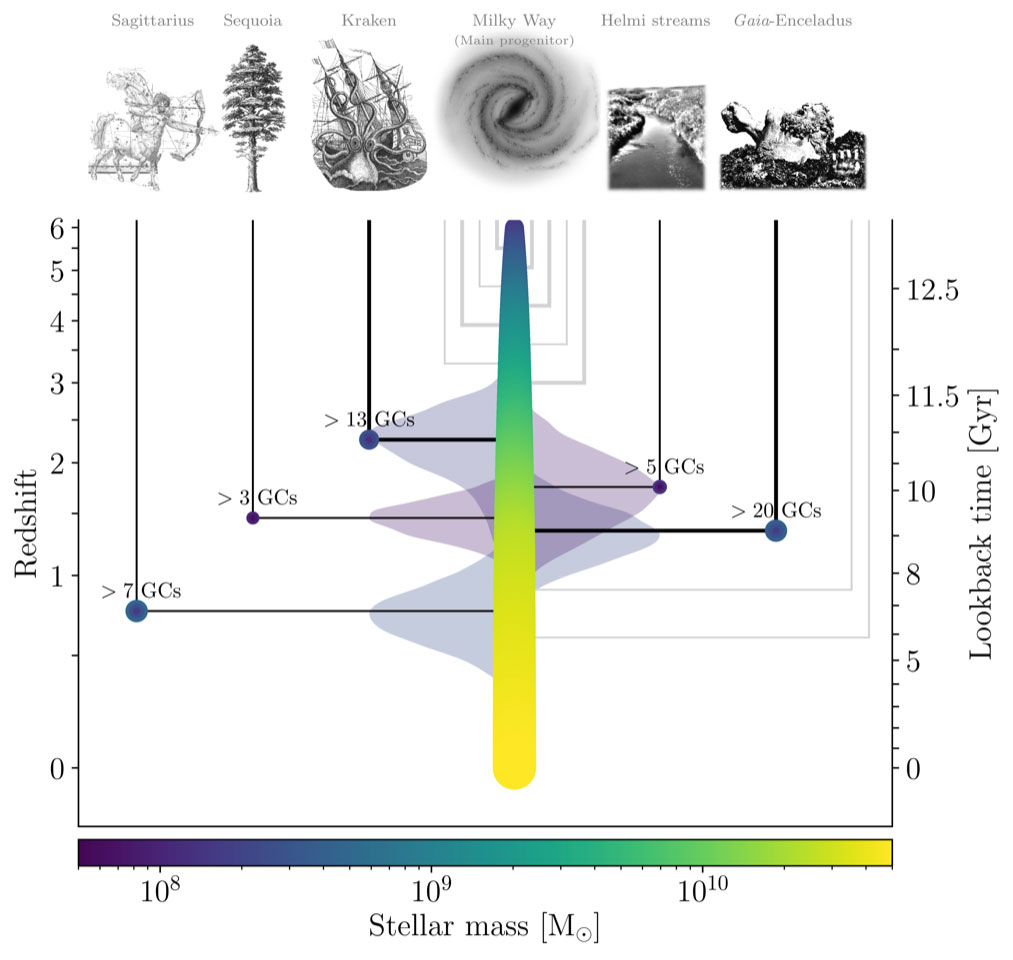
The merger history of the Milky Way reconstructed, along with the stellar mass added to our galaxy and the number of globular clusters originating from each merger. This reconstruction, however, has substantial uncertainties to it, as shown by the curves associated with each merger event. For example, the latest study, based on subgiant stars instead of globular clusters (as shown here), places the Gaia-Enceladus merger as potentially even earlier than the Kraken merger.
Credit: J. M. Diederik Kruijssen et al., MNRAS, 2020
It’s with this in mind that a new technique for searching for these small, faint, low-mass, and almost-completely-dark galaxies arose. The idea was that there are likely many examples of the types of galaxies that merged with the Milky Way, albeit long ago, out there in intergalactic space. Those galaxies could have some globular clusters around them, but their central regions would be almost completely devoid of stars, being anchored instead by nearly 100% dark matter. Only a small, faint population of stars would exist at the center of these galaxies, which could be identifiable through the detection of several globular clusters bound together.
This was the motivation behind the search for what eventually yielded this new “dark galaxy” candidate: CDG-2. If there are “pockets” of dark matter — what we might think of as dark matter substructure — within a larger dark matter halo, as theoretically expected, then globular clusters could form within them, expelling the excess gas and just leaving a population of stars behind. That larger halo could bring multiple globular clusters together, but could also not necessarily contain other reservoirs of gas or normal matter, being instead overwhelmingly dominated by dark matter. It would represent a new class of object: the darkest, or most dark matter-dominated, objects known to date.
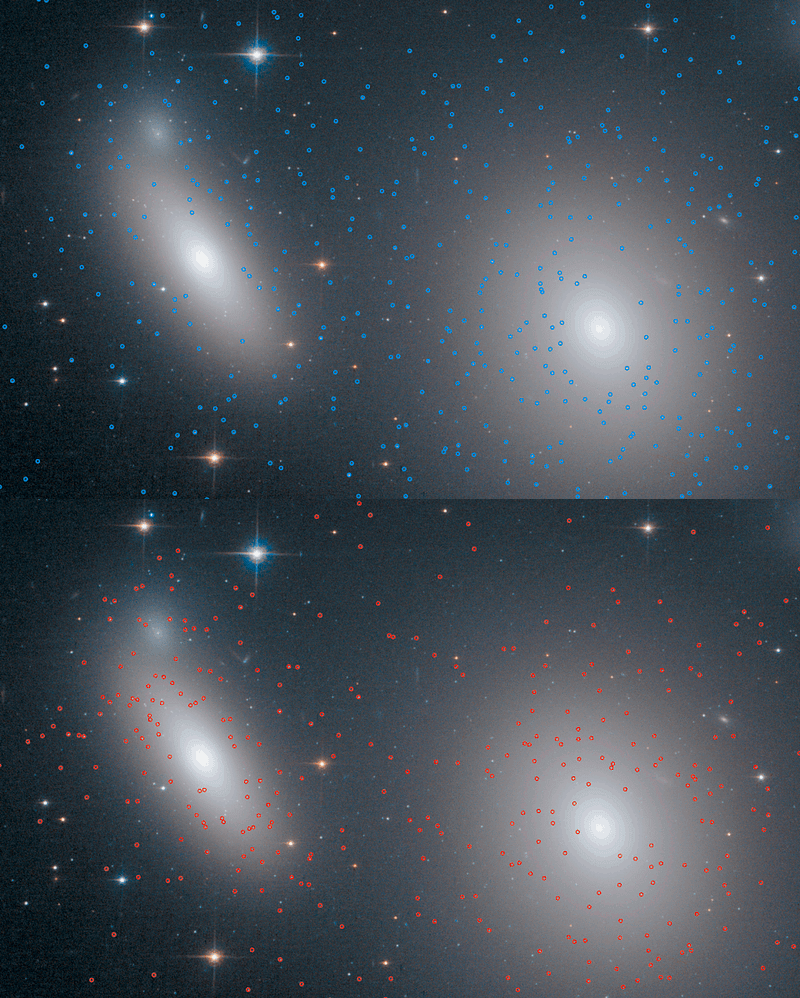
This is a blink comparison that plots the location of the red stars and blue stars that dominate the globular clusters in galaxies NGC 1277 and NGC 1278. It shows that NGC 1277 is dominated by ancient red globular clusters, but NGC 1278 contains many blue-colored ones. This is evidence that galaxy NGC 1277 stopped making new stars many billions of years ago, compared to NGC 1278, which has more young blue star clusters. While giant ellipticals may have 10,000+ globular clusters, the Milky Way has about 150, and some small galaxies have only a handful.
Credit: NASA, ESA, and Z. Levay (STScI)
In the past, the story for the darkest galaxies of all has been at the extreme faint, low-mass end of the galaxy spectrum. It’s imagined that you start with a small clump of matter: roughly a 5-to-1 mix of dark matter-to-normal matter, consistent with the large-scale cosmic average. Because normal matter collides inelastically with other particles of normal matter, they can emit light, cool, and gravitationally collapse. When normal matter collapses sufficiently, stars begin to form. Those stars then produce winds and ultraviolet radiation, which ionizes and blows the surrounding normal matter outward. In this way, the galaxy becomes depleted of normal matter, while all the dark matter persists.
This explains why, when we look at large, high-mass galaxies as well as larger structures (galaxy groups, galaxy clusters, cosmic filaments and great walls, etc.), we typically see that original 5-to-1 dark matter-to-normal matter ratio: the same as the overall cosmic average. With greater overall masses and deeper gravitational potentials, normal matter is extremely difficult to eject from these objects. However, as we look to lower and lower mass galaxies, we find that they’re more dark matter-dominated: as though the normal matter was ejected long ago, and only the already-formed stars persist inside a (relatively) giant halo of dark matter.
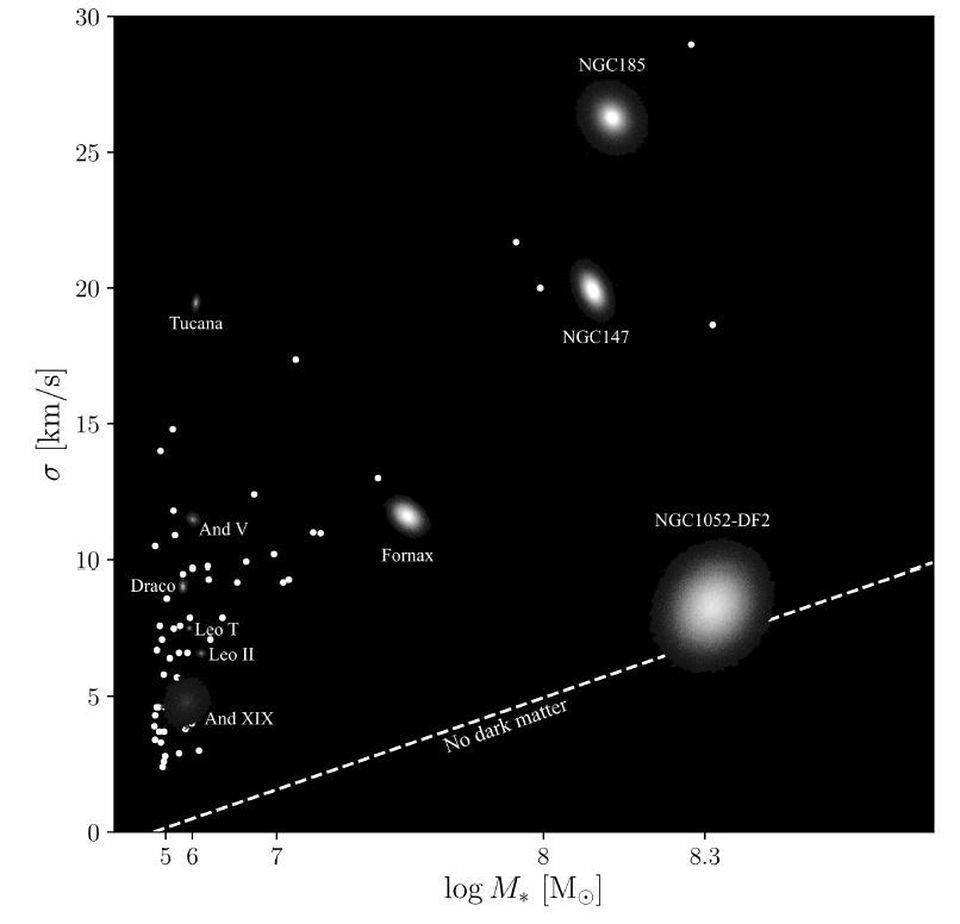
Many nearby galaxies, including all the galaxies of the Local Group (mostly clustered at the extreme left), display a relationship between their mass and velocity dispersion that indicates the presence of dark matter. The lower in mass a galaxy is, in general, the higher its dark matter-to-normal matter ratio. NGC 1052-DF2 is the first known galaxy that appears to be made of normal matter alone, and was later joined by DF4 in 2019. Galaxies like Segue 1, however, are particularly dark matter-rich; there are a wide diversity of properties, and dark matter-free galaxies are only poorly understood, with many questioning their nature.
Credit: S. Danieli et al., ApJL, 2019
The question then becomes: if this picture is correct, then what would the faintest, most dark matter-dominated galaxies look like? What would their properties be? And, because astronomy is an observationally-driven science, can we find them and, if so, how?
As the new study‘s first author, Dayi Li, told Science, “There could be a class of galaxies that are so faint that they don’t have any [stellar content where the main galaxy normally is] and they only have globular clusters within them. Then all the other content or mass in this galaxy is just dark matter.”
The idea is as follows.
As these low-mass initial overdensities grow, the first episodes of star-formation lead to a few globular clusters.
The normal matter within those globular clusters gets blown away, ejected from the dark matter halo that surrounds them.
Next, at least two, and maybe a few more, of these globular clusters, being located within a larger dark matter halo, all become gravitationally bound together.
Due to a combination of factors, including radiation from the shining stars, stellar cataclysms, and virialization effects, the remnant normal matter then gets ejected, with either very few or possibly even no stars existing where the main galactic body normally is.
When all is said and done, this should result in an almost completely dark galaxy: with loads of dark matter, a few globular clusters, and hardly any “main galaxy” stars at all at the center of it all.
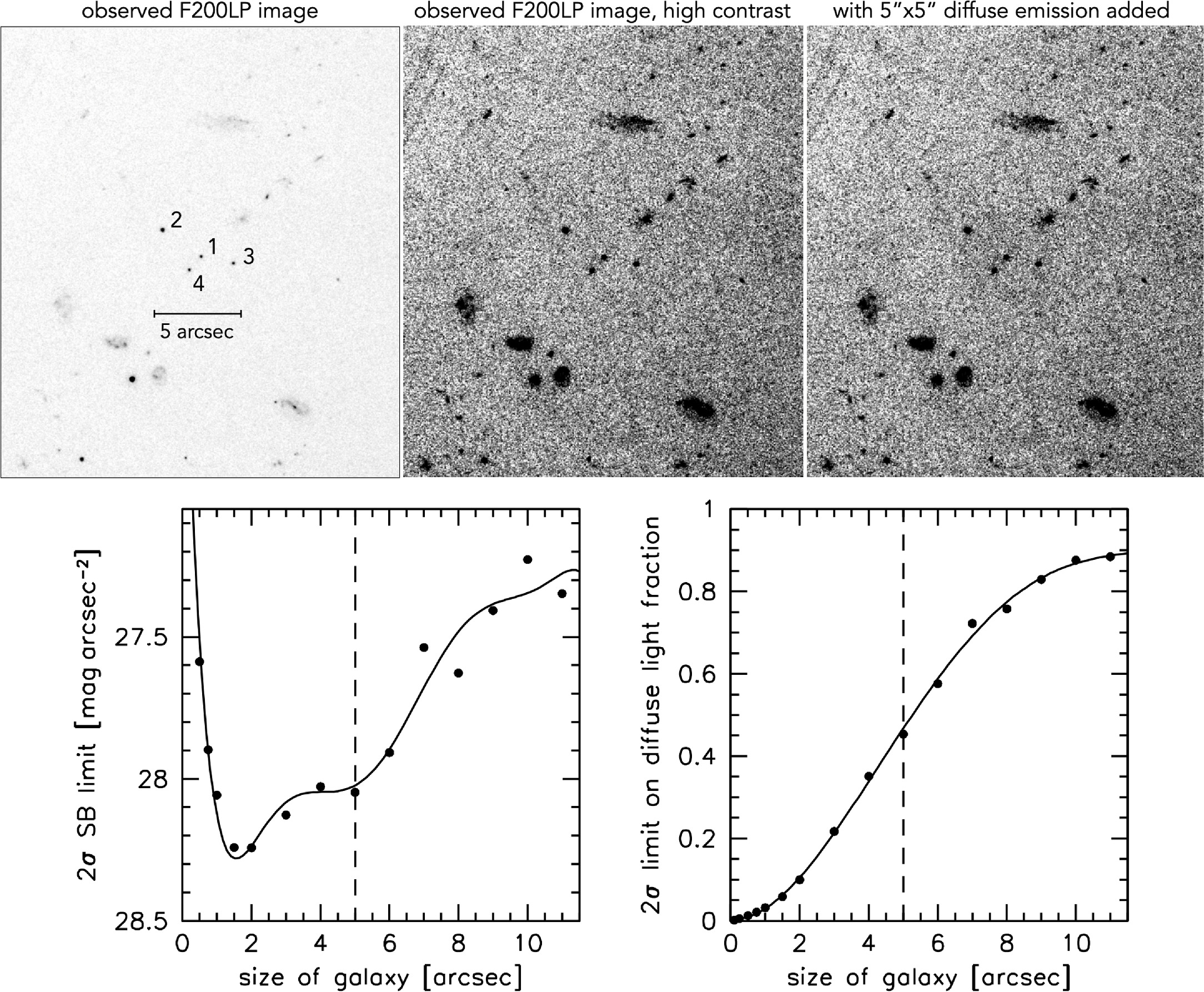
Within the Perseus Cluster of galaxies, four objects that are likely globular clusters (top left panel) are found grouped together in a very tight region of space. However, there is no galaxy or evidence for additional stars visible at the center or in the vicinity of those clusters, despite the existence of deep Hubble imagery. Because of this, this was theorized to be a candidate dark galaxy: CDG-1.
Credit: P. van Dokkum et al., Research Notes of the AAS, 2024
The way you’d look for objects like this, therefore, would be to look for a collection of just a few globular clusters in a small region of space, all bound together gravitationally, with either no galaxy at all or an extremely faint galactic body at the center of the identified globular clusters. A team set out to do exactly this, publishing their first dark galaxy candidate, known as Candidate Dark Galaxy-1 (CDG-1), in 2024. (The image from that paper is shown above.) However, an archival data search, follow-up observations with Hubble, and deep imaging with Euclid data all revealed no diffuse light, as one would expect if there were a faint galaxy connecting them. As of 2026, there is still no evidence for any stellar association with CDG-1.
However, the same team, using a very similar technique and looking in the same region of space (near the constellation of Perseus), then found a second grouping of four globular clusters, again in a very tight region of space. As you can see from the figure below, there are indeed many globular clusters: with red and blue pointing out globular clusters identified in two different catalogues (DOLPHOT and DAOPHOT, respectively). When both of these high-resolution, deep observations are combined (see the overlap), clear evidence appears for that grouping, with what appears to be four globular clusters all found together in a tiny region of space.
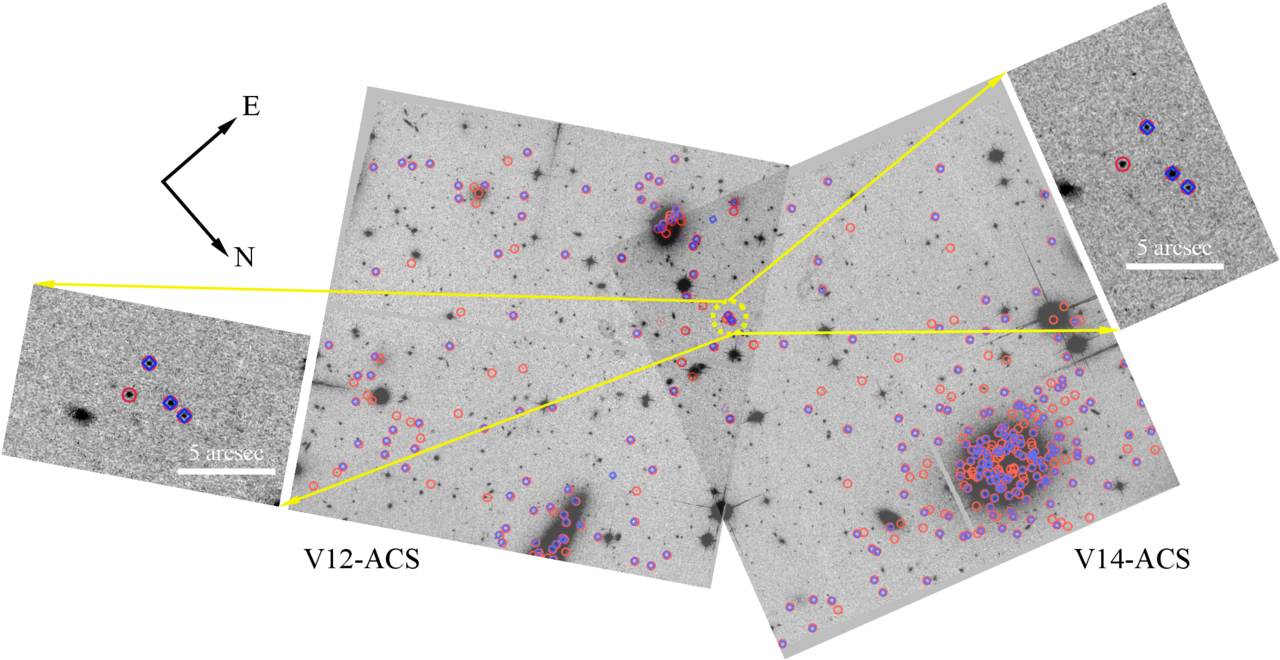
A candidate dark galaxy, discovered initially by the association of four globular clusters all tightly confined to within a small region of space, is consistent with the notion of a largely dark matter-dominated galaxy. However, this candidate object requires follow-up and the identification of faint, diffuse emission that would be associated with a main galactic body.
Credit: D. Li et al., Astrophysical Journal Letters, 2026
That’s great, in and of itself. It is very difficult to know where to point your telescopes if you hope to find the faintest, lowest-surface-brightness galaxies of all: the one with the lowest stellar densities. It is, in fact, those galaxies that are the most extreme in a sense: with the biggest potential mismatches between their dark matter and normal matter contents. However, this only elevates them to the status of “candidate dark galaxies,” with this new one being known as CDG-2. In order to promote them to the status of “galaxy,” and to actually know what the properties of that galaxy are, you’d hope to get two more things.
One thing you’d hope to get would be detailed spectroscopic measurements of those globular clusters.
Are they at the same redshift as one another?
Are they indeed globular clusters, and not some other type of impostor object?
What are the relative velocities between them?
And can you confirm their 3D positions in space, to assure that they aren’t simply lying along the same line-of-sight?
That data, unfortunately, doesn’t exist yet; it would have to be acquired with a separate, specifically dedicated set of observations.
The second thing you’d hope to get, however, would be evidence, no matter how faint and diffuse, for the existence of a “main body” of stars where the galaxy, if it exists, can be exposed directly. After all, we’ve found ultra-diffuse galaxies, with extremely low surface brightnesses, before; it just requires a large exposure time using our most sophisticated telescopes of all.
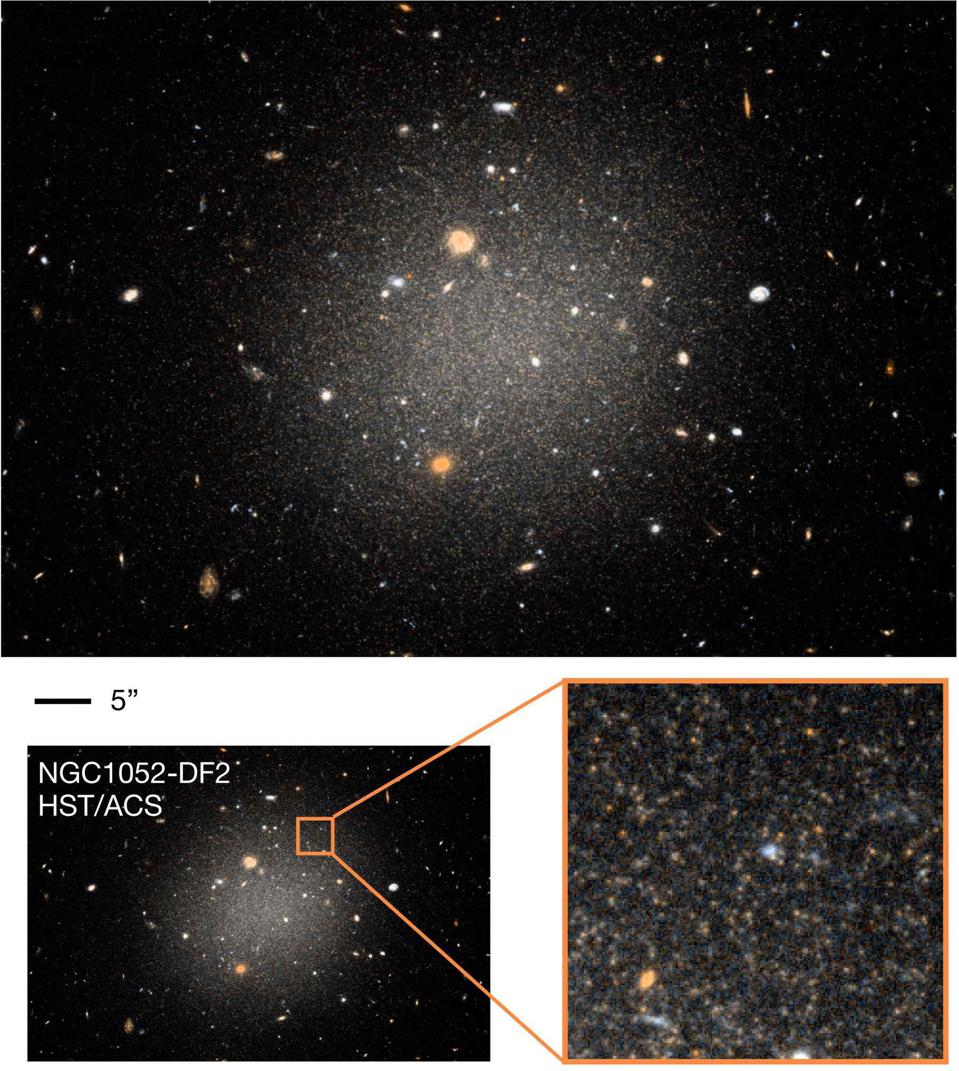
Galaxy DF2, shown here, is known as an ultra-diffuse galaxy, having one of the lowest surface brightnesses of any known galaxy to date. When we examine their stars inside of a galaxy, the density of stars can range from ultra-diffuse to ultra-compact, depending on how their stars are distributed. Galaxies like DF2 and DF4 are ultra-diffuse, and take deep imaging and excellent calibration to reveal them at all. In the absence of space telescope data, data from specialized and/or multiple ground-based observatories can be combined to reveal features, including faint features, in the vicinities of bright objects that no single observatory is capable of revealing on its own.
Credit: Z. Shen et al., ApJ, 2021
However, this new galaxy candidate, CDG-2, has something to offer that none of the other candidate dark galaxies hitherto identified can: when we look at the data from other ground-based and space-based observatories of that region, there is a very faint excess of light that can be identified in this region. Specifically, the observatory that revealed it is ESA’s Euclid, which is expected to yield mosaics of huge swaths of the sky extremely deeply. The first 1% of its cosmic data resulted in a 208 gigapixel mosaic, and hence, the full suite of Euclid data, when complete, should exceed 10 terapixels: the greatest astronomical data source of all-time by many metrics.
When the Euclid data is combined with the other existing data, including the Hubble data about the globular clusters, what we find is astounding: a diffuse collection of starlight, located precisely atop where these four globular cluster candidates are located. The authors were very careful to not just make this case based on statistical arguments, but to actually inject a mock ultra-diffuse galaxy into the data itself, and see if their software could pull it out. Lo and behold, the signal for the mock galaxy was just as strong as the signal for CDG-2 was, even when the globular clusters were masked completely away.
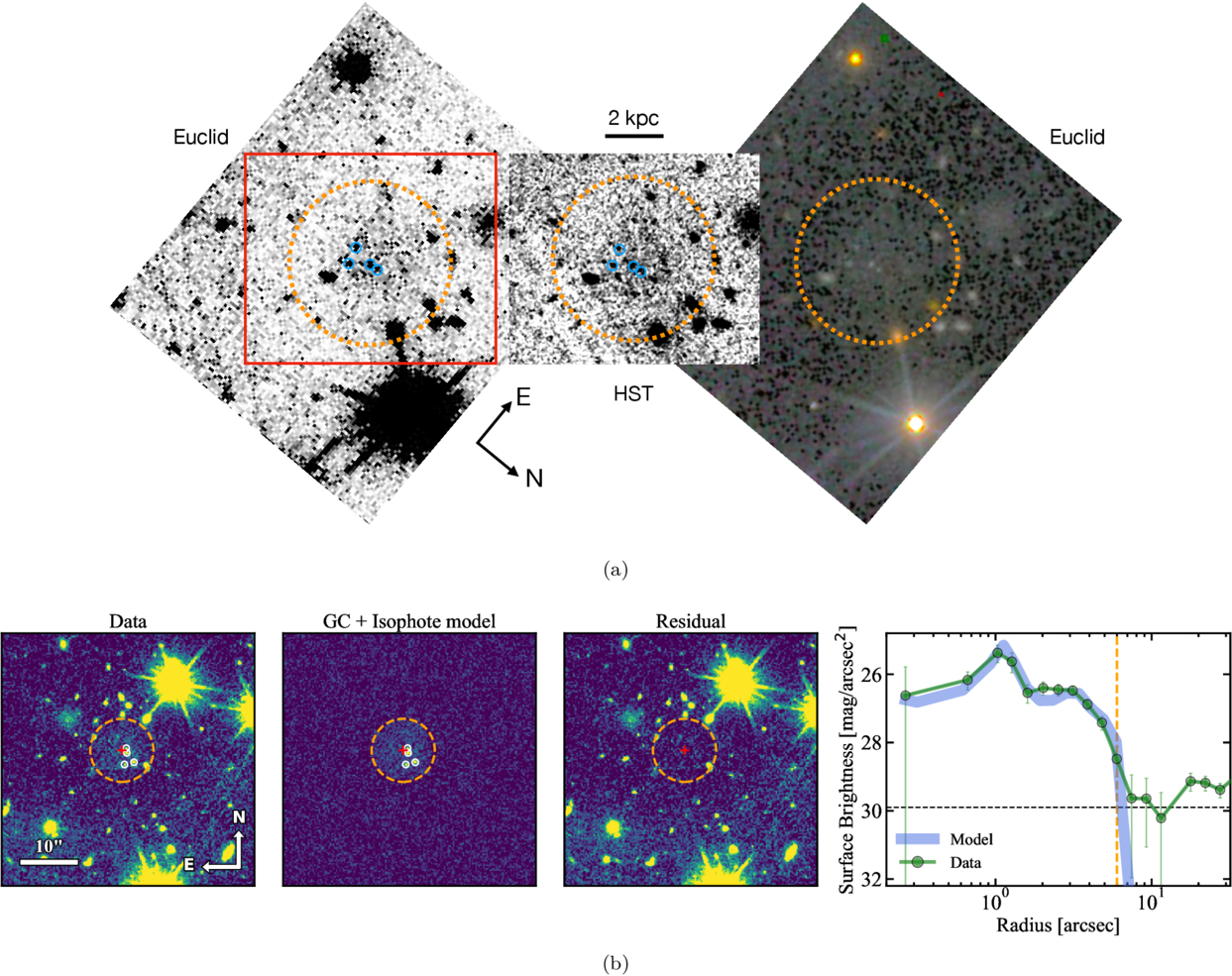
While one might have to squint their eyes and hold their breath to imagine that they see evidence for faint, diffuse starlight in the Hubble images (even the stacked Hubble images) of candidate dark galaxy CDG-2, the Euclid data is much less ambiguous. A visual inspection reveals that diffuse starlight, associated directly with the location of those four previously identified globular clusters. A more robust statistical analysis confirms the signal as well, consistent with a typical ultra-diffuse galaxy.
Credit: D. Li et al., Astrophysical Journal Letters, 2026
This is extremely interesting, of course, but it’s really just the start of the science that needs to be done on this object, which could yet turn out to be the most dark matter dominated galaxy ever discovered. First, we need to confirm that these globular clusters are indeed all at the same distance, and that they aren’t just serendipitously aligned, independent points that happen to be located along the same line-of-sight. (Like the asterism known as Brocchi’s cluster, for instance.) That requires deep spectroscopy, which will not be easy to acquire. Second, we’d want superior imaging of the host galaxy, so we can measure its velocity dispersion and other parameters. And third, we’d want ages for the stellar populations, so we can confirm that there is no gas left and there has been no evidence for recent or ongoing star-formation.
But if we get all of those things, and they do confirm the predictions one arrives at under the assumption of dark matter, it would then become very difficult to explain the existence of this object at all in a dark matter-free scenario. The existence of multiple populations of dwarf galaxies, where some obey the baryonic Tully-Fisher relation and others obey a completely different relation, can be explained if the amount of dark matter within them isn’t fixed, but can vary from object-to-object, but not with a single, universal modification to the laws of gravity.
If both classes of objects are confirmed, and CDG-2 would be the most extreme example of a dark matter-rich dwarf galaxy ever found, then it really is the death-knell for modified gravity proposals. Sure, it’s observationally expensive to acquire those critical measurements, but with the contents of the Universe on the line, it sure is hard to justify not looking when the technology to do so is already here.