
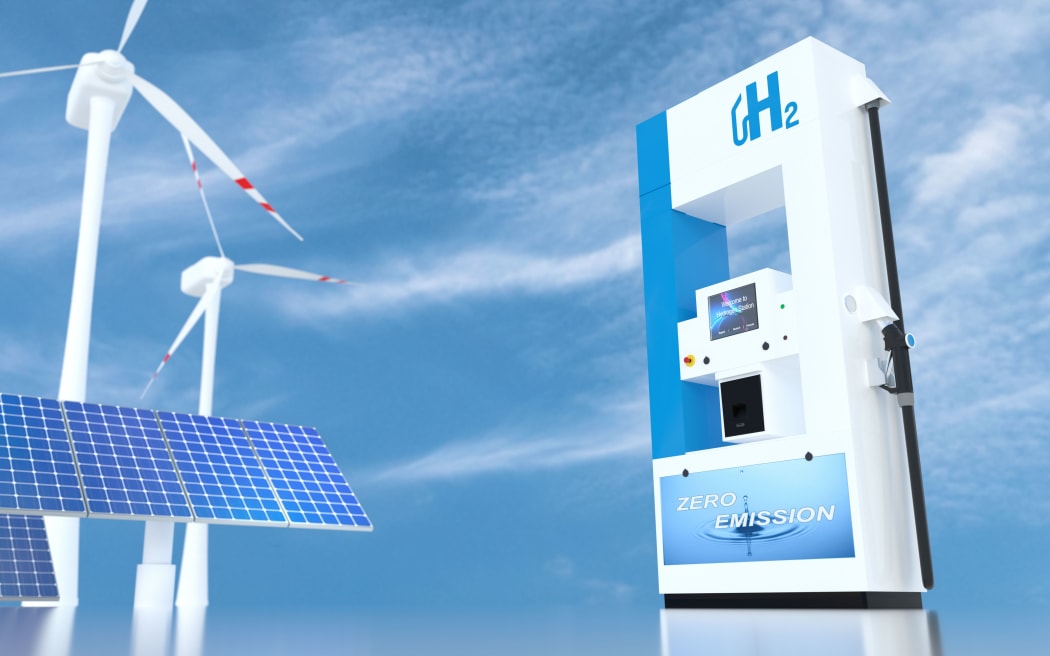
Auckland University economic modelling has found green hydrogen could have some limited use in future.
Photo: 123RF
There are calls for more support for green fuel alternatives as the Middle East conflict exposes New Zealand’s vulnerability to fuel supply chain shocks.
Auckland University economic modelling has found green hydrogen – hydrogen produced by renewables – could have some limited use in future for industries heavily reliant on gas and coal for production.
But cost and limited infrastucture remained major barriers, as did a lack of government policy.
“If we can use renewable electricity, wind, for example, or possibly geothermal as a source of electricity, then that is an attractive option,” Auckland University energy economist Professor Basil Sharp said.
“But until such time as the technology improves and we can get the costs down, it’s going to be somewhere out in the future.”
As the government pushes ahead with a liquified natural gas import facility and global LNG prices soared as a result of Qatar halting production, Sharp said more attention needed to be paid to New Zealand’s energy independence.
“There could be an unintended impact associated with promoting importation of LNG that could and I’m not saying it will, but it could have an impact on the rollout of our renewables.
“It could have an impact on the technology, such as the viability of green hydrogen going forward.”
Green hydrogen a bit player in road to net zero
The modelling found that at best, green hydrogen was capable of supplying about 12 percent of industrial process heat energy by 2050 .
Because it was so expensive to produce, green hydrogen needed the right conditions to be viable and was more attractive when carbon prices were higher, renewable electricity was cheaper, and hydrogen technology costs fell.
It was in those scenarios researchers said hydrogen could play a complementary role in helping New Zealand reach net zero emissions, but electrification was still the key.
“Even if they are making very small contributions to our energy independence when the technology and and the costs come down, we need to be in a position, to take advantage of that and actually promote the utilisation of hydrogen in the economy,” said Sharp.
A new export for NZ?
One of the model’s co-authors and senior economics lecturer Le Wen said New Zealand was already well-placed to produce green hydrogen because 80 percent of our electricity was renewable.
Wen said that if the country invested in and scaled up green hydrogen production, the country could become a leader in genuinely low-emissions hydrogen.
“It may not solve everything on its own, but it could give the country a strong new export opportunity,” he said.
Sign up for Ngā Pitopito Kōrero, a daily newsletter curated by our editors and delivered straight to your inbox every weekday.