
Last year, I posted about the challenges I faced, trying to daylight public-interest information about the government’s Roads of National Significance programme. As I wrote then, entire documents – including even titles – were being withheld on what looked to me like flimsy grounds.
Now, months later, after going to the Ombudsman, I have some new information.
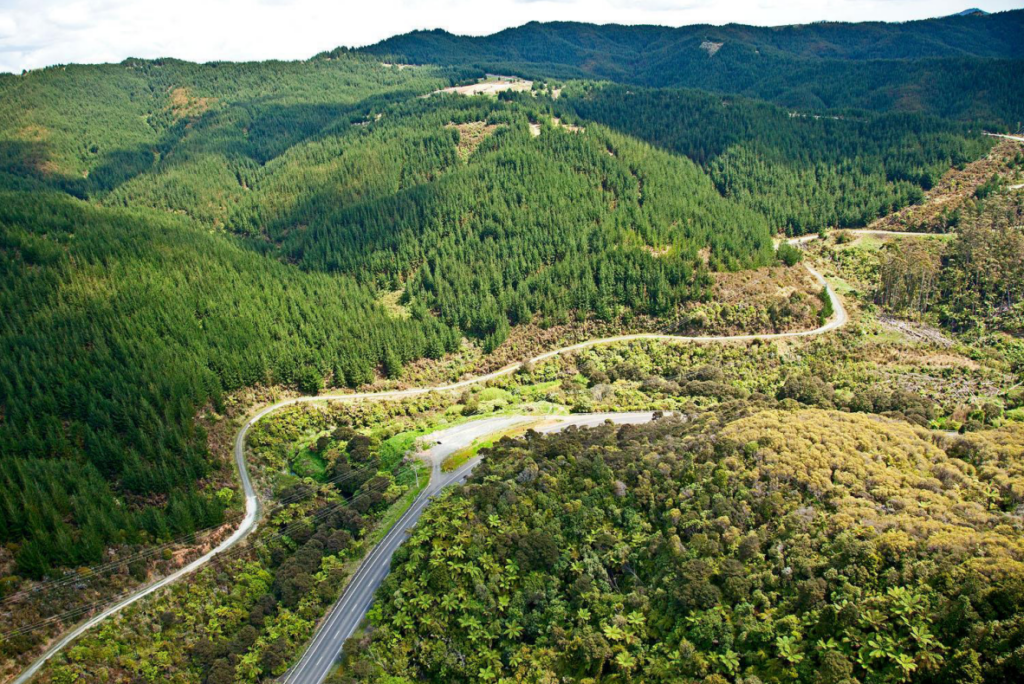
Specifically, about the RoNS that’s closest to breaking ground: SH1 from Warkworth to Te Hana.
For context: this project was originally part of the previous (2008-2017) National Government’s Roads of National Significance programme, and is now considered to be stage one of three for the 100km Northland Expressway between Warkworth and Whangārei.
Additionally in 2024, under prior Minister of Transport Simeon Brown, NZTA developed a strategy to deliver all three sections of the Northland Expressway by 2039 – the full cost of which is (currently) estimated at around NZD $22,000,000,000. These were all mandated, under Brown’s 2024 Government Policy Statement on Land Transport, to be four-laned, grade-separated highways.
What’s going on?
A Cabinet paper from mid-2025 reveals that the government plans to sign a Public Private Partnership (PPP) by July 2026 for Warkworth to Te Hana. It also notes a preferred bidder is to be confirmed in February 2026. So, around now, which may be why the document was finally released.
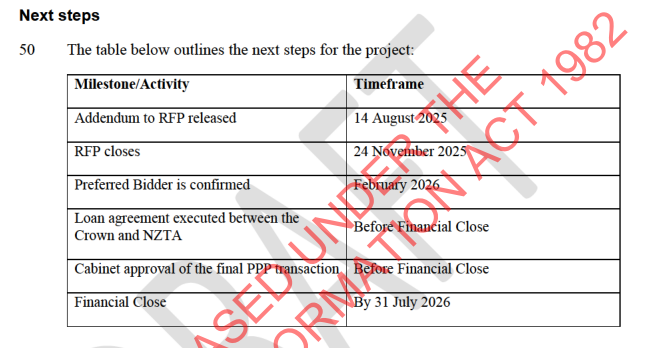
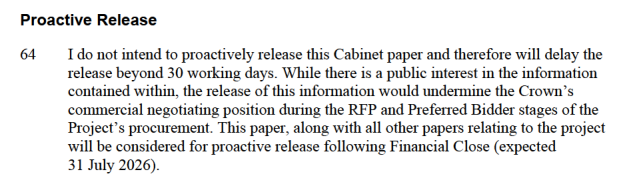
The paper also suggests the government’s plan was to commit to this PPP without the public knowing anything about the terms or total cost until after it was signed (if at all). Given the lack of information since, this assumption probably still stands.
Why the secrecy? Is it because this PPP would have a significantly higher ‘peak debt’ requirement – with debt that would last over 10 years longer than any Public Private Partnership New Zealand has ever entered into?
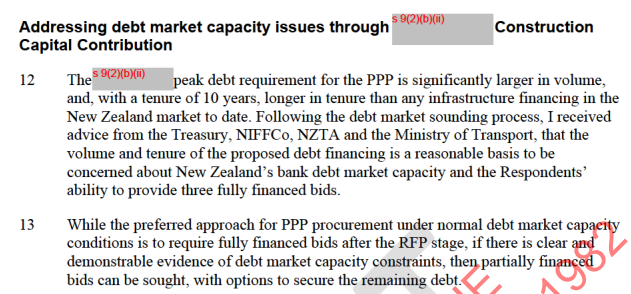
This involves a repayment commitment so huge (and note, this is for just Stage 1 of the full expressway!) that, according to this Cabinet paper, a debt-market sounding indicated:
‘[there is] unlikely to be sufficient liquidity in the New Zealand debt market for more than one fully financed bid.’
So where will the funding come from?
The government can’t afford to pay for the RoNS through the National Land Transport Fund as it is, but also didn’t want to raise taxes in their first term. So they’ve planned to raise fuel taxes by 12c per litre in January 2027, 6c per litre in January 2028 and 4c per litre in January 2029, with more increases potentially coming in the 2027 GPS.
In other words, the cost of transport for everyone who drives in New Zealand is already set to go up, to help fund for Warkworth to Te Hana. But it’s still not quite enough.
So the Cabinet paper recommends a ‘construction capital contribution’ (CCC) – whereby the government gives money to NZTA to give to the delivery entity. Specifically, the Ministers of Transport and Finance recommend that government ‘take[s] advantage of the Crown’s lower cost of capital’, and use a 10-year Crown loan with commercial terms.
The paper notes this would reduce the overall cost of the project, as NZTA would have less to pay in the way of annual charges required by the PPP itself.
You read that right: the Cabinet paper says that if the government directly funds a project, the overall cost to the country is much lower than a PPP.
Because under a PPP, the government, i.e. the public, are essentially borrowing at commercial rates.
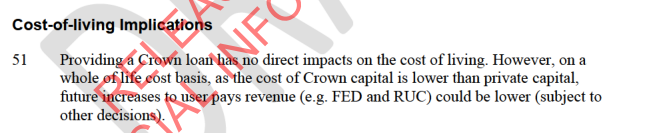
Now the government is also being sneaky here: because, by covering a part of the project through a Crown loan, they are clipping the ticket and funnelling fuel tax and road user charge revenue back into Crown accounts.
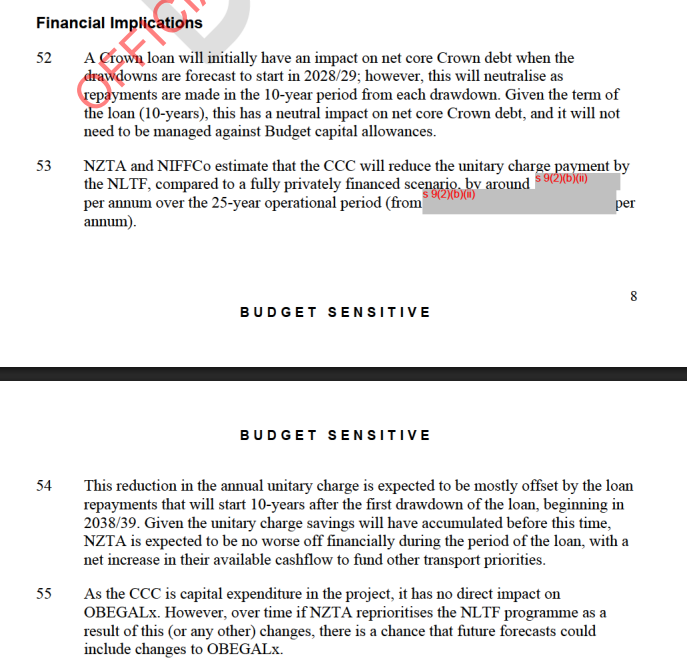
In which case you may be wondering: why do a PPP at all, if it costs us more?
In theory, the benefit is that the private sector takes on the risk of financing, building, and potentially operating and maintaining the project over a long contract period.
But given the examples of Transmission Gully and Moa Point – where it’s doubtful the private entities involved will see any repercussions – how are we supposed to believe that the government won’t be left holding the bag, if and when things go wrong?
Even leaving aside the PPP angle, the government concedes two things:
this project needs a Crown loan – in addition to private financing – to get under way.and NZTA won’t have enough funding in the NLTF to pay for the Construction Crown Contribution during the project’s construction period.
But it also asserts that NZTA will have enough once it needs to start repayments on the Crown loan and the PPP charges… around 2038/39.
However, this is only true if the proposed increases in Road User Charges and Fuel Excise Duty actually happen from 2027 onwards.
That’s a pretty confident claim about future funds – especially with climate disasters wrecking more and more roads and bridges around the country each year – but okay.
On that point: apparently this Cabinet paper saw no need for an assessment of climate implications.

But we haven’t mentioned an even bigger issue. Which is, that with all this debt set to be paid back from the NLTF, that’s going to be hundreds of millions of dollars a year spent paying back this debt (for one road) that then can’t be spent on other transport projects or maintenance.
The opportunity cost for going forward with this project could be enormous – not just for transport, for the country as a whole.
All of this dancing around the funding issue raises the question: what’s the actual price tag for Warkworth to Te Hana? Shouldn’t we have at least an inkling, before this government signs New Zealand up to any contract, in advance of the election?
What will this project cost?
This is currently being kept under wraps, with redactions of every single instance that would show what this project (and its PPP deal) will cost us.
But we can make an educated guess, based on a few parameters.
The 2019 Detailed Business Case for Warkworth to Te Hana had the project between $1.7 billion to $2.1 billion, which is the number that the National Party ran on in its 2023 campaign.
More recent costings put the work at $3.5 billion to $4 billion. In fact, based on the Cabinet paper, it seems like the estimated capital cost has increased since then:
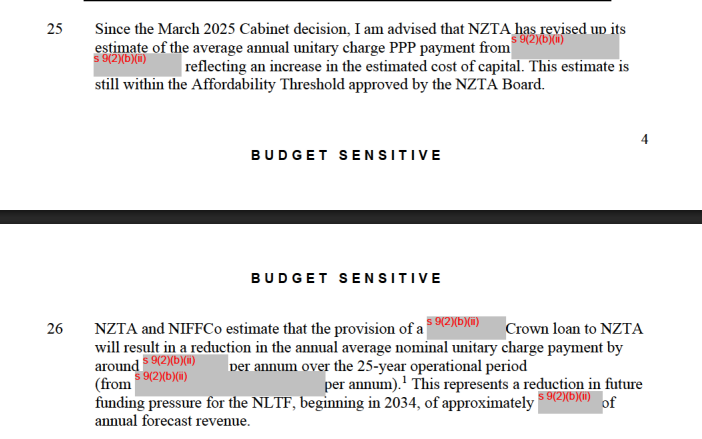
Based on previous PPPs, we can reasonably expect any project delivered via a PPP to exceed predicted costs by some way.
But let’s stick with $4bn, the cost of just Phase 1.
What’s NZ$4,000,000,000 between friends?
To put this potential price tag into perspective, what would it work out at if you split the cost between the ~700,000 households in Northland and Auckland?
$5,714 per household, just for Stage 1 of the Northland Expressway.
Now add the costs of Stage 2 and 3, to get us all the way to Whāngarei – which looks to be $18 billion combined… that’s another $25,746 per household.
In other words, $31,460 per household in Northland and Auckland to build the full road.
And all in all, at approximately $22,000,000,000 to build all 95km from Warkworth to Whangārei… that’s $232 million per km.
But wait, there’s more! There’s always more. Everyone knows big roading project budgets blow out. Look at Transmission Gully, where the total final cost appears to be $2.5bn – double the projected cost of $1.25bn.
And we already know the estimated cost of the Warkworth to Te Hana section has increased, because it says so in the Cabinet paper. So the real amount is likely to be a lot more than that. (Who knows, per km it may even rival the – shelved for now – East-West Link for the title of most expensive road in the world.)
To be clear, the cost of the Northland expressway won’t be localised to Auckland and Northland. Unless a completely prohibitive toll is charged ($31+++), only a very minuscule amount would ever be reclaimed from those who actually use it – meaning the vast majority of cost will be spread across the entire nation, via taxes, fuel levy and road user charges.
Moreover, once that money is spent, it’s spent. And the costs don’t end there: the road will then require significant maintenance, in perpetuity – costing us more over its lifetime than the alternatives. (And yes: there are more affordable alternatives for this route, which I’ll get into further down).
The $22,000,000,000 question: what else can you get for that?
Speaking of alternatives: you might well wonder, what could a small country buy for twenty-two billion dollary-doos, these days?
Here’s a few options:
And I’m sure you would only need a fraction of that money to electrify the Golden Triangle train network, and extend regional passenger rail services.
Or, hey – if you wanted to fund an entire transport programme for our premier city, you could probably deliver the entirety of the Congestion Free Network (assuming a doubling of capital cost since 2016).
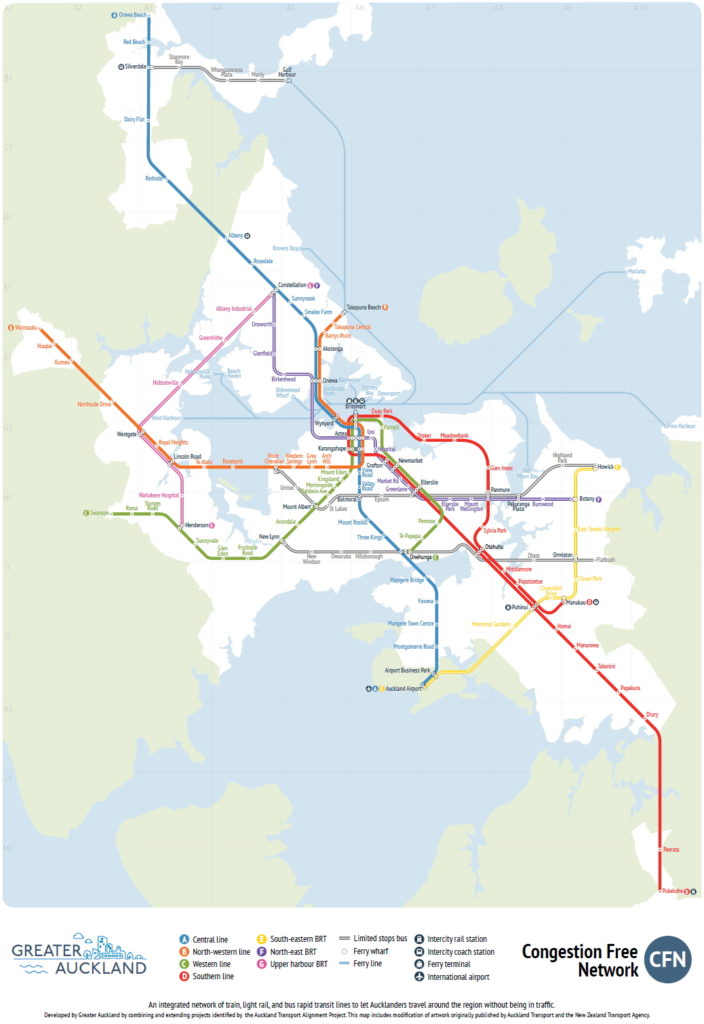
Or, one (1) four-lane road from Warkworth to Whāngarei.
You could even ask – given this is ostensibly about unlocking regional potential – the people of Northland what they’d like to do with $22,000,000,000. Or even just with the $4,000,000,000 for the first stage, an amount this government is apparently on the brink of signing a deal for.
And of course, we could also expand this discussion across other regions to query what the government plans to spend on the other RoNS, which have a total bill of upwards of $40-50 billion (so far), not including any repair bills for climate chaos.
But for now, let’s home back in on that $4,000,000,000 project the government is keen to lock us all into before the election.
How urgent is it, exactly? What’s our framework for making these kinds of big decisions?
Do we even need this project – and do we need it now?
Helpfully, a wonderful piece of work was released a few weeks ago from Te Waihanga/Infrastructure Commission, in the form of the National Infrastructure Plan. It states clearly that future investment in land transport needs to be:
a) lower, and
b) more focused on outcomes that decarbonise New Zealand (like public transport, walking and cycling), as well as maintenance, renewals, and resilience – and away from state highway improvements.
Our Forward Guidance suggests capital spending on land transport should moderate from recent elevated levels. We forecast investment demand based on New Zealanders’ historical willingness to pay. Slowing population and income growth, alongside the potential for shifts in network usage as our economy decarbonises, suggest that land transport costs should represent a smaller share of household expenditure going forward. In this context, we would expect investment to shift away from state highway improvements toward maintenance, renewals, public transport, and resilience. Our Forward Guidance can inform decisions on funding levels and the user charges needed to support them.
It also spells out our over-investment in roads, and the significant funding gap between revenue streams and planned investment. A Roads of National Significance-sized-and-shaped gap:
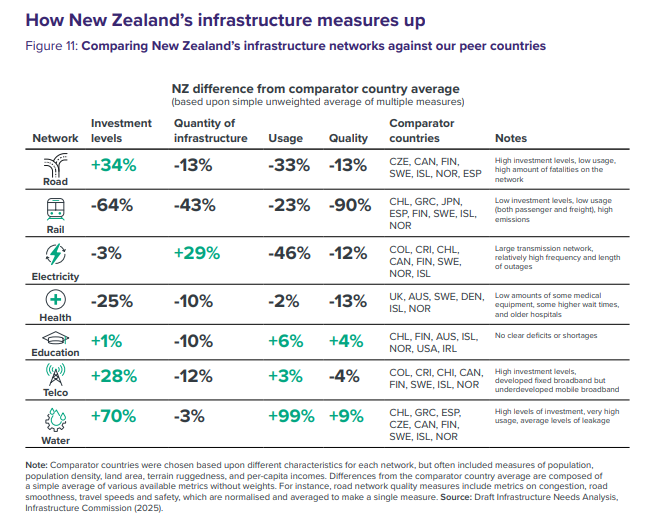
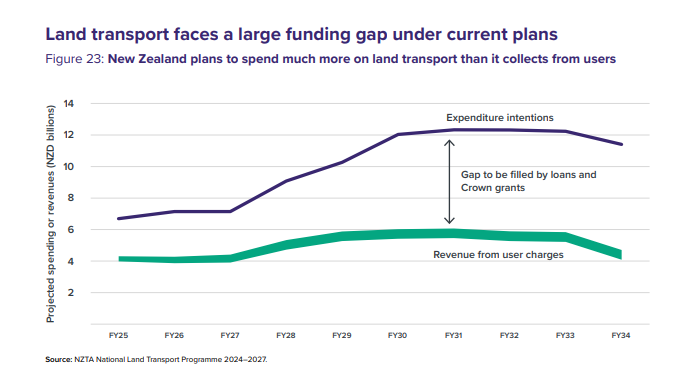
The NIP gives us a clear and evidence-based rationale to seriously question the level of investment in the Roads of National Significance.
So let’s do that.
For one, the benefits derived from the RoNS do not stack up. And Warkworth to Te Hana, which is one of the ‘better’ RoNS, really does not stack up.
When consent was issued for this project in 2019, when it was set to cost $1.7bn to $2.1bn, it had a Benefit Cost Ratio of only 0.7 – meaning for every dollar spent, we’d only get 70c back.
Now, the project cost is at least double that 2019 estimate, so that BCR is likely even worse – even with the changes in methodology that has projects assessed over time with a lower discount rate.
Even putting aside tenuous claims of benefits, the 2019 Detailed Business Case stated that certain triggers were required to go ahead, due to uncertainty re the exact timing of long-term investment on this scale.
Does the project clear these hurdles? Let’s see…
To trigger investment, according to the 2019 DBC, Warkworth to Te Hana needed to meet at least 2 of the following:
DSI savings forecast from Dome Valley safety improvements not achieved within 3 yearsA 30% increase in total number of closure hours per annum from 2018 levelsForecast traffic volumes are predicted to exceed 25,000 AADT
So first, the Dome Valley safety improvements project.
This was part of the huge 2018 Road Safety Programme from the last government, when Phil Twyford was Minister of Transport and Julie Anne Genter was Associate Transport Minister, and was largely completed in 2022.
And anyone who has driven through the Dome Valley since the improvements knows how much better it feels. But what does the data say? Looking at NZTA’s Crash Analysis System, we may need a few more years to confirm, but the project looks to have significantly reduced the risk of DSIs from crashes.
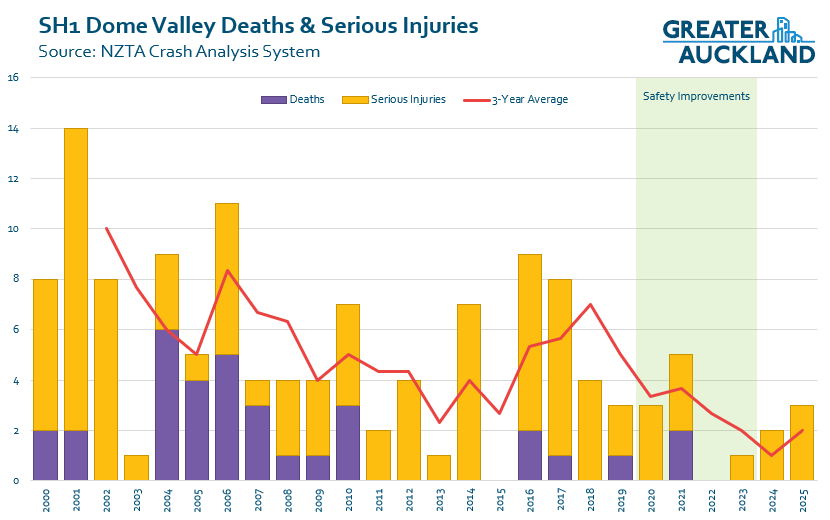
Second, the number of closure hours. Data is hard to come by, but given the increase in extreme weather events, it would be fair to say closures have probably increased – while at the same time, we can expect fewer closures due to crashes, thanks to the safety improvements on Dome Valley.
But let’s assume the measure of total closure hours has been achieved.
That leaves forecast volumes of traffic – the most nebulous trigger, because forecasting traffic via modelling should not be treated as an absolute. Modelling is just one tool, and certainly shouldn’t be used as a trigger point for decision-making on this scale.
As the chart below shows, traffic growth ramped up after 2013, and in the 10 years to 2024 vehicle volumes south of Wellsford grew by an average of 2.6% per year (notwithstanding the COVID dip).
Assuming a similar level of continuing growth, we wouldn’t hit the 25,000 per day threshold until around 2050. That would mean needing to start construction in the early 2040s.
To put it another way, locking in a deal by July 2026 would mean we’re starting this project fifteen years too early by official measures.
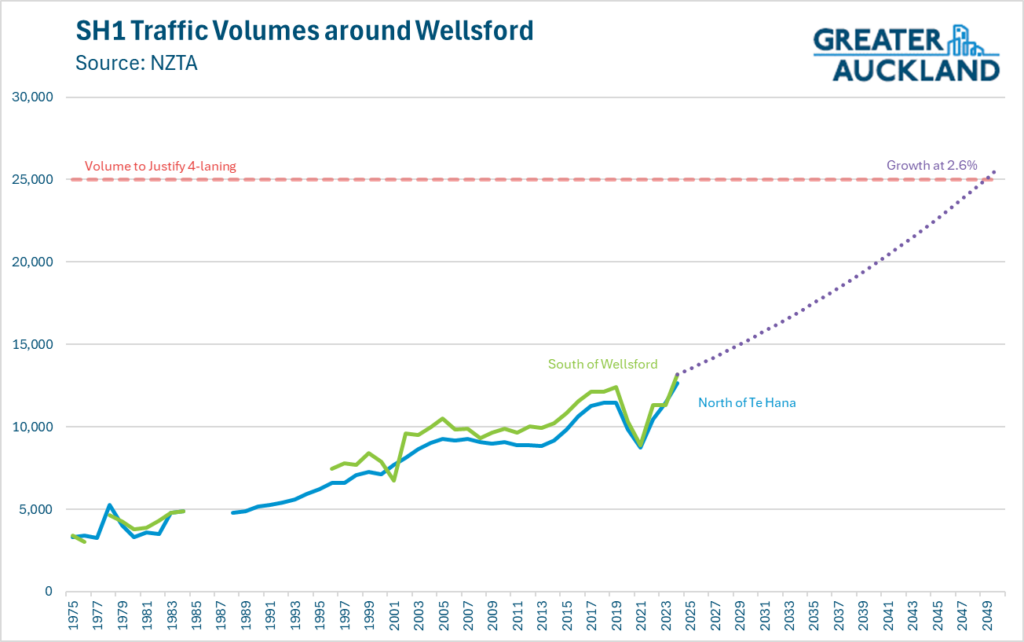
And that’s assuming traffic volumes continue to grow. The current population growth projections for Northland are, at the high estimate, half of 2.6% per year. So, not only is the government rushing into starting this project a decade-and-a-half too early, a four-lane expressway may never be needed.
Why the rush – when the more affordable alternatives are better for us all?
There are huge and very real consequences of racing ahead with PPP contracts for RoNS like the Northland Expressway – not least, the massive opportunity cost.
Ramming through these mega-projects (and their mega-budgets) means we lose out on so many more much-needed, right-sized solutions that deliver most of the benefits we’re supposedly chasing. We simply don’t need to spend upwards of $22,000,000,000 on this one corridor.
There really are only three important features of the Northland expressway:
safetyreliabilityand resilience.
Safety and reliability can be achieved with 2+1 style projects (three total lanes, with two in one direction and one in the other, depending on location), separating oncoming traffic with median safety barriers, and adding more passing lanes. Arguably you wouldn’t need a full 2+1 everywhere either.
Resilience is primarily an issue in the Brynderwyns, where slips often close the road, and might require a more expensive intervention such as tunnelling. Any other hotspot areas could likely be resolved with smaller scale interventions.
All of the above still comes at a fraction of the cost of 95km of four-lane 110km/h expressway.
The Dome Valley safety improvements (median barriers, fixing dangerous corners, shoulder-widening,) cost about $80m for 15km. The proposed Northland Expressway is about 95km, or 6.3 times longer. So at a rough estimate, upgrading the entire corridor with Dome Valley style improvements…
…would still only cost about $500m.
That is 1/44th of $22 billion.
To put that into perspective, for $22 billion, you could do 4,180km of Dome Valley style improvements – over twice the current total length of State Highway 1 itself (2,006km).
And two-lane roads are substantially cheaper to build (and maintain!) than four-lane expressways:
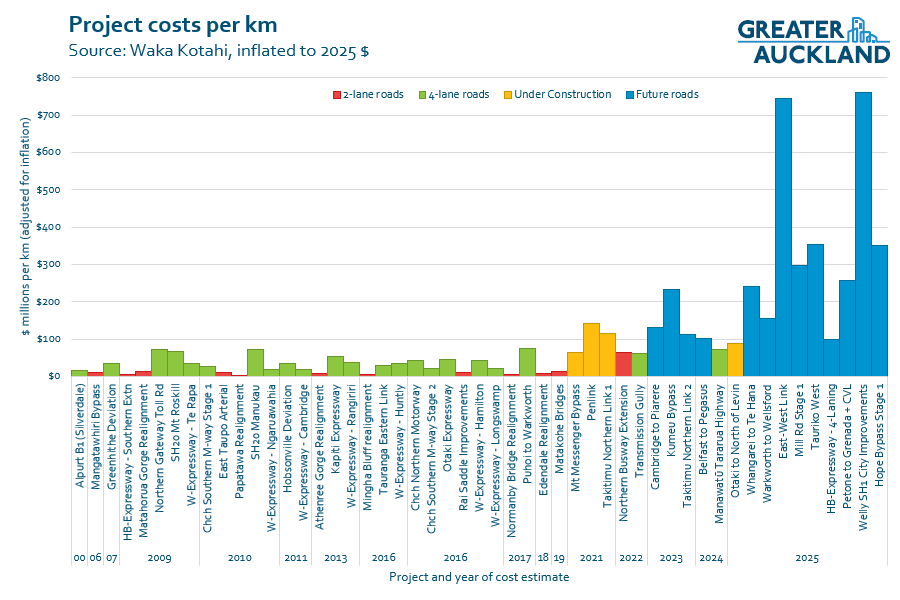
The scale of the proposed work, both Stage 1 of Warkworth to Te Hana, and Stage 2 and 3 of the Northland expressway, is exorbitant – and these are the cheaper RoNS!
The $22,000,000,000 question demands answers
I’m still pursuing the exact cost of Warkworth to Te Hana, via the Ombudsman. But even while awaiting the number, we know enough to demand answers.
What is better for Northland, Auckland, and the country as a whole? Smaller, targeted upgrades that can be delivered far more quickly, cheaply and reliably?
Or a handful of megaprojects that risk blowing out both budget and construction time, and put our fortunes in the hands of PPPs with private entities who may or may not be around when things fall apart?
Why is the government rushing ahead with a project that’s simply not fit for our needs nor our budget, as the Infrastructure Commission has made clear?
Why, as with so much major national investment, are key details being kept from the public? The fact we’re being secretly signed up to black-box billion-dollar deals for projects that don’t even stack up by the flawed metrics of a flawed business case, should shock us.
If we’re being committed to a $4,000,000,000+ project, surely we should know what the deal is? (And Government parties-in-waiting should also want to know what size can they’ll be expected to carry, if contracts are about to be signed).
Shouldn’t we all be allowed to weigh up the more affordable alternatives that will achieve the same goals, faster, and leave money for all the other things?
Just because the project has already got this far doesn’t mean we have to keep going. That’s a classic sunk cost fallacy, and we’re smarter than that.
If we truly want to solve our infrastructure challenges – which are huge – we need to pause this project and any moves towards a PPP. It’s time to stop throwing our money into a RoNS-shaped black hole.
Now’s a good moment for whoever’s in charge to be the grown-up, and to treat citizens like grown-ups. Our current leadership (and our would-be leaders) need to take a deep breath, daylight the discussion, and start to right-size the ridiculous RoNS fairy-tale fantasies.
It’s the only way we’ll ensure we actually have the resources – and the workforce – to achieve all the many other things we need, to thrive as a country.
If you want to see more in-depth posts like this one, consider supporting us by sharing it on social media, or making a donation.
Greater Auckland’s work is made possible by generous donations from our readers and fans. We’re now a registered charity, so your donations are tax-deductible. If you’d like to support our work you can join our circle of supporters here.
Share this