
By Aaron Blake, CNN
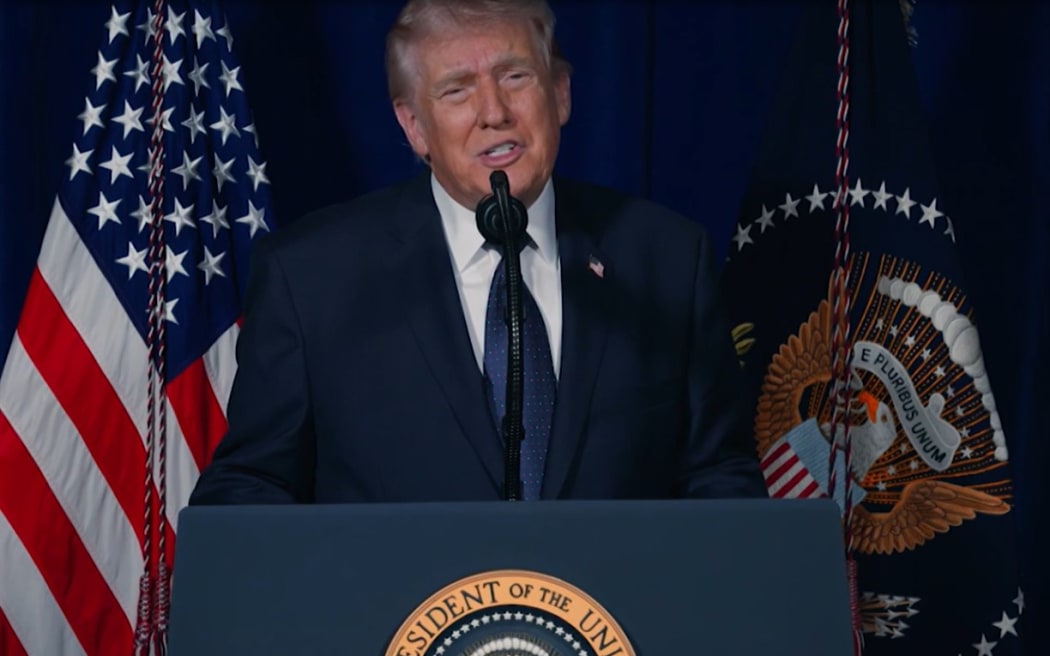
US President Donald Trump gives an update on the military campaign against Iran.
Photo: Screenshot
Analysis: “We’re very clear-eyed,” Defence Secretary Pete Hegseth assured about the Trump administration’s war with Iran. He said it had “clear objectives” and assured that the mission “is very, very clear” to American soldiers.
But while undertaking perhaps the most serious and fraught US military operation in two decades, the administration has delivered anything but clarity.
Ahead of Saturday morning’s strikes on Iran, it declined to enunciate a consistent set of goals and motivations.
And it’s spent the three days since shifting the goalposts and contradicting itself.
Trump spoke publicly on Monday for the first time since launching the strikes, and he laid out four objectives for the war: destroying Iran’s missile capabilities, annihilating its navy, preventing it from ever obtaining a nuclear weapon and preventing it from arming terrorists.
But it’s been a journey to get to that point.
The nuclear threat
Perhaps most stunning has been the evolution in how the administration has described the nuclear threat Iran poses.
Despite Trump spending months assuring that his June strikes on Iran’s nuclear facilities had “obliterated” its nuclear program, Trump and his team recently began playing up the threat again.
Trump’s Middle East special envoy Steve Witkoff claimed on February 22 that Iran was enriching uranium at “well beyond” the threshold for civil use. He said it was “probably a week away from having industrial-grade bomb-making material.”
Then Trump in his State of the Union address last Tuesday said Iran was building intercontinental ballistic missiles “that will soon reach the United States of America.”
But Secretary of State Marco Rubio contradicted Witkoff, saying on Wednesday that Iran was in fact “not enriching right now” – but was trying to restart its nuclear program in other ways.
US intelligence also contradicted Trump. An unclassified Defense Intelligence Agency assessment from last year said the prospect of Iran striking the US with an ICBM was still a decade away. And CNN and others reported that there was no intelligence suggesting this was anything close to an imminent problem.
Fast-forward to Monday, and Hegseth put an entirely new spin on all of this.
Hegseth did not say, as Witkoff did, that Iran was enriching uranium at dangerously high levels. Nor did he say that it had missiles that would soon be capable of striking the US homeland.
He instead cited a build-up of more conventional weapons that he said laid the groundwork for those more serious threats. Hegseth intermittently referred to this as a “conventional shield” or “umbrella.”

Defence Secretary Pete Hegseth.
Photo: AFP
“Iran was building powerful missiles and drones to create a conventional shield for their nuclear blackmail ambitions,” Hegseth said. He added that this jeopardized “our bases, our people, our allies” in the region.
“They were stalling, buying time to reload their missile stockpiles and restart their nuclear ambitions,” Hegseth said.
So in a week, the justifications have gone from an imminent threat from Iran having nuclear bomb-making material, to Iran at least having the means to strike the US homeland with missiles, to now Iran using conventional weapons to create the conditions to be able to “restart their nuclear ambitions.”
That’s a huge walkback.
Trump echoed those comments later Monday morning, citing Iran’s efforts to “shield their nuclear weapon development and make it extraordinarily difficult for anyone to stop them.” But he then also mentioned Iran supposedly having an ICBM that could strike the United States “soon.”
While the George W. Bush administration’s claims about the “weapons of mass destruction” threat posed by Iraq unravelled over years, the Trump administration is seeing its claims about Iran fall apart – and often be abandoned – in a matter of hours or days.
Whether Iran was about to strike
But it wasn’t just Iran’s nuclear threat that was supposedly imminent. The administration on Saturday also argued there was a real threat of Iran soon striking US forces in the Middle East with those conventional weapons – and that that’s, in part, why Trump had to take action.
A senior administration official who briefed reporters said there was evidence that Iran could strike “potentially, preemptively.”
“And the president decided he was not going to sit back and allow America’s forces in the region to absorb attacks from conventional missiles,” the official said.
But that explanation hasn’t panned out, either. A source familiar with the intelligence told CNN there were no indications that the Iranians planned to strike US forces or assets first – unless they were attacked by Israel or the US. On Sunday, Pentagon officials who briefed congressional staff acknowledged that reality, CNN reported.
Later Monday, Rubio argued that Iran was an imminent threat because the US believed it would hit back if it was attacked by Israel.
“The imminent threat was that we knew that if Iran was attacked, and we believed they would be attacked, that they would immediately come after us, and we were not going to sit, sit there and absorb a blow before we responded,” he told reporters on Capitol Hill before briefing top congressional leaders.
Rubio said the objective is to “eliminate the threat of Iran’s short-range ballistic missiles and the threat posed by their Navy, particularly to naval assets.”
The nature of the threat is not a small point. What the threat was ahead of the strikes – and how imminent it was – matters greatly when it comes to the legitimacy of the US and Israeli action, both when it comes to public perception and international law.
Regime change
The other big shift in the administration’s messaging has been around regime change.
In the hours after launching the strikes, Trump repeatedly emphasized regime change was a goal – and possibly even the goal.
“All I want is freedom for the people,” Trump told the Washington Post.
This was also a major point of emphasis in Trump’s first video message about the operation.
“America is backing you with overwhelming strength and devastating force,” he told the Iranian opposition. “Now is the time to seize control of your destiny and to unleash the prosperous and glorious future that is close within your reach. This is the moment for action. Do not let it pass.”
“When we are finished, take over your government,” Trump added. “It will be yours to take.”
But the administration now seems to have cold feet about this. It has repeatedly downplayed the US role in changing the regime.
That was punctuated by Hegseth saying explicitly Monday, “This is not a so-called regime change war.”
“But the regime sure did change,” he added. “And the world is better off for it today.”
Rubio said Monday the administration “would not be heartbroken” if there is regime change, but reiterated that the objective is about destroying Iran’s ballistic missile capability.
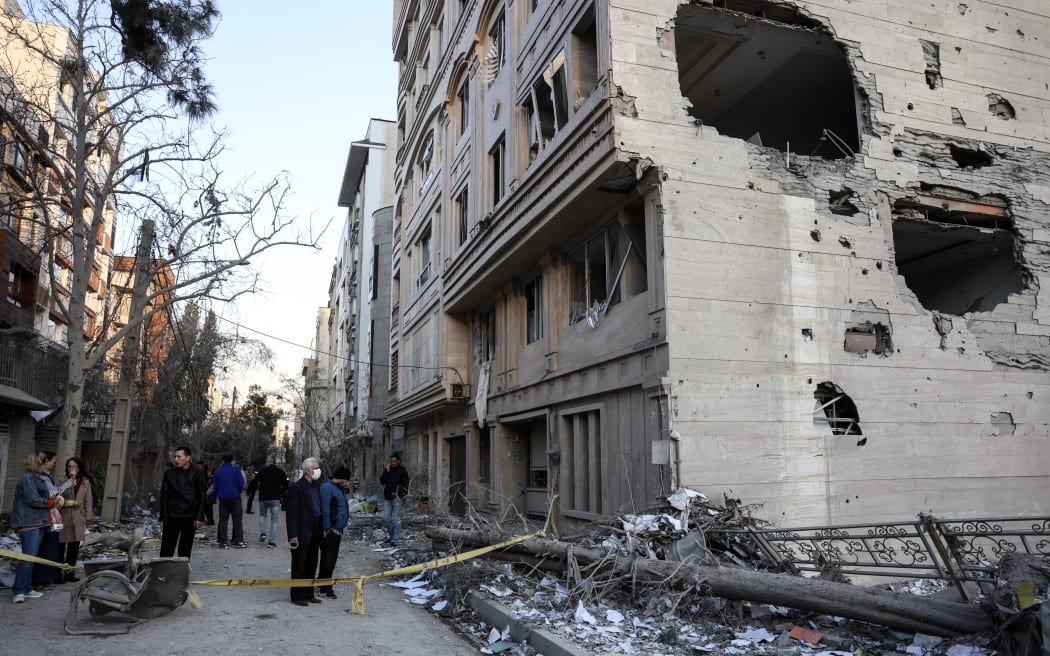
Residents stand on a street beside damaged residential buildings near Niloufar square in Tehran on 2 March.
Photo: AFP
Relatedly, there have been inconsistencies in how the administration has talked about the killing of Supreme Leader Ayatollah Ali Khamenei. Trump told ABC News on Sunday, “I got him before he got me. … I got him first.”
But Republican Rep. Mike Turner of Ohio told CBS News that he’d spoken with Rubio, who told him “we did not target Khamenei, and we were not targeting the leadership in Iran.”
And Hegseth echoed that Monday. When asked to comment on Khamenei’s killing, he said only: “I think Israel did a great job in the conduct of that operation.”
US intelligence was clearly shared with the Israelis. But it’s telling that the administration is trying to distance itself from the most significant regime-changing action.
The timeframe and what’s next
When it comes to who takes over, Trump offered dizzying commentary this weekend.
In an interview with The New York Times, he said he had “three very good choices” about who would run Iran now. (He declined to name them.)
But in a later interview with ABC News, the president suddenly signalled those people were, in fact, dead.
“The attack was so successful it knocked out most of the candidates,” Trump told ABC’s Jonathan Karl. “It’s not going to be anybody that we were thinking of because they are all dead. Second or third place is dead.”
The administration has also struggled to convey a potential timeframe for the war, with Hegseth on Monday calling it a “gotcha-type question.”
In various comments over the weekend, Trump has floated it taking “four to five weeks,” “two or three days” and a week. He also said it’s “always been a four-week process,” before suggesting it could be less than that. On Monday, he told CNN’s Jake Tapper that “we’re a little ahead of schedule,” while also suggesting military action would be intensifying.
“We haven’t even started hitting them hard. The big wave hasn’t even happened. The big one is coming soon,” Trump told Tapper in a phone interview.
And he said at Monday’s event that the military “has the capability to go far longer” than his four-to-five-week projection.
“Whatever it takes,” Trump said.
– CNN