
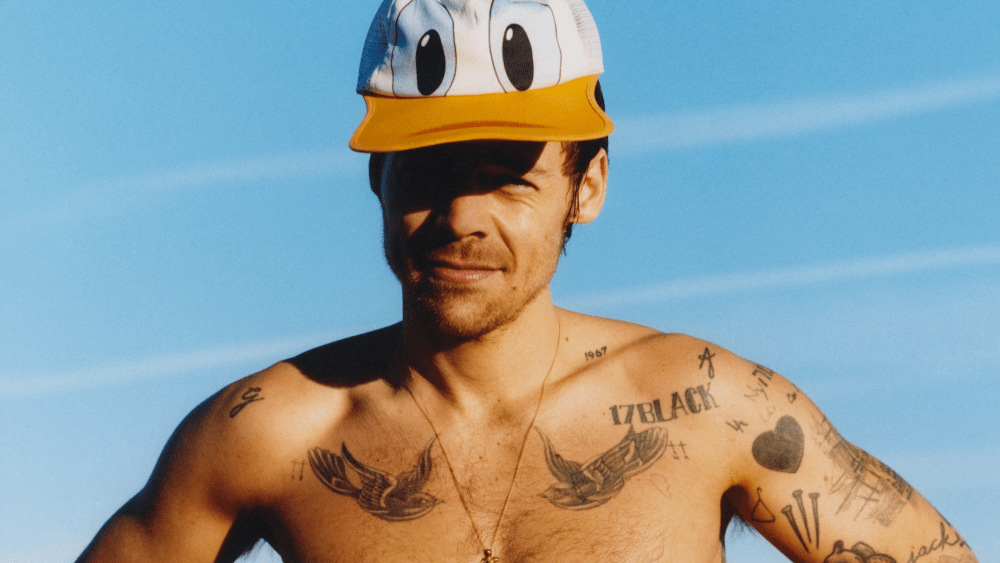
A guest interview with legendary Japanese novelist Haruki Murakami as a cover story in Runners World is probably not the big media return that Harry Styles’ fans were expecting, but for all his popularity, the singer does know how to keep fans guessing.
Yet as one might expect from the author of “The Wind Up Bird Chronicle” and “Norwegian Wood” — who is also an avid marathon runner and published “What I Talk About When I Talk About Running” in 2007 — the conversation between the 77-year-old writer and the 32-year-old superstar isn’t just about exercise or running marathons. It’s also about creativity, living with fame, and the influences and choices Styles made for his first new album in nearly four years, “Kiss All the Time. Disco, Occasionally,” which comes out Friday.

Laura Jane Coulson
Styles — who was inspired by Murakami’s book and ran the Tokyo and Berlin marathons last year, hence the connection — hasn’t been known to dig deep existentially in past interviews, but this one finds him covering ground he doesn’t usually. The questions he poses to Murakami are often as revealing as his own answers to other questions.
The interview leads with a heady exchange — “I wonder if you might have any advice to pass on to me: as a man, as an artist and as a runner?” Styles asks the 77-year-old writer, whose response can be edited down to: “Embrace the contradiction… If there’s something that’s dirty within you, you can’t just present it as is. You kind of have to turn the contradiction into something positive by sharing it with other people who might not think they have one. Sublimate those contradictions within you into art.” Yet the article becomes more earthbound as it progresses, especially when Styles is talking about the influences behind his new album, and his own struggles with fame.
“Something I’ve often struggled with, in the middle of a tour, is feeling like I’m not sure what I’m giving, not sure what I’m adding to the world,” Styles says. “Especially when the reward system and the kind of…adulation that you can receive feels so loud. Like clearly I’m getting so much from this, I’m getting all this energy. People are giving me so much, which I deeply appreciate. But what am I contributing? At times I felt quite existential about that.”
That existentialism extends to how one creates art when a person is so famous that it’s difficult for them to be normal and observe life. “For me, one of the things that can be complicated is that, as an artist, say if you’re a novelist or a musician or a filmmaker, you’re an observer — but when you become a known person, you become the observed.”
He says he was inspired by communal feeling of the nightclubs in Berlin and the anonymity of a dancefloor, where some of the album was recorded, and artists like British electronic producers Floating Points and Jamie XX and German techno DJs Fadi Mohem and Ben Klock.
“I wanted to recreate [what] I had on the dance floor, being lost in instrumentation and the musicality,” he says. “It was so immersive, like, this is how I want to feel when I’m on stage too. I don’t want it to feel like a sermon I’m delivering. I wanted it to feel like, oh, we’re in this music together. Like I’m in it with you.”
From there, it’s not a far leap to the commonalities between electronic music and the zen qualities of running. “I’ve found the hypnotic, meditative aspect of music to have a lot of synergy with the meditative aspect of running,” Styles says. “When I’m running is when I have…time to think a lot about what I’m making and other things in life too.”
Both Styles and Murakami spoke about the possessiveness many artists feel before sharing a creation with the the world. “I think there’s a point when you’re making something, when it feels so pure to you; a really beautiful moment where it’s finished and it’s just yours,” Styles says. “Then there’s almost a sadness at the handing-over. You have to let it go, like sending your kid off to school, and then it feels somewhat detached from you. But only in the last couple years have I realized how much of people’s responses to it are not necessarily about me at all. I think I’m of less importance.
“And that can be quite scary, realizing that it’s not about me, but it can also be really freeing to know actually, my job here is to just remain a person, and to keep recording that,” he concludes. “That’s what my job is. Rather than me being supposed to deliver the answer and let everyone know what life is about. I think there’s freedom in realizing that actually my job is to let people watch while I ask the questions. Because questions are more interesting than answers.”
Read the full interview here.