
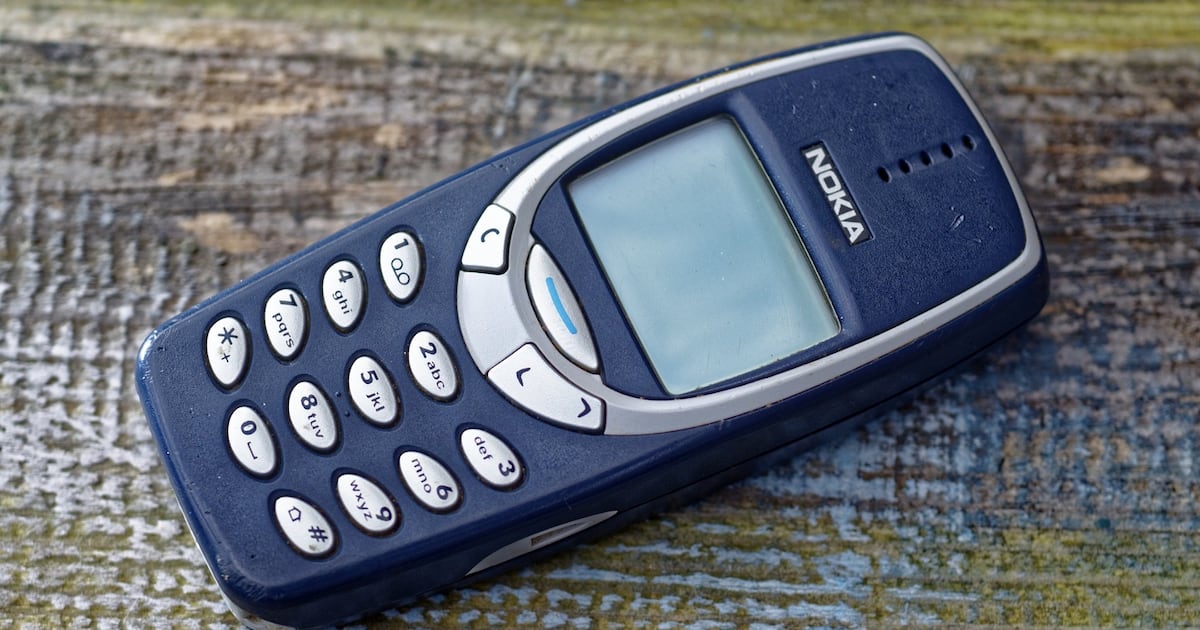
You might assume that, at 43, the things that make me feel old these days are of the more obvious variety. Discovering new grey hairs. Waking up to an increasing number of fine lines on my face. That middle-aged grunting noise or “sigh” I involuntarily make when I sit down and then stand up. My clicky knee. That one incredibly annoying, but persistent chin hair that comes back every single month. Or simply realising that I recognised practically none of the acts at this year’s Grammy Awards.
But you would be wrong.
The dreaded penny of ageing only properly dropped for me at the start of this year, when I realised that I’ve had the same mobile phone number for 30 years. Yes, 30 years. I felt like I should maybe get Guinness on the line to put me down in the record books, but quickly realised we rarely use our phones for making calls any more, and I don’t have a landline, so maybe I should send them a quick voice note instead? You know, because it’s easier for me.
Still, as ageing as it feels to have had the same mobile phone number for three decades, it turns out I’m actually in the ha’penny place. The first mobile phone call in Ireland was made 40 years ago in December 1985, when Pat Kenny phoned the then minister for communications, Jim Mitchell, on a beige handheld brick in a landmark moment people probably didn’t fully comprehend the future implications of at the time. I wonder if the vetaran broadcaster still has the same mobile number? Pat, if you’re reading this, get on to Guinness.
I got my first mobile phone in 1996. It was a Panasonic G350, which was, in truth, an ugly, dark, heavy handset. My children took one look at a picture of it I found on Google and laughed, assuming it must be a toy, but back then, I felt as though it was the coolest thing on the planet.
The screen was tiny, with a display similar to a digital watch, and the buttons made a fantastically pleasing noise when pressed. There was no snake or Tetris game on it. The ringtones on offer were a simple, small selection of beeps. Texting wasn’t yet a thing, and I only had my parents’ numbers in there plus a couple of friends’ landlines, which I dared not use my mobile to call them on in case it cost a fortune. The battery was an eyesore that clipped on to the back of the phone like an oversized rucksack, and which dramatically increased the weight – but, once charged, it would last for what felt like weeks at a time. I pulled the aerial up when making a call, and even had one of those naff leather-style covers with plastic on the front to protect the precious phone in the rain.
My parents didn’t get one especially for me – it was more of an added incentive on a corporate plan that was keen to lock in businesses to their network. Rather than let it go to waste, I reckon they felt giving their young teenager a mobile phone would be handy if I needed to contact them – and vice versa. I adored it, but I rarely used it. Most of the time it was nothing more than an accessory I loved looking at.
Still, at the time, a 13-year-old with a mobile phone struck everyone as a wildly outrageous move. Questions along the lines of, “You have a mobile?”; “Wow, can I see it?”; “What do you need that for?” accompanied by raised eyebrows and tut-tutting. In an amazingly short space of time, the tut-tutting stopped and everyone had one in their pocket.
Fast forward 30 years into the era of the smartphone, and my Panasonic brick seems so innocent. For most of us, our phone is now our most important, most used possession. It’s our alarm clock, our wallet, our diary, our workspace, our health assistant. It’s where we consume most of our media and news, and increasingly, it’s our social space too. Almost everything we do requires one, from basics like banking to ordering food, to bigger things like booking holidays and even finding out who died. In fact, it’s almost impossible to compare the mobile phone of 1996 with the mobile phone of now.
Today, my little old brick could form part of any historical exhibition on the evolution of the phone, sitting dustily alongside the likes of the pedestal telephone, the cordless landline and the car phone, as children the same age as my own wander past, laughing at the old technology compared with the super-smart devices they use and covet with natural ease.
And if I’m being honest, that’s what aged me the most (although I do think keeping the same number for 30 years was no mean feat, considering until the early Noughties a change in provider meant a change in number).
This misty-eyed recalling of how twee my first mobile was compared to now and how many iterations I’ve lived through makes me sound like Grandpa Simpson marvelling at how the CD player used to be the gramophone, or a grandparent telling children about the milk cart going by and not having a fridge or TV: “Gather round now children while I tell you about my first ‘brick phone’, why I spent hours playing Snake on the legendary Nokia 3310 and why my favourite dumb phone of all time was the hallowed Motorola Razr flip phone.”