
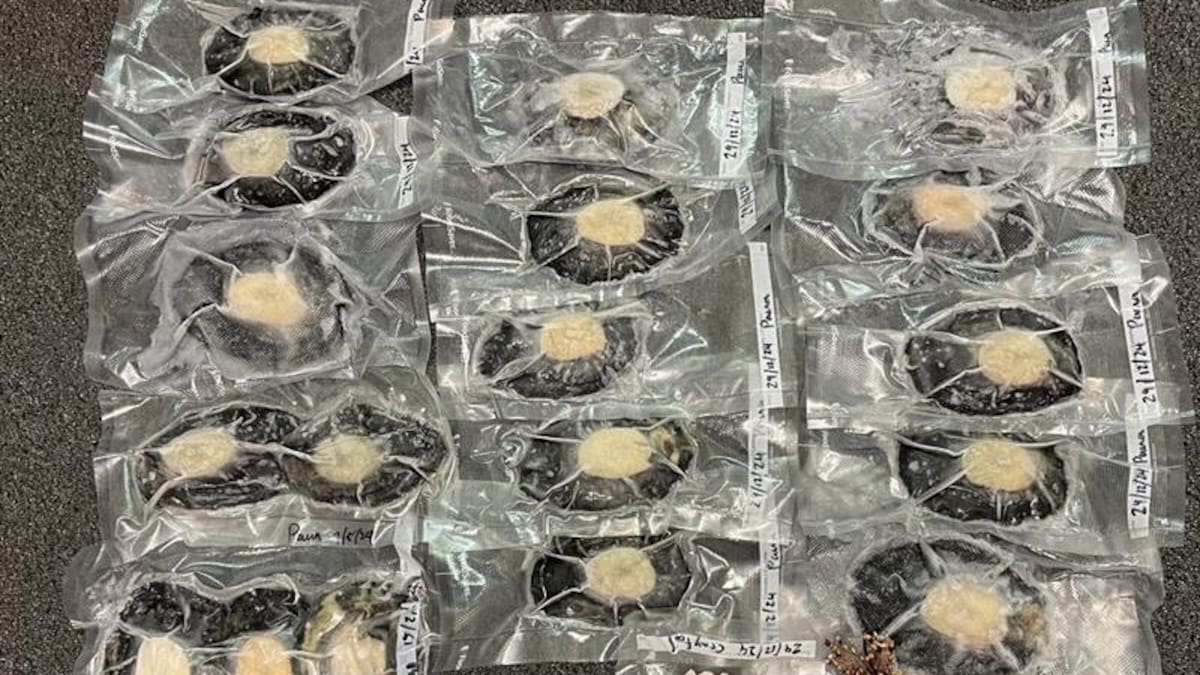
He was sprung after posting it to his Facebook page and then offering the seafood for sale on a different, specially set-up Facebook page.
Joshua Spooner has pleaded guilty in the Nelson District Court to charges of selling seafood without a commercial permit, after he and three mates went on a dive trip in February last year. He was caught trying to sell six crayfish and 10 pāua through Facebook. Photo / Ministry for Primary Industries
The 31-year-old, who worked as a deckhand, pleaded guilty in the Nelson District Court last year to three charges brought by the Ministry for Primary Industries (MPI) of possessing seafood for sale in breach of laws aimed at protecting stocks and a legitimate, high-value market.
The charge carries a maximum fine of $250,000 and/or a community-based sentence.
Harm was ‘in the selling’
The lawyer for the prosecution, Julie Wotton, said they were the most serious offences a recreational fisher could commit, but it was accepted that Spooner had not gone diving with the intention of catching seafood to sell.
She said that while the quantity taken was small, and had not exceeded any limits on take, the harm was in the selling.
During sentencing, Spooner said through his lawyer, Hayley Campbell, that he was at first unaware that what he was doing was illegal, and his aim had been to supplement his family income.
But Judge Jo Rielly said this was at odds with what was outlined in the summary of facts, and details of the charges to which he had pleaded guilty last year.
She was satisfied that at the time he engaged in the selling, he was “well aware” it was illegal to do so, but went ahead.
The Nelson man was one of 26 people who were caught in 2025 illegally trading seafood gathered recreationally.
The rules say only seafood caught by a person with a valid commercial fishing permit can be sold legally.
Facebook sales after dive trip to remote location
In February last year, Spooner and his mates went to Kaihoka, an area in the far northwest of Golden Bay where they dived for seafood.
Two days later, he posted a picture of the catch to the Kai Basket NZ Facebook page via his personal profile, according to the summary of facts.
He then set up another Facebook profile called Cray Cray to sell the seafood, taking care to ensure it was not linked to his “Josh Spooner” profile.
He knew it was illegal to sell recreational catch, MPI says in its summary of facts.
Spooner then advertised the crayfish for sale as “30 each, big ones 50″ with a photograph of a chiller bag containing six crayfish and a pick-up place in Richmond.
He received several responses, including one that told him he shouldn’t be doing it and gave him a copy of the rules.
He deleted the post, which had been up for about 15 minutes.
Joshua Spooner sold seafood online after he and three mates went on a recreational dive trip to the Kaihoka area near Nelson in February 2025. Image / Google Maps
However, the summary of facts says Spooner then arranged to sell three crayfish for $110 to one of the people who had responded.
He offered to “throw in a crayfish tail for free”.
Spooner replied to a further 10-15 others who had responded, telling them he was “out of crayfish”, but might be able to get more, and he had pāua instead, if they were interested.
One person showed an interest, and Spooner offered them 18 pāua, but they eventually settled on four for $40.
Clandestine meeting in supermarket carpark
He arranged to meet the buyer in a supermarket carpark.
The next day, Spooner sold a cooked and vacuum-packed crayfish from his home to an associate for $40.
Later that day, on February 18, 2025, he drove to the same supermarket carpark with four pāua, three crayfish and one crayfish tail, planning to meet a buyer, but the transaction fell through when the buyer didn’t arrive.
Spooner left and drove to another location to deliver crayfish to a buyer. MPI said Spooner had arranged to deliver it to an unoccupied vehicle parked in a specific place and left unlocked.
He placed one cooked and vacuum-packed crayfish, two uncooked and frozen crayfish and one cray tail inside a chiller bag left in the vehicle.
The next day, fishery officers searched Spooner’s Richmond home and found evidence of his offending, including a cellphone, dive equipment and the chiller bag, which was the same as the one in the advertisement.
Spooner admitted during an interview to having created the social media profile Cray Cray to sell crayfish in circumstances he knew were illegal to sell.
Campbell sought a conviction and discharge, given the “very low scale” of offending. She said that would be enough of a penalty alongside the cost to redeem his forfeited vehicle.
Judge Rielly said a fine was appropriate, but she accepted Spooner’s description of what happened as a “moment of extremely poor judgment” he now deeply regretted.
She said it was unclear how fishery officers uncovered what happened, and the court did not need to know the reasons for the investigation or method of surveillance, but it was clear there must have been a level of surveillance on Spooner’s activities.
MPI told NZME the associates were not charged because Spooner was the person responsible for the offending he admitted, including selling his catch.
Laws designed to protect resource
The fisheries regulator says laws ensure the resource remains sustainable through the quota management system.
MPI says commercial fishing is a highly regulated activity and legitimate operators incur considerable costs, including the purchase of annual catch entitlements, permit fees and taxes.
Commercial operators also have to abide by strict reporting rules to help ensure the viability of stocks.
They also invested heavily in research into the rock lobster fishery and its life cycle.
“Black-market traders, by operating outside the quota management system, incurred none of the costs, nor did they provide information about their fishing activities,” MPI says.
Judge Rielly said in fining Spooner that she needed to send a message of general deterrence and to highlight the harm caused to the wider community when recreational fishers sold seafood unlawfully.
From a fines starting point of $4500, Spooner was awarded deductions for his co-operation with the MPI investigation and early guilty pleas.
Tracy Neal is a Nelson-based Open Justice reporter at NZME. She was previously RNZ’s regional reporter in Nelson-Marlborough and has covered general news, including court and local government for the Nelson Mail.