
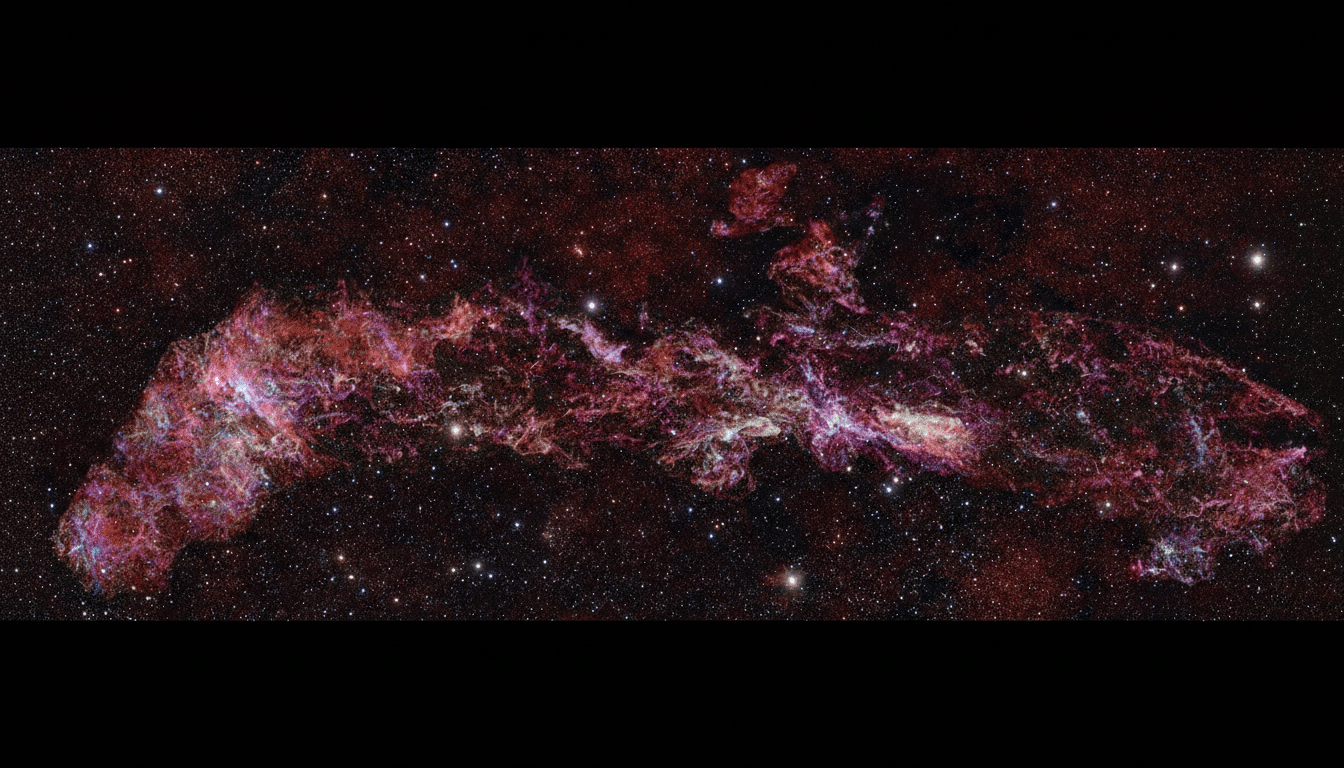
A new radio panorama has peeled back the dust-shrouded heart of the Milky Way, delivering the sharpest, widest view yet of the galactic core. Built from an enormous mosaic by the Atacama Large Millimeter/submillimeter Array in Chile, the image stretches across a sky area roughly as wide as three full moons and traces the tangled web of gas and dust that encircles the supermassive black hole Sagittarius A*.
The project, known as the ALMA Central Molecular Zone Exploration Survey, or ACES, spans about 650 light-years across the Central Molecular Zone. That region holds tens of millions of solar masses of dense material, yet it mysteriously underperforms at making stars—forming them about 10 times more slowly than standard theories predict. This map was designed to find out why.
Why The Galactic Center Lags At Starbirth
Compared with the calmer neighborhoods of the Milky Way’s disk, the core is hotter, denser, and far more turbulent. Gas streams in along the galaxy’s bar, slams into itself, and is jostled by intense radiation, strong magnetic fields, and rapid orbital shear. Any of those can stir up pressure that counters gravity, preventing clouds from collapsing into newborn stars even when fuel is abundant.
This inefficiency has puzzled astronomers for years because it challenges well-tested recipes that link gas density to star-formation rate. The galactic center is the only such environment we can examine in this level of detail, making it a crucial laboratory for understanding galaxies, including the starbursting systems seen in the early universe. Researchers involved in ACES, including scientists from the European Southern Observatory and Liverpool John Moores University, say the core hosts some of the most massive, short-lived stars in the Milky Way, whose explosive deaths can further reshape the region.
A Radio Panorama That Balances Scale And Detail
Past surveys of the core typically faced a tradeoff: go wide and lose fine structure, or zoom in and miss how small clouds connect to the global gas flow. ACES does both at once. The ALMA mosaic resolves compact clumps and filaments that could be forming stars while still capturing nearly the entire reservoir of star-forming gas in the region.
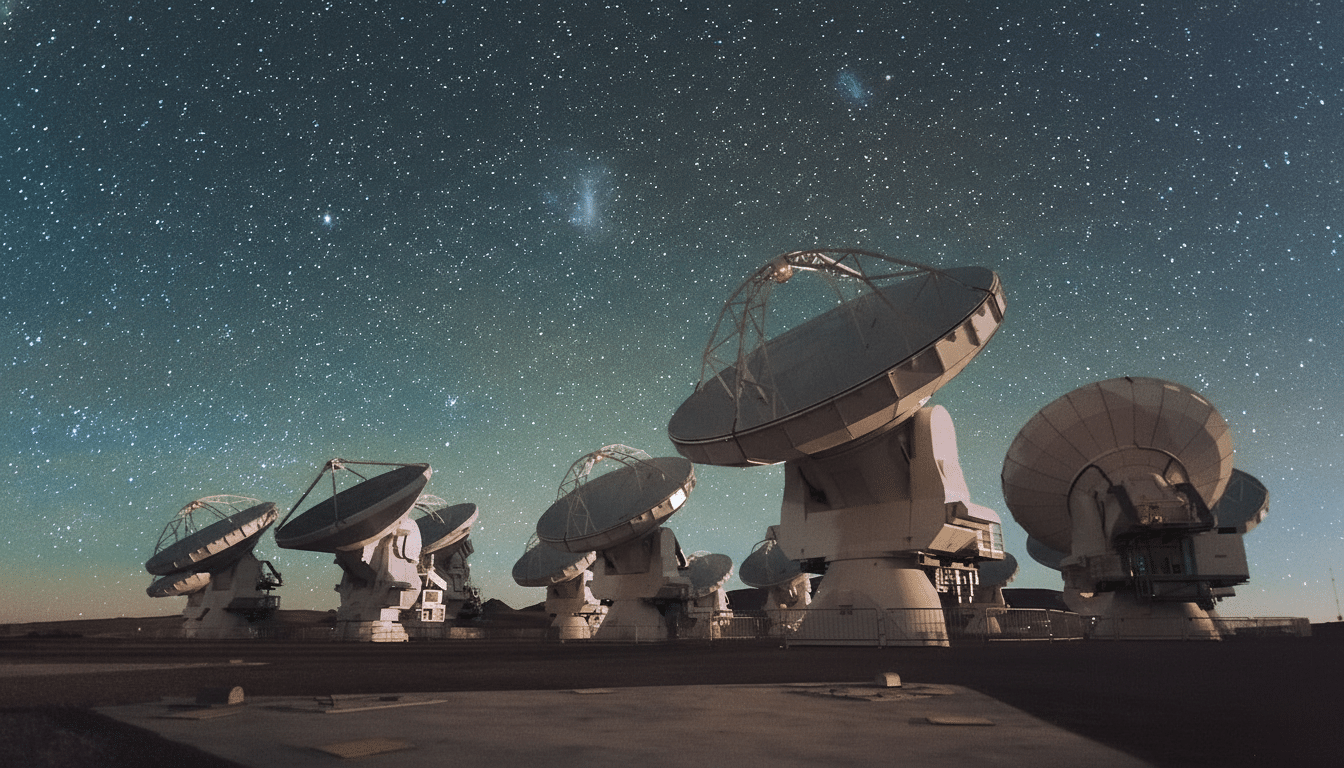
The observatory—an international partnership among the European Southern Observatory, the National Astronomical Observatory of Japan, and the U.S. National Radio Astronomy Observatory—works at millimeter and submillimeter wavelengths, which cut through the dust that blocks visible light. According to the team, this is ALMA’s largest mosaic of the Milky Way’s core to date, with initial results accepted in a suite of papers in Monthly Notices of the Royal Astronomical Society.
Chemistry As A Physics Decoder For The Galactic Core
ACES goes beyond eye-catching imagery. The team recorded more than 70 molecular “fingerprints” across the map, including silicon monoxide, methanol, and acetone. Each molecule responds to different conditions: silicon monoxide is a classic shock tracer, methanol flags chemistry on dust grains, and complex organics reveal regions where energetic processes are at work.
By comparing the strengths and motions of these lines, researchers can reconstruct temperature, density, and turbulence—essential clues for spotting where gas is funneled inward, where it gets bottled up, and where gravity finally wins to ignite star formation. Just as important, the chemical atlas highlights places where star formation stalls, offering a side-by-side test of competing theories.
Simulations Put The Flow To The Test In The Core
Observations alone can’t tell the whole story, so the ACES team paired the mosaic with computer simulations that follow gas as it rides the galaxy’s bar, swings past the black hole, and endures feedback from massive stars. They then built synthetic “mock” observations from those simulations to see which scenarios best match reality.
This approach will let scientists pinpoint where and when star formation switches on and off along the orbiting gas streams, test whether specific orbital bottlenecks trigger collapse, and weigh the relative roles of gravity, turbulence, magnetic pressure, and feedback from supernovae and the rarer hypernovas that pack more than 10 times the energy of a typical stellar explosion.
Why This Image Matters For Understanding Our Galaxy
The new mosaic is more than a pretty picture; it’s a reference atlas for an extreme astrophysical environment just 26,000 light-years away. It will guide follow-up campaigns with radio facilities such as the Very Large Array and future arrays, and complement infrared views of embedded stars that other observatories can provide. Because the Milky Way’s center shares traits with young, tumultuous galaxies, insights gleaned here can scale to systems billions of light-years away.
For now, ACES delivers a rare combination of breadth and precision at the galaxy’s dynamo. It shows where the fuel is, how it moves, and where it falters—bringing astronomers closer to explaining why a gas-rich heart can be so surprisingly stingy with its stars.